In today's fast-paced market, the ability to adapt, innovate, and deliver value quickly is no longer a competitive advantage, it's a necessity. Agile methodologies have transformed how software is built, moving teams away from rigid, long-cycle development towards a more flexible, collaborative, and results-oriented approach. However, simply adopting an agile framework like Scrum or Kanban is not a guarantee of success. True agility comes from mastering the core principles and implementing proven techniques that drive efficiency, quality, and continuous improvement.
This comprehensive guide delves into 10 essential agile development best practices crucial for any high-performing team. We will move beyond the basic definitions and provide a blueprint for modern development success. You will find actionable insights, specific implementation details, and practical examples to help you refine your processes, empower your developers, and consistently deliver outstanding products.
This listicle is designed for teams at every stage of their agile journey. Whether you are building your first agile workflow or looking to optimize an established one, these practices offer a clear path forward. We will explore key ceremonies like sprint planning and retrospectives, technical disciplines such as Test-Driven Development (TDD) and CI/CD, and collaborative strategies including pair programming and collective ownership. Each item is presented as a vital component for building a culture of excellence and responsiveness, ensuring your team is equipped to meet today's development challenges head-on. By mastering these techniques, you can unlock your team's full potential and turn good development habits into great project outcomes.
1. Sprint Planning and Time-Boxing
At the core of many successful agile development best practices is the disciplined rhythm of Sprint Planning and time-boxing. This approach, popularized by the Scrum framework, structures development into fixed-length iterations called sprints, typically lasting one to four weeks. During a collaborative Sprint Planning ceremony, the entire development team, along with the Product Owner and Scrum Master, defines a clear goal and selects a set of high-priority items from the product backlog that they can realistically complete within that timeframe.
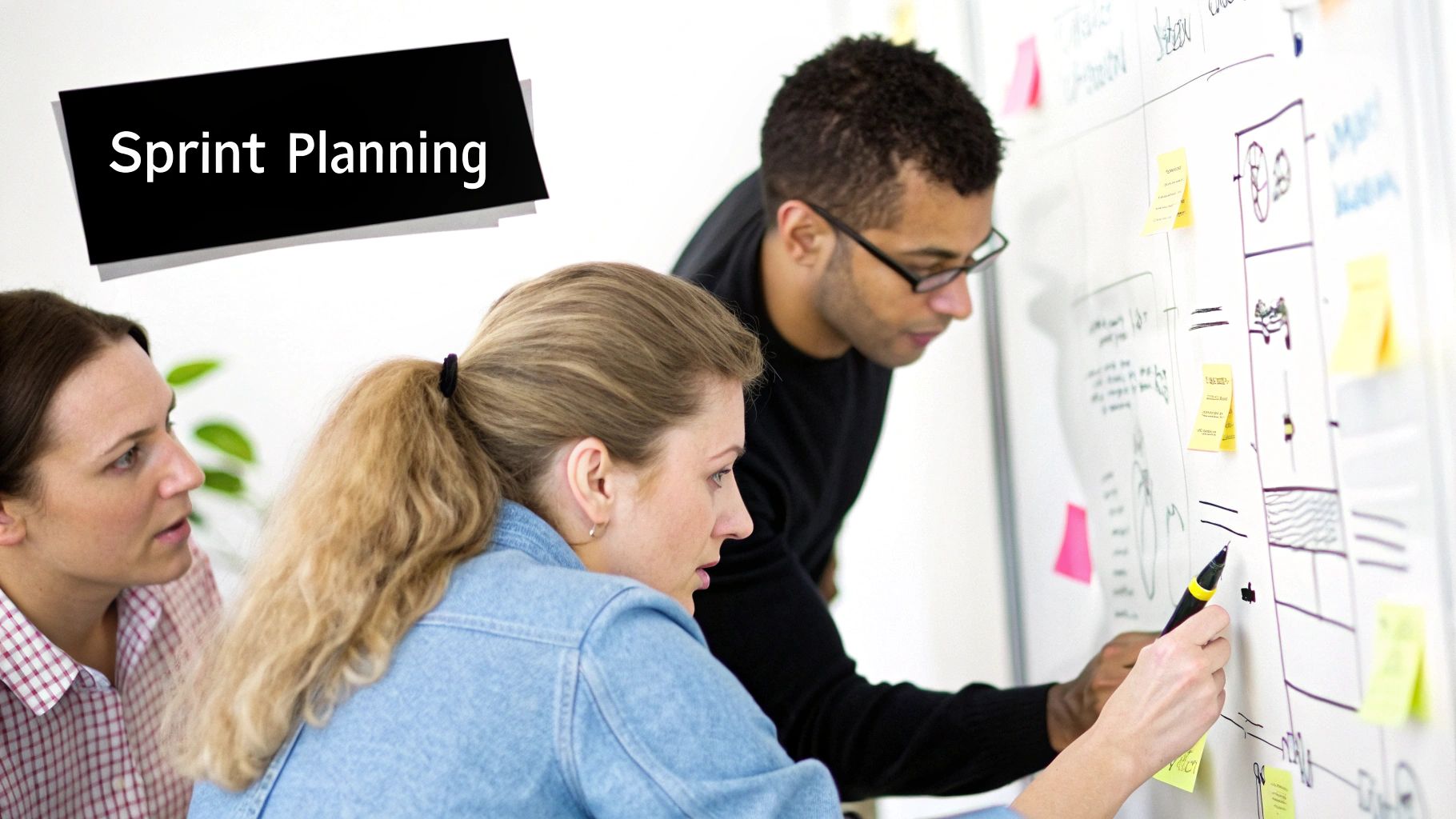
This structure is not just about scheduling tasks; it’s about creating a predictable cadence for delivery. Time-boxing enforces focus and forces difficult prioritization decisions, preventing scope creep and ensuring the team delivers a valuable, usable increment of the product on a consistent basis. For instance, teams at Atlassian often use two-week sprints to maintain momentum, while Microsoft's Azure DevOps teams might use three-week sprints for larger, more complex features.
How to Implement Sprint Planning Effectively
To get the most out of this practice, treat Sprint Planning as a foundational team commitment. Start by defining a clear, compelling Sprint Goal. This goal provides a unified purpose beyond simply completing a list of tasks and guides the team's decisions throughout the sprint.
Follow these actionable tips for success:
- Use Historical Data: Leverage the team's historical velocity (the amount of work completed in past sprints) to forecast capacity accurately. This data-driven approach leads to more realistic commitments and reduces the risk of burnout.
- Involve the Whole Team: Ensure developers, QA engineers, designers, and the Product Owner are all present and actively participating. This collective ownership is crucial for a successful plan.
- Protect the Sprint: Once a sprint begins, the committed work should be protected from external changes or new requests. This stability allows the team to focus and deliver on their promise. A well-defined process should exist for handling urgent, unplanned work without derailing the sprint.
- Start with Two Weeks: If you are new to sprints, a two-week duration is an excellent starting point. It's long enough to complete meaningful work but short enough to allow for rapid feedback and course correction.
By mastering Sprint Planning and time-boxing, your team establishes a reliable rhythm that enhances predictability, sharpens focus, and consistently delivers value to stakeholders.
2. Daily Stand-ups (Daily Scrums)
A cornerstone of effective agile development best practices is the Daily Stand-up, also known as the Daily Scrum. This is a short, 15-minute, time-boxed meeting held every day for the development team to synchronize activities and create a plan for the next 24 hours. The goal is to improve communication, identify impediments, promote quick decision-making, and eliminate the need for other meetings. It serves as a rapid-fire check-in, not a detailed status report.
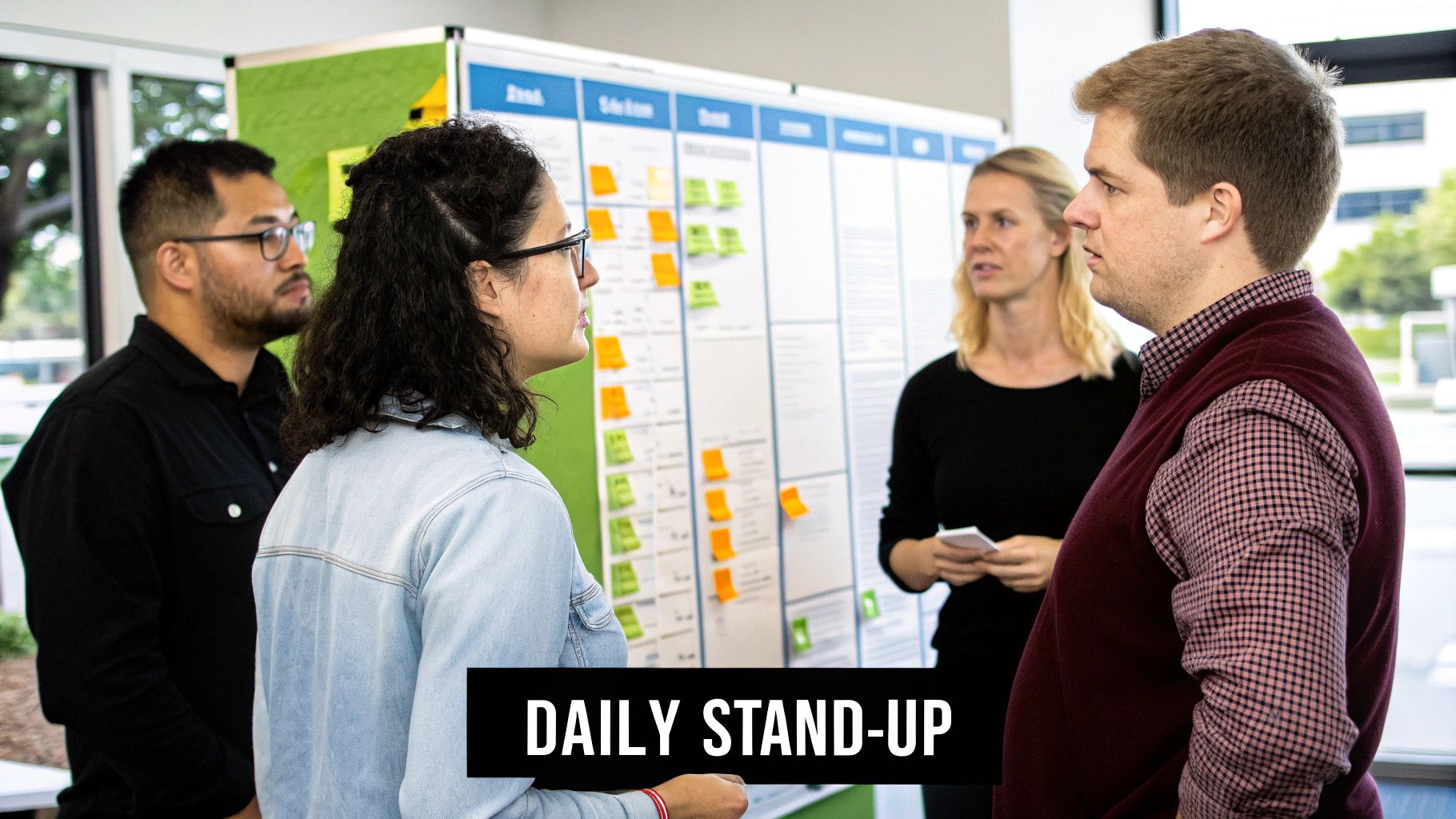
This practice keeps the entire team aligned and focused on the sprint goal. It fosters a culture of transparency and collective ownership by making progress and obstacles visible to everyone daily. For example, remote-first companies like Shopify often use video stand-ups to maintain face-to-face connection, while Google's distributed engineering teams use virtual stand-ups and chat tools to coordinate across different time zones.
How to Implement Daily Stand-ups Effectively
To ensure your Daily Stand-up is a value-add and not a dreaded routine, it must be sharp, focused, and consistent. The classic format has each team member answer three questions: What did I do yesterday? What will I do today? What impediments are in my way?
Follow these actionable tips for success:
- Keep it Strictly to 15 Minutes: Use a timer to enforce the time-box. This brevity forces concise updates and respects everyone's time, keeping the meeting high-energy.
- Use a Task Board: Center the meeting around a physical or digital task board (like Jira or Trello). This provides a visual anchor and shifts the focus from individuals to the flow of work toward the sprint goal.
- Take Detailed Discussions Offline: If a topic requires a deeper dive, schedule a separate follow-up meeting with only the necessary people. The stand-up's purpose is to identify these issues, not solve them. This is often called "parking lotting" an issue.
- Stand Up (Even Remotely): The physical act of standing helps keep the meeting brief and focused. For remote teams, encouraging participants to stand at their desks can help maintain the same energetic dynamic.
By facilitating a crisp and purposeful Daily Stand-up, you empower your team with the daily alignment needed to navigate complexities and swiftly remove blockers.
3. Continuous Integration/Continuous Deployment (CI/CD)
A cornerstone of modern agile development best practices is the adoption of a robust Continuous Integration and Continuous Deployment (CI/CD) pipeline. This practice automates the process of building, testing, and deploying code, enabling teams to release software faster and more reliably. Continuous Integration (CI) involves developers frequently merging their code changes into a central repository, after which automated builds and tests are run. Continuous Deployment (CD) extends this by automatically deploying all code changes that pass the testing phase to a production environment.
This automated pipeline dramatically reduces integration friction and shortens the feedback loop. By catching bugs early and automating deployments, teams can shift their focus from manual, error-prone release processes to building high-quality features. Tech giants have famously leveraged this practice for competitive advantage; Amazon, for example, deploys code every 11.6 seconds on average, while Netflix executes thousands of deployments daily, all powered by sophisticated CI/CD pipelines.
The following infographic illustrates the fundamental flow of a CI/CD pipeline, from code commit to final deployment.
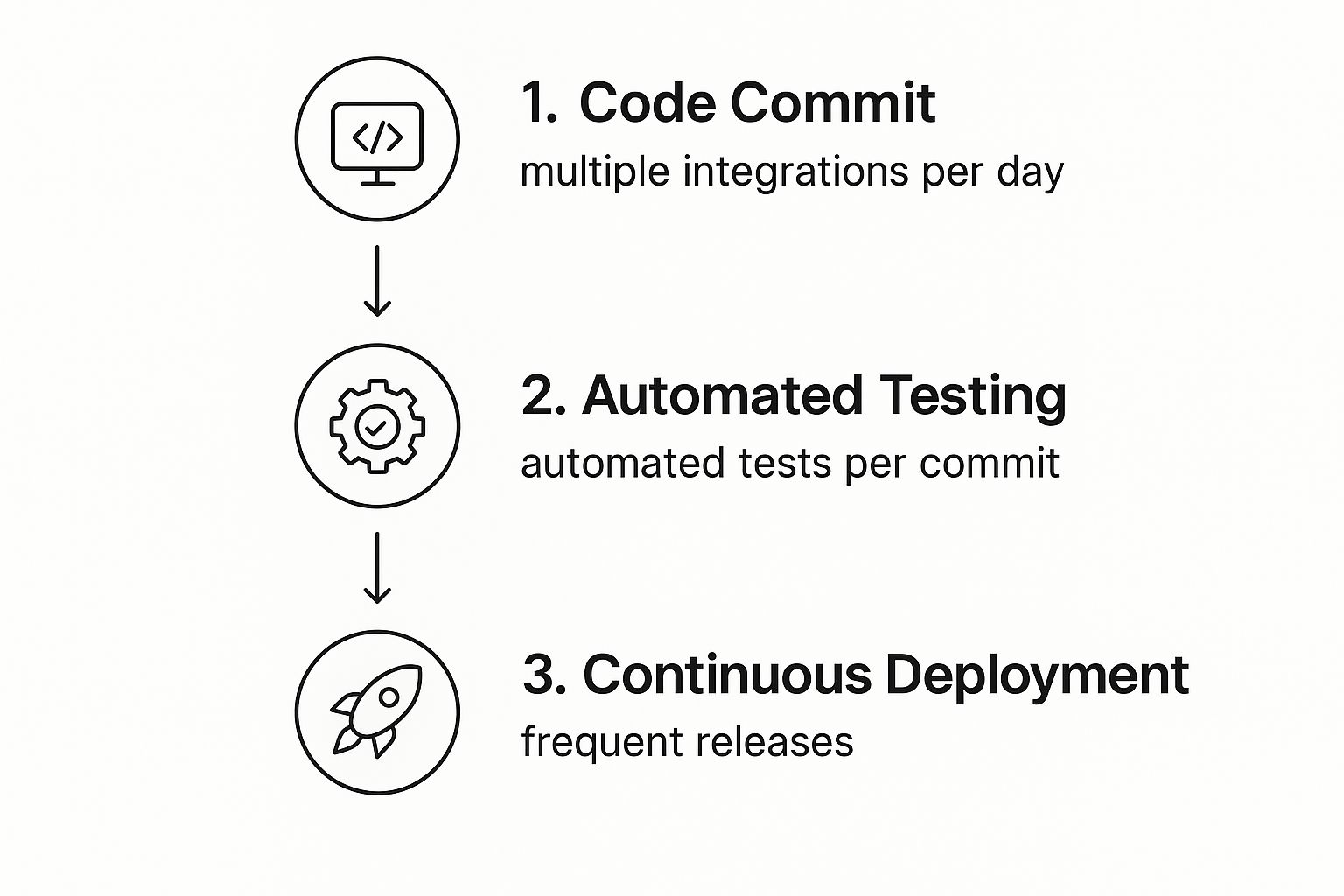
This streamlined process ensures that every code change is validated through an automated quality gate before being released to users, maintaining stability while increasing delivery speed.
How to Implement CI/CD Effectively
Successfully implementing CI/CD requires a commitment to automation and a disciplined approach to testing. The goal is to create a reliable, "hands-off" path from a developer's machine to production.
Follow these actionable tips for success:
- Start with Continuous Integration: Before aiming for full continuous deployment, master CI. Ensure that every code commit automatically triggers a build and a suite of unit and integration tests. This builds the foundation for a trustworthy pipeline.
- Invest in Comprehensive Automated Testing: A CI/CD pipeline is only as reliable as its automated tests. Your test suite must be fast, comprehensive, and dependable to give the team confidence to deploy automatically.
- Use Feature Flags: Decouple deployment from release using feature flags (or toggles). This allows you to deploy new code to production in a "turned off" state, reducing the risk of a release and enabling you to activate features for specific users when ready.
- Practice Infrastructure as Code (IaC): Manage and provision your infrastructure (servers, databases, networks) using code and automation tools. This makes your environments reproducible, version-controlled, and consistent with your application code.
- Establish Clear Rollback Procedures: Even with extensive testing, issues can occur. Have a well-defined, automated rollback plan to quickly revert to a previous stable version if a deployment causes problems.
4. Test-Driven Development (TDD)
A cornerstone of modern agile development best practices, Test-Driven Development (TDD) flips the traditional coding sequence on its head. Instead of writing production code first, TDD is a methodology where developers write an automated test before writing the code needed to pass that test. The process follows a simple, powerful cycle known as Red-Green-Refactor: write a small test that fails (Red), write the absolute minimum code to make it pass (Green), and then clean up the code for better design and clarity (Refactor).
This practice, championed by software pioneers like Kent Beck, isn't just about testing; it's a design discipline. It encourages simpler, more modular code and provides a comprehensive safety net of tests that grows with the application. For instance, the Ruby on Rails framework was built heavily on TDD principles, ensuring its robustness, and consultancies like Thoughtworks have used TDD to deliver high-quality software for years. This approach ensures code is always covered by tests, improving quality and making future changes safer.
How to Implement Test-Driven Development Effectively
To successfully adopt TDD, teams must embrace its short, iterative cycles as a core part of their workflow. The goal is to let tests guide the software's design, focusing on what the code should do (its behavior) before worrying about how it does it.
Follow these actionable tips for success:
- Keep Cycles Short: The Red-Green-Refactor loop should be very fast, often taking only a few minutes. This rapid feedback keeps developers focused and minimizes complexity.
- Focus on Behavior, Not Implementation: Write tests that describe what a piece of functionality should accomplish from a user's perspective, not how the internal code is structured. This makes tests more resilient to refactoring.
- Practice Pair Programming: Learning TDD can be challenging. Pairing with an experienced TDD practitioner is one of the fastest ways to understand the mindset and master the mechanics.
- Refactor Both Code and Tests: The refactor step isn't just for production code. Improve your tests as well by making them clearer, more descriptive, and easier to maintain. You can even use AI tools to generate TDD tests to speed up this process.
By integrating TDD, your team builds a more reliable, maintainable, and well-designed product, embedding quality directly into the development process.
5. User Story Mapping and Backlog Refinement
A powerful duo among agile development best practices, User Story Mapping and consistent Backlog Refinement provide a visual, collaborative way to understand the user journey and maintain a healthy, actionable product backlog. Popularized by thought leaders like Jeff Patton, story mapping visualizes the user's experience with a product by arranging user activities and tasks chronologically. This map becomes the backbone for breaking down large features into manageable user stories, ensuring the team never loses sight of the end-to-end user flow.
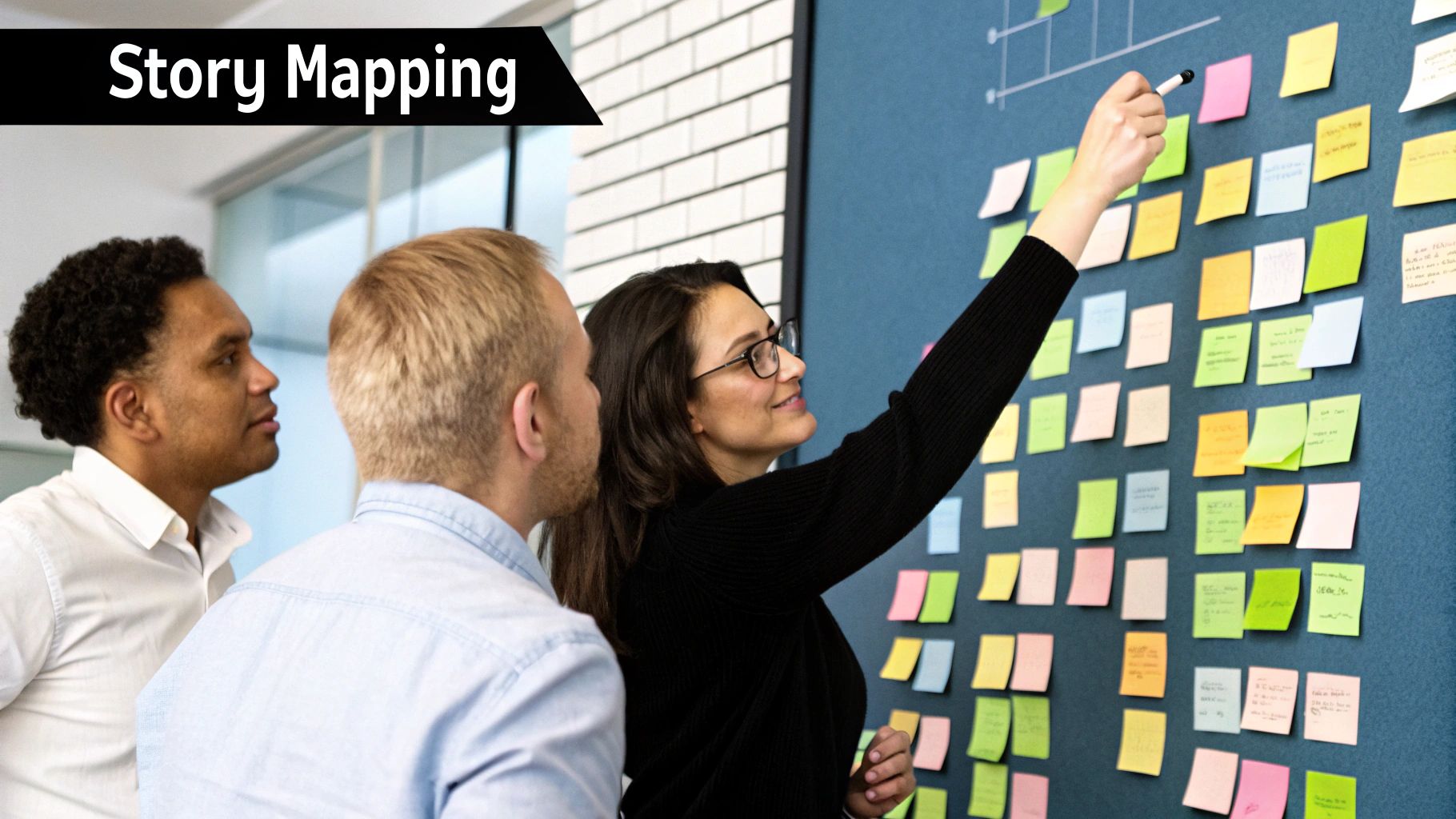
This practice moves beyond a flat, one-dimensional backlog by adding context and a shared understanding of what you're building and why. It shifts the conversation from "what features to build" to "how to improve the user's experience." For example, Airbnb employs user story mapping to visualize the entire journey of both hosts and guests, from booking to checkout, helping them identify pain points and opportunities for innovation. Similarly, Spotify's squads use it to plan new features, ensuring every piece of work contributes to a cohesive user experience.
How to Implement Story Mapping and Refinement Effectively
To integrate this practice, begin by treating it as a product discovery and planning tool, not just a backlog organization task. The goal is to build a shared understanding across the entire team, including developers, designers, testers, and stakeholders.
Follow these actionable tips for success:
- Start with the "Big Picture": Begin a mapping session by defining high-level user activities or the "narrative backbone" of the user journey. Use physical or digital sticky notes to allow for easy collaboration and reorganization.
- Involve Diverse Stakeholders: Invite participants from different departments (e.g., marketing, support, sales) to your mapping sessions. Their unique perspectives enrich the map and uncover requirements that the core team might miss.
- Hold Regular Refinement Sessions: Backlog refinement isn't a one-time event. Schedule short, recurring meetings (e.g., weekly) to review, estimate, and clarify upcoming stories. This keeps the backlog clean and ready for future sprints.
- Use the Map for Release Planning: Slice the story map horizontally to define releases or sprints. The first slice should represent a minimum viable product (MVP) that delivers a complete, valuable journey for the user, even if it's a simple one.
6. Retrospectives and Continuous Improvement
A cornerstone of true agility is the practice of holding regular retrospectives, which embodies the principle of continuous improvement. This essential ceremony provides a dedicated space for the development team to reflect on their recent work cycle, typically at the end of a sprint. The core purpose is to systematically inspect the team’s process, tools, and collaboration to identify what worked well, what didn't, and what can be improved for the next iteration.
This practice is not about assigning blame; it's about fostering a culture of collective ownership and incremental adaptation. It’s a powerful engine for evolving team practices and resolving persistent issues before they escalate. For instance, Spotify’s renowned squad model heavily relies on frequent retrospectives to maintain autonomy and drive process evolution, while Salesforce engineering teams use them to refine workflows and adapt to new technical challenges, ensuring they remain one of the top agile development best practices.
How to Implement Retrospectives Effectively
To make retrospectives truly impactful, they must be more than just a routine meeting. The goal is to create an environment of psychological safety where every team member feels comfortable sharing honest, constructive feedback without fear of judgment. This open dialogue is the foundation for identifying actionable improvements.
Follow these actionable tips for success:
- Vary the Format: Keep the team engaged by using different retrospective techniques. Formats like "Start, Stop, Continue," "Mad, Sad, Glad," or the "4Ls" (Liked, Learned, Lacked, Longed For) can provide fresh perspectives.
- Focus on Actionable Items: The outcome of every retrospective should be a small, concrete list of one or two improvement items the team commits to implementing in the next sprint. Track these items to ensure follow-through.
- Use Data and Metrics: Support discussions with objective data, such as sprint burndown charts, cycle time, or defect rates. This helps ground conversations in facts rather than just feelings. You can find many useful guides and tools to learn more about Retrospectives and Continuous Improvement resources on vibecoding.vip.
- Celebrate Successes: Don't just focus on problems. Acknowledging wins and celebrating progress is crucial for boosting morale and reinforcing positive behaviors.
By embedding meaningful retrospectives into your development cycle, your team creates a powerful feedback loop that drives sustainable improvement, enhances team health, and ensures your processes evolve effectively over time.
7. Cross-functional Teams and Collective Ownership
A cornerstone of modern agile development best practices is the formation of cross-functional teams with a culture of collective ownership. This model moves away from siloed, component-based teams (like separate front-end, back-end, and QA teams) and instead assembles a single team with all the skills necessary to take a feature from concept to deployment. This typically includes developers, testers, UI/UX designers, and business analysts, all working together as a single, cohesive unit.
This structure is designed to eliminate handoffs, reduce dependencies on external groups, and accelerate the feedback loop. When the entire team owns the outcome, quality becomes a shared responsibility, not just the job of a tester. This principle is famously embodied by Amazon's "two-pizza teams" and Spotify's "squad" model, where small, autonomous teams have end-to-end responsibility for their service or feature.
How to Implement Cross-functional Teams Effectively
Building a truly cross-functional team requires more than just putting different roles in the same room; it requires a shift in mindset toward shared goals and responsibilities. The primary objective is to measure team outcomes, not individual contributions, fostering a collaborative environment where everyone is invested in the final product.
Follow these actionable tips for success:
- Invest in Cross-Training: Encourage team members to learn from each other. A developer learning basic testing principles or a tester understanding the deployment pipeline makes the entire team more resilient and flexible.
- Embrace Collective Code Ownership: Popularized by Extreme Programming (XP), this practice means any team member can change any part of the codebase. This is supported by using shared coding standards, pair programming, and robust code reviews to maintain quality and spread knowledge.
- Define Clear Team Boundaries: While the team is autonomous, define its scope and responsibilities clearly. This helps the team focus its energy and understand its mission within the larger organization.
- Start with Co-location: If possible, have the team sit together. Physical proximity dramatically improves communication, collaboration, and the speed at which problems are solved. If remote, invest heavily in high-quality collaboration tools.
By fostering cross-functional teams and collective ownership, you break down the bottlenecks that slow development and build a resilient team capable of delivering high-quality software independently.
8. Incremental and Iterative Development
A foundational principle of agile development best practices is the dual approach of incremental and iterative development. This method involves building and releasing software in small, functional pieces (increments) through repeated cycles (iterations). Each cycle produces a working, tested, and potentially shippable piece of software that adds tangible value, allowing for continuous feedback and adaptation.
This practice moves away from the "big bang" release model, where a product is developed in its entirety before users ever see it. Instead, it prioritizes delivering value early and often. For instance, Salesforce famously delivers major incremental platform updates three times per year, allowing its customers to adapt gradually. Similarly, the initial release of Google's Gmail focused on core email functionality, with features like labels, chat, and filters added in subsequent iterations based on user feedback.
How to Implement Incremental and Iterative Development
Adopting this practice requires a shift in mindset from building a perfect final product to building a valuable product right now. The goal is to start with a minimal but functional core and expand outward based on validated learning from real users and stakeholders.
Follow these actionable tips for success:
- Define Clear Increment Goals: For each iteration, establish a clear goal and "Definition of Done" for the increment. What core problem will this piece of software solve for the user?
- Start with Core Functionality: Identify the Minimum Viable Product (MVP) or the most critical user journey. Build and release this core functionality first to establish a solid foundation and gather immediate feedback.
- Use Feature Flags: Implement feature flags (or feature toggles) to control the rollout of new increments. This allows you to deploy code to production without making it visible to all users, enabling safer testing and gradual releases.
- Maintain Architectural Integrity: As you add increments, ensure they align with the overall system architecture. Regularly review and refactor to prevent the accumulation of technical debt that can hinder future development.
By building iteratively and incrementally, teams can reduce risk, respond quickly to market changes, and ensure the product they build is the one users actually need.
9. Pair Programming and Code Reviews
A cornerstone of modern agile development best practices is the integration of collaborative coding techniques like Pair Programming and Code Reviews. These practices are designed to enhance code quality, distribute knowledge across the team, and catch defects early. In pair programming, two developers work together at one workstation, with one acting as the "driver" writing the code and the other as the "navigator" reviewing it in real-time and planning the next steps.
This synergy isn't just about writing code twice; it's about continuous peer review and shared problem-solving. Code reviews, a complementary practice, involve systematically checking a developer's code before it is merged into the main codebase. This process is fundamental to the engineering cultures at companies like Google and GitHub, where it is used to maintain high standards of quality and consistency. Similarly, consultancies like Thoughtworks have championed pair programming to accelerate onboarding and deliver robust solutions.
How to Implement Collaborative Coding Effectively
To truly benefit from these practices, they must be embedded into the team's culture as supportive, learning-focused activities. The goal is collective code ownership and improvement, not individual criticism. Start by setting clear expectations and guidelines for giving and receiving feedback.
Follow these actionable tips for success:
- Rotate Pairs Regularly: Actively switch pairing partners to prevent knowledge silos and ensure that expertise is distributed evenly throughout the team.
- Switch Roles Frequently: The driver and navigator should swap roles often, typically every 30-60 minutes, to maintain high engagement and share the cognitive load.
- Establish Clear Review Criteria: Create a checklist or style guide for code reviews. This focuses feedback on objective standards like readability, performance, and adherence to design patterns, rather than personal preference.
- Focus on Constructive Feedback: Frame comments and suggestions as questions or collaborative explorations. Instead of "This is wrong," try "What do you think about handling this edge case here?" For more inspiration, you can find a variety of real-world project examples with different collaboration styles. Explore some Pair Programming and Code Reviews examples on vibecoding.vip to see these practices in action.
By adopting Pair Programming and Code Reviews, your team builds a powerful feedback loop that elevates code quality, accelerates learning, and strengthens collaborative bonds.
10. Definition of Done and Acceptance Criteria
A cornerstone of quality and clarity in agile development best practices is the establishment of a robust Definition of Done (DoD) and specific Acceptance Criteria (AC). These two concepts work together to create a shared understanding of what "complete" truly means, eliminating ambiguity and ensuring that every piece of work delivered meets an agreed-upon standard. The DoD is a comprehensive, team-wide checklist that applies to all work items, while Acceptance Criteria are unique conditions a specific user story must satisfy to be considered finished.
This distinction is crucial for maintaining consistent quality across an entire project. For example, a team at Microsoft might include mandatory security reviews and accessibility checks in their global DoD for all features. In contrast, squads at Spotify are empowered to define their own DoD, tailoring it to their specific context but always ensuring it represents a shippable state. This practice prevents the "it works on my machine" problem and aligns the entire team on quality expectations.
How to Implement DoD and AC Effectively
To leverage these practices, treat them as a living social contract within the team, not just a static document. The DoD should be created collaboratively and displayed prominently, serving as a constant quality gate. Acceptance Criteria, often written in a format inspired by Behavior-Driven Development (BDD), should be defined before development on a story begins.
Follow these actionable tips for success:
- Make Them Specific and Measurable: Avoid vague terms. Instead of "is tested," use criteria like "unit tests written with 85% code coverage" and "all acceptance tests pass."
- Include Non-Functional Requirements: A strong DoD should cover more than just functionality. Incorporate criteria for performance, security, documentation, and code quality. SAP, for instance, often includes performance testing baselines in their Definition of Done.
- Evolve Over Time: Your DoD is not set in stone. Revisit it regularly, especially during sprint retrospectives, and update it to reflect new learnings, technologies, or team standards.
- Use AC to Guide Development and Testing: Well-written Acceptance Criteria serve as a perfect guide for development and a direct source for test cases, ensuring the final product meets the user's needs precisely. Atlassian teams often use this approach to align developers and QA.
By integrating a clear Definition of Done and story-specific Acceptance Criteria, your team builds a powerful framework for quality, transparency, and alignment, ensuring that what you deliver is truly complete.
Agile Development Best Practices Comparison
| Practice/Technique | Implementation Complexity 🔄 | Resource Requirements ⚡ | Expected Outcomes 📊 | Ideal Use Cases 💡 | Key Advantages ⭐ |
|---|---|---|---|---|---|
| Sprint Planning and Time-Boxing | Medium (requires team coordination and discipline) | Moderate (team effort for planning & velocity tracking) | Predictable delivery cycles, focused work, reduced scope creep | Teams needing structured iteration and predictable delivery | Provides focus and urgency, facilitates stakeholder communication |
| Daily Stand-ups (Daily Scrums) | Low (short daily meetings) | Low (time for daily sync) | Improved communication, early blocker identification | Teams needing daily alignment and quick coordination | Enhances transparency, promotes accountability |
| Continuous Integration/Continuous Deployment (CI/CD) | High (requires automation setup, cultural shift) | High (tools, test coverage, monitoring) | Faster, reliable software delivery, reduced integration issues | Teams seeking rapid, automated build/test/deploy cycles | Improves code quality, accelerates time-to-market |
| Test-Driven Development (TDD) | Medium-High (requires mindset and discipline) | Moderate (time in writing tests) | Higher code quality, better design, comprehensive test coverage | Teams emphasizing code quality and maintainability | Reduces defects, clarifies requirements |
| User Story Mapping and Backlog Refinement | Medium (needs facilitation and collaboration) | Moderate (time for sessions and updates) | Shared understanding, better prioritization, reduced scope creep | Agile teams focusing on user-centered feature planning | Improves stakeholder communication, clarifies MVP |
| Retrospectives and Continuous Improvement | Low-Medium (requires regular meetings and facilitation) | Low (time and facilitation skill) | Continuous learning, process improvements, boosted morale | Teams committed to process improvement and feedback loops | Prevents recurring issues, promotes team ownership |
| Cross-functional Teams and Collective Ownership | High (cultural and structural changes required) | High (cross-training, skill diversity) | Faster decision-making, better collaboration, resilient teams | Organizations aiming for autonomous, end-to-end delivery | Reduces dependencies, enhances knowledge sharing |
| Incremental and Iterative Development | Medium (requires adaptive planning) | Moderate (planning, stakeholder involvement) | Early feedback, risk reduction, adaptable to changes | Projects with evolving requirements and need for early value | Enables frequent value delivery, reduces uncertainty |
| Pair Programming and Code Reviews | Medium-High (cultural adaptation needed) | Moderate-High (developer time investment) | Improved code quality, shared knowledge, defect reduction | Teams prioritizing quality and collaborative learning | Facilitates knowledge transfer, catches defects early |
| Definition of Done and Acceptance Criteria | Low-Medium (requires team alignment) | Low (time for definition and review) | Consistent quality, better planning, clear completion criteria | Teams wanting clear quality standards and accountability | Reduces ambiguity, improves stakeholder confidence |
From Theory to Practice: Embedding Agility into Your Team's DNA
Navigating the landscape of agile development can feel like learning a new language. We have explored a comprehensive set of techniques, from the foundational ceremonies of Sprint Planning and Daily Stand-ups to the technical excellence driven by Test-Driven Development (TDD) and CI/CD. We've seen how User Story Mapping clarifies vision, how Retrospectives fuel continuous improvement, and how the collaborative spirit of Pair Programming and Cross-functional Teams builds a culture of shared success. Each of these practices represents a powerful tool in your team's arsenal. However, the true transformation happens not when you simply adopt these practices, but when you weave them together into a cohesive, living system.
Adopting these agile development best practices is not about checking boxes on a list; it is a fundamental shift in mindset. It's the difference between "doing agile" and "being agile." The former involves mechanically performing rituals like daily scrums without understanding their purpose. The latter is about internalizing the core principles of transparency, inspection, and adaptation, using the practices as a means to achieve genuine collaboration and deliver exceptional value. This journey from mechanical execution to an ingrained culture of agility is the ultimate goal.
Your Action Plan for Implementing Agile Best Practices
Transforming your team's process can seem daunting, but progress begins with a single, deliberate step. Here is a practical roadmap to start turning these concepts into your team's reality:
- Start Small and Be Selective: Resist the temptation to implement everything at once. This approach often leads to confusion and burnout. Instead, use your next retrospective to identify the team's most significant pain point. Is it unpredictable delivery? Start with stricter Time-Boxing and a clearer Definition of Done. Is code quality a concern? Introduce TDD on a small, non-critical feature or formalize Code Reviews.
- Focus on One Process and One Technical Practice: A balanced approach yields the best results. For example, you could focus on improving your Backlog Refinement process to ensure stories are well-understood while simultaneously experimenting with Pair Programming to improve knowledge sharing and code quality. This dual focus addresses both the "what" and the "how" of your work.
- Measure and Visualize Progress: Make your efforts visible. Track metrics that matter, such as cycle time, defect rates, or team velocity. More importantly, use qualitative feedback from retrospectives to gauge team morale and identify roadblocks. Visualizing progress, whether on a physical board or a digital tool, creates a powerful feedback loop that reinforces positive changes.
The Lasting Impact of True Agility
Mastering these agile development best practices does more than just help you ship software faster. It fundamentally changes the nature of your work and the culture of your team. It replaces ambiguity with clarity, blame with collective ownership, and stagnation with continuous improvement. When your team has a robust Definition of Done, everyone shares a common understanding of quality. When Retrospectives are honest and action-oriented, problems are solved at their root, preventing them from recurring.
This commitment to agility creates a resilient, adaptive, and highly engaged team. It builds an environment where developers, designers, and creative technologists can do their best work, supported by processes that enable rather than hinder innovation. The ultimate benefit is a sustainable engine for creating products that not only meet but exceed user expectations. The journey is ongoing, but by consistently applying and refining these principles, you are not just adopting a methodology; you are building a lasting competitive advantage and a more fulfilling way to work.