Learning how to think like a programmer isn’t about memorizing syntax or mastering a specific language. It’s about a fundamental shift in how you look at problems. The core of it rests on three pillars: breaking down big challenges into tiny pieces, spotting patterns, and then building a clear, step-by-step path to a solution.
The Programmer's Mindset: It's a Way of Thinking, Not Typing
Before you ever write a line of code, the real work has already started in your head. When you truly adopt a programmer's mindset, you stop seeing a massive, overwhelming project and instead see a collection of small, solvable puzzles. This is the secret to turning that feeling of "I don't even know where to start" into a clear, actionable plan.
This skill is absolutely essential in a world built on software. The global software market is on track to hit $741 billion by 2025, and the software development sector alone is expected to swell to nearly $250 billion by 2029. These numbers aren't just statistics; they represent a massive demand for people who can think systematically and untangle complex digital knots. If you want to dive deeper, you can discover more about these software development trends and see just how valuable this mindset has become.
Core Mental Models for Developers
This way of thinking feels like a superpower, but it’s not magic. It's a structured approach that anyone can learn and internalize. The goal is to evolve from being a passive user of technology to an active creator who can tell a computer exactly what to do, with no ambiguity. It all boils down to a deliberate process of analysis and planning that happens long before your fingers touch the keyboard.
This infographic lays out the three core concepts that form the foundation of a programmer's thought process.
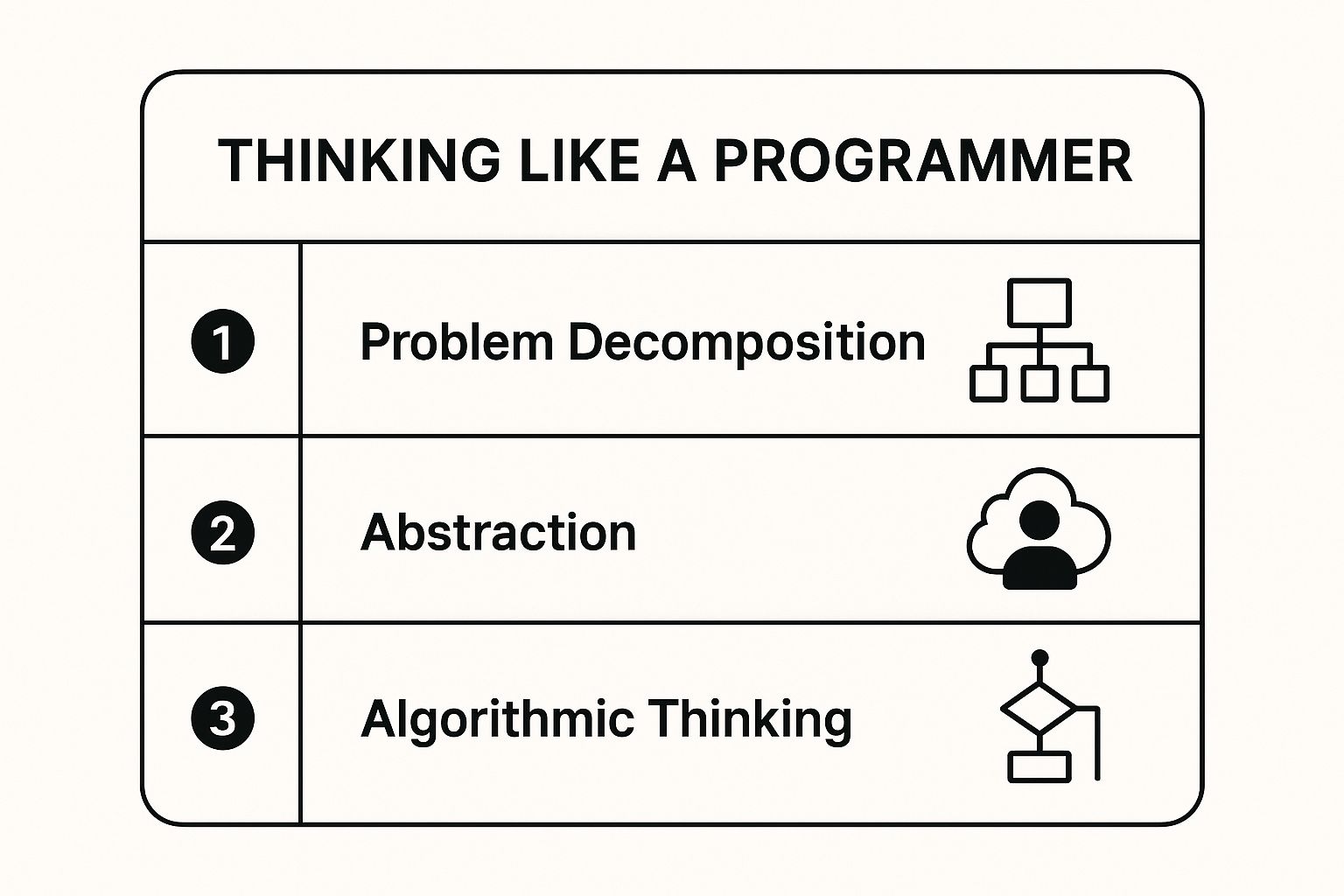
When you get a handle on problem decomposition, abstraction, and algorithmic thinking, you're not just learning to code—you're building a powerful framework to tackle any technical challenge that comes your way.
Adopting a Problem-Solving Perspective
So, how do you actually start making this shift? It begins with the questions you ask. Instead of looking at a project and thinking, "How do I build this entire app?" you learn to ask, "What is the absolute smallest, simplest thing this app needs to do first?" This methodical questioning is everything.
The table below breaks down the key mental shifts you need to make. It contrasts the way most people approach a task with how a programmer is trained to see it.
Key Programmer Mindset Shifts
| Traditional Approach | Programmer's Approach | Why It Matters |
|---|---|---|
| Sees a single, large task. | Decomposes it into small, independent sub-tasks. | Prevents overwhelm and creates a clear, step-by-step roadmap. |
| Gets stuck on all the details at once. | Uses abstraction to ignore irrelevant details for now. | Fosters focus on the core logic and prevents getting lost in the weeds. |
| Thinks about the end result vaguely. | Defines a precise, ordered sequence of steps (an algorithm). | Ensures the computer can execute the instructions flawlessly and predictably. |
By internalizing these shifts, you stop just looking at a problem and start analyzing it.
A programmer's true language isn't Python or JavaScript—it's logic. Code is just the way we translate that logic for a computer to understand.
This perspective helps you create a "mental blueprint" for your solution before you even think about implementation. Over time, you'll naturally learn to:
- Identify the essential components of any problem.
- Tune out the noise and focus on what truly matters for the core functionality.
- Map out the sequence of operations required to get from A to B.
Making these habits second nature is the real foundation. Every technical skill you acquire from here on out will be built on top of this solid, problem-solving base.
Break Down Problems Before You Build Solutions

Here's a secret that took me years to truly appreciate: the most powerful skill a developer has isn't writing clever code. It's the ability to look at a huge, intimidating problem and break it down into small, manageable pieces.
This skill is called problem decomposition, and it's your best defense against that "where do I even start?" feeling. It’s how you turn a vague idea into a concrete plan of attack.
Think about it this way: you wouldn't start building a house by nailing random boards together. You'd start with a blueprint. Decomposing a problem is how you create that blueprint for your code, turning a daunting project into a clear, achievable to-do list.
From Vague Idea to Actionable Plan
Let's get practical. Imagine a client asks you to build a simple appointment scheduler. That's a big, fuzzy request. An experienced programmer’s mind immediately starts slicing it up, not by thinking about code, but by asking questions.
The first move is always to define the absolute bare-bones version. What's the smallest thing we can build that actually works? This is your Minimum Viable Product (MVP).
- Can a user see a list of available time slots?
- Can a user pick an empty slot and book it?
- Can a user view their own confirmed appointments?
Right there, you've got three core features. Each one is a self-contained challenge you can tackle independently. This is the essence of thinking like a programmer—making steady progress on small things instead of getting paralyzed by the whole.
The art of programming is the skill of controlling complexity. The principle of decomposition is our most powerful tool for that.
Now, let's zoom in even further. Pick just one of those features: "a user can book an empty time slot." What does that really mean in practice? It's time for another round of questions.
Defining Data and User Actions
To let someone book an appointment, what information do we need from them? And what will they actually do on the screen?
| Data We Need to Store | User Actions to Handle |
|---|---|
| User's name | Clicking on an available time |
| User's email (for confirmation) | Filling out a submission form |
| The selected date and time | Clicking a "Confirm Booking" button |
| A short note about the appointment | Receiving a success or error message |
All of a sudden, "book an empty time slot" isn't an abstract idea anymore. It's a tangible set of requirements. We know we need a database table for appointment details. We know we need a user interface with specific forms and buttons. We've translated a concept into a concrete list of programming tasks.
This process is repeatable for every single feature on your list. If you're looking for more hands-on practice, digging into some practical coding examples and tutorials is a great way to see how other developers approach this, from simple apps to more complex ones.
By doing this over and over, you build the single most critical habit in software development. You start seeing every big challenge not as a single, unclimbable wall, but as a staircase you can build, one small, solid step at a time.
Embrace Debugging as a Learning Process

Here's a hard-won truth for anyone learning how to think like a programmer: errors aren't failures. They're clues. That cryptic error message popping up on your screen isn't a personal attack. It's the program giving you a direct, if sometimes frustrating, piece of feedback about where your logic went sideways.
A junior developer sees a bug and often feels a wave of frustration. A seasoned pro sees that same bug and gets curious. Making that mental shift is everything. It transforms debugging from a soul-crushing chore into one of the most powerful learning tools you have. Every single bug is a golden ticket to understanding the system you're building on a much deeper level.
The temptation is to start changing code randomly, hoping something sticks. But that's not how an expert operates. A real programmer's mindset is all about being systematic—a detective methodically hunting for the root cause.
Form a Hypothesis and Test It Methodically
The moment you see a bug, the first and most important step is to stop typing. Just stop. Take a breath and think. Before you change a single line of code, form a clear hypothesis about what you believe is causing the issue.
Ask yourself, "Okay, what do I think is going on here, and why?"
Once you have a theory, you need to test it in a controlled, isolated way. Don't just tweak something and rerun the entire application. That’s a recipe for confusion. Instead, you need to zero in on the problem with some classic, simple techniques.
- Strategic Print Statements: In Python, it's
print(). In JavaScript, it'sconsole.log(). Whatever your language, this is your best friend. Sprinkle these throughout your code to check the value of a variable at key points. You'll quickly see if the program's state matches what's in your head. - The Socratic Method: Start questioning your code’s core assumptions. Ask it simple questions like, "Is this variable really the number I think it is at this point?" or "Did this
ifstatement actually run, or was it skipped?" This forces you to challenge your own mental model of the code's flow.
Debugging is simply the process of closing the gap between what you think your code does and what it actually does. It's the ultimate reality check for your understanding.
This disciplined approach does more than just fix bugs. It builds resilience and sharpens the very analytical skills that define a great developer. You're training your brain to be incredibly precise.
Isolate the Problem Like a Scientist
When a bug feels huge and overwhelming, the goal is always the same: make the problem smaller. A tried-and-true technique is to start "commenting out" large blocks of code. If the error vanishes, you've just successfully cornered your suspect in a much smaller area.
Let's say you're working on a feature where a user's profile information isn't saving correctly. That's a big, vague problem. Instead of looking at the entire system, you break it down and test each link in the chain.
- Check the Input: First things first, is the data from the user form even correct? Use a print statement to see the data right after it's submitted, before any processing happens. Is the email formatted right? Is the name field coming through as
null? - Verify the Middle Step: If the input is good, look at the function that's supposed to handle it. Is it mangling the data somehow before it tries to save it to the database?
- Confirm the Output: Finally, if the data looks good all the way through, check the database interaction itself. Is the
save()command failing for some reason, maybe due to a permissions issue or a data type mismatch?
This step-by-step isolation turns a mystifying "it's broken!" situation into a series of small, answerable questions. When you learn to embrace debugging this way, you're not just fixing code. You're becoming a sharper, more insightful programmer with every bug you squash.
Find Patterns and Write Reusable Code
One of the biggest tells of an experienced programmer is that they absolutely hate repeating themselves. Seriously. If they've solved a problem once, they’ll go out of their way to make sure they never have to solve that exact same problem again.
This instinct is a huge part of learning to think like a programmer. It’s what separates code that just works from software that’s truly efficient, clean, and professional.
This whole idea boils down to a concept called abstraction. It might sound a bit academic, but in practice, it’s one of the most useful tools in your belt. Abstraction is simply the art of spotting a chunk of logic you keep using, pulling it out, and turning it into a general-purpose tool, like a function or a component. Instead of solving the same puzzle over and over, you build one elegant solution you can use anywhere.
From Repetitive Logic to Reusable Tools
Let's make this real. Imagine you're building a website and you have a few different forms: one for user registration, a contact form, and maybe a password reset form. Each one needs to check if the user entered a valid email. The beginner's approach? Just write the email validation logic three different times, once for each form.
Sure, it works. But it’s incredibly fragile. What happens when you realize your validation rule needs an update? Now you have to hunt down and change that logic in three different places. Miss one, and you’ve just introduced a bug.
An experienced developer sees this pattern from a mile away and immediately thinks, "This should be a function."
They would write a single, clean isValidEmail() function. It takes one thing—an email address—and returns true or false. Now, all three forms can simply call this one function. If the validation logic needs to change tomorrow, you only have to update it in one spot. Simple.
This way of thinking pays off massively:
- Easier Maintenance: Fixing a bug or tweaking logic in one place is worlds better than tracking down every copy-pasted instance.
- Increased Reliability: A single, well-tested function is much more reliable and less likely to have inconsistent bugs than three separate versions.
- Faster Development: Once that tool is built, you and your teammates can grab it and use it on the next project without ever having to think about it again.
Abstraction isn't about hiding complexity; it's about managing it. By creating reusable components, you can focus on the unique challenges of a new feature instead of re-solving old problems.
Spotting Patterns in Your Own Work
Getting into this habit means you have to actively look for repetition while you work. As you're coding, keep asking yourself one simple question: "Have I written something like this before?"
Think about a common task, like processing data a user submits. You'll start to see patterns everywhere.
| Task | Repetitive Step | Potential Abstraction |
|---|---|---|
| Sanitize User Comments | Remove HTML tags and extra whitespace. | Create a sanitizeInput(text) function. |
| Format Blog Post Titles | Capitalize the first letter of each word. | Build a toTitleCase(string) utility. |
| Crop User Profile Pictures | Resize an image to a 1:1 aspect ratio. | Develop a cropToSquare(image) component. |
When you start thinking this way, it’s a game-changer. Your codebase stops feeling like a long list of instructions and starts looking more like a well-organized system of interconnected, reusable parts. This is the moment you go from just writing code to truly engineering a solution.
Connect Your Mindset to Real Career Growth

Learning how to think like a programmer isn't just some abstract academic skill—it's a direct investment in your future. Let’s be real: companies aren't just looking for someone who can rattle off Python syntax. They need people who can take a tangled, real-world business problem, dissect it logically, and build a working solution.
Frameworks and languages have their seasons. They come and go. But the ability to think critically and solve complex problems? That’s timeless. It's the core skill that makes you an indispensable part of any team and an adaptable professional for years to come.
This mindset is exactly what the job market is screaming for. Tech jobs in the U.S. are set to grow at twice the pace of the national average, ballooning from 6 million to 7.1 million roles between 2024 and 2034. The Bureau of Labor Statistics also projects about 356,700 new computer and IT openings every single year through 2033. This isn't just growth; it's a constant demand for skilled thinkers.
Becoming an Adaptable Problem Solver
The developers who thrive long-term are the ones who can pivot. Technology moves at a breakneck speed, and today’s hot new framework can easily become tomorrow's legacy code. If all you've done is memorize commands, you'll be left behind. But if you understand the core principles of problem-solving, picking up a new tool is just a matter of learning a different dialect.
Think about it. The fundamental challenges in software development don't really change:
- Managing Complexity: How do you keep a system from collapsing under the weight of more data and more users?
- Ensuring Reliability: How can you build software that stands up to unexpected inputs and doesn't crash?
- Improving Efficiency: How do you write code that’s not just fast, but also clean enough for others to maintain?
These are questions of logic and architecture, not just syntax.
Your career currency isn't the number of languages you know; it's the complexity of the problems you can solve. A programmer's mindset is what allows you to tackle bigger and more interesting challenges over time.
This foundation in problem-solving is what makes you so valuable. It’s what gives you the confidence to learn new technologies and contribute in a meaningful way, no matter which way the industry winds blow. If you're looking to build this kind of resilient skill set, exploring a variety of coding resources and educational materials is a great way to get the broad exposure you need.
Ultimately, by focusing on how you think, you’re building a career that’s more secure, more rewarding, and packed with opportunity. You stop being just a coder and start becoming a true software engineer.
Actionable Exercises to Sharpen Your Skills
Building a programmer's brain is a lot like training for a sport. It’s all about consistent, focused practice. Thinking like a programmer isn’t a switch you flip on only when you’re looking at a code editor; it’s a mindset you can cultivate all day, every day.
The real trick is learning to see everyday situations as mini-puzzles. This constant, low-stakes effort is what builds the deep-seated problem-solving habits that separate great developers from those who just know syntax.
Train Your Brain Away from the Keyboard
You don’t need to be typing code to sharpen your logical thinking. The goal is to get into the habit of breaking down any process into a series of clear, unambiguous steps. It’s a game you can play in your head.
- Deconstruct Everyday Tasks: Think about making your morning coffee. Instead of just "make coffee," break it down like a computer would need to understand it. Is the pot clean? If not, wash it. Grab a filter. Add exactly three scoops of coffee. Fill the water to the 8-cup line. This forces you to be precise and think sequentially, which is the heart of programming.
- Analyze Board Game Rules: Grab a favorite board game and try to explain its rules as a logical system. What are the key variables (like player turns, resources, or victory points)? What are the main functions (drawing a card, moving a piece)? What’s the conditional logic (
IFyou land on this space,THENthis happens)?
These simple exercises train your brain to see the world in systems, inputs, and outputs—the absolute foundation of a programmer’s mindset.
The best programmers I’ve known aren't just coders; they're system thinkers. They have a knack for seeing the interconnected logic beneath the surface, which is how they build things that don't fall apart later.
Engage with Focused Coding Challenges
Once you're comfortable deconstructing problems in your head, it's time to bring that skill to actual code. This is where dedicated practice platforms are worth their weight in gold. They offer self-contained problems with clear goals, letting you focus entirely on the logic.
Websites like Codewars or LeetCode are perfect for this. They have thousands of small challenges (often called "kata") sorted by difficulty. You can start small, maybe with a function to reverse a string, and work your way up to complex algorithmic puzzles.
This kind of focused practice is incredibly effective. It cuts out all the noise of building UIs or setting up databases, allowing you to isolate and strengthen that core problem-solving muscle. And if you want to be more efficient, checking out a curated list of developer tools and utilities can expose you to new resources that make tackling these challenges smoother.
Align Your Practice with Industry Demand
Thinking like a programmer also involves a bit of strategy—knowing which skills the market actually wants. As you get better, focusing on in-demand technologies makes your time investment pay off.
As of 2025, Python's dominance continues with a 29.6% market share, and JavaScript is still the most widely used language with 13.8 million developers. The programming language market is on a steep climb, projected to grow from $188.86 billion in 2023 to $379.91 billion by 2030.
These numbers aren't just trivia; they're a roadmap. They show why practicing with popular, well-supported languages is so important. By doing so, you're not just learning to think—you're preparing yourself for a real-world career. You can read more about these software development statistics to see where the industry is pointing.