Let's cut through the buzzwords. At its core, software development innovation is simply about finding smarter, faster, and more creative ways to solve problems. It's about looking past the "way we've always done it" and embracing new tech and methods to build software that's not just functional, but truly effective and elegant.
What Is Software Development Innovation, Really?
Imagine graduating from a standard bucket of LEGO bricks to a master builder's kit. You're still building, sure, but now you have specialized parts (new technologies) and advanced techniques (new methodologies). This new toolkit lets you create something far more complex, impressive, and purpose-built.
Innovation doesn't always mean inventing something from thin air. More often than not, it’s about applying existing tools in clever new ways to solve old problems. It’s the engine that pushes development teams beyond just shipping code to delivering exceptional user experiences and genuine business value.
Software development innovation is the practice of integrating new strategies, methodologies, and technologies into the development lifecycle to improve efficiency, quality, and the overall value of the final product. It’s a mindset focused on continuous improvement and creative problem-solving.
This kind of thinking touches every single stage of the development process, from the first spark of an idea all the way through to deployment and ongoing maintenance.
Core Pillars of Innovation
When you break it down, software development innovation really stands on a few key pillars. These aren't just abstract concepts; they are practical areas where teams can focus their energy to make real breakthroughs.
- Methodological Shifts: This is about moving away from rigid, step-by-step processes like Waterfall toward more fluid frameworks like Agile and DevOps. This shift allows for rapid iteration, much better team collaboration, and a final product that actually reflects what users need.
- Technological Adoption: It's about bringing powerful new tools into your workflow. Think AI-powered coding assistants that handle the grunt work, low-code platforms that accelerate delivery, or advanced cloud services that offer incredible scalability on demand.
- Cultural Transformation: This might be the most important pillar. It's about building a team culture where experimentation is encouraged and failure is seen as a learning opportunity, not a career-ender. This sense of psychological safety is what empowers developers to take the calculated risks that often lead to the biggest wins.
Why It Is Essential Today
Not too long ago, sticking to a predefined development plan was good enough. But the modern business and tech worlds move at a breakneck pace, demanding a far more dynamic approach. Software isn't just a back-office support tool anymore; for many companies, it is the business.
This fundamental shift means that innovating how you build software is no longer a "nice-to-have." It’s a critical factor for survival and growth. Companies that get this right can react to market shifts faster, create far better products, and become magnets for top engineering talent. This guide will show you exactly how this modern mindset is reshaping the entire industry.
Why Innovation Is No Longer a Choice
There was a time when innovation was a "nice-to-have" in business—a side project for when you had extra time or budget. Those days are long gone. In today's hyper-competitive world, treating software development innovation as anything less than essential is a surefire way to get left behind.
Standing still is the fastest way to fall behind. The modern market is global, meaning a disruptive competitor can pop up anywhere, anytime. If you aren't constantly refining your products and improving your processes, you're not just losing ground; you're risking becoming irrelevant.
The Economic Engine Driving Change
The sheer size and speed of the software industry place enormous pressure on development teams. It's not just about coding an app anymore; it's about carving out a space in a massive, fiercely competitive market that demands more powerful, intuitive, and efficient software every single day.
The numbers tell a staggering story. The software development market is projected to grow by 6.30% every year between 2025 and 2029, swelling to a market volume of $249.98 billion. In 2025 alone, North America is on track to generate $97.64 billion in revenue, cementing its role as a global powerhouse. This intense economic pressure creates a high-stakes game where only the most forward-thinking and adaptable companies will win.
Responding to Sky-High User Expectations
We've all been trained to expect more from our software. Think about the apps on your phone—they're constantly being updated with new features, performance boosts, and slicker designs. This constant cycle of improvement is no longer a perk; it's the baseline.
In today's market, user satisfaction is directly tied to the pace of innovation. A product that doesn't evolve is perceived as a product that is dying. This puts direct pressure on development teams to deliver more value, faster than ever before.
To keep up, development teams have to find ways to work smarter and faster. Embracing a culture of innovation is what gives them that edge. It allows teams to:
- Act on user feedback immediately, iterating on features and squashing bugs in weeks or even days, not months.
- Get ahead of market trends by experimenting with new technologies that open up new possibilities.
- Build better, more secure products by embedding advanced testing and security right into the development process.
Trying to compete using old methods is like showing up to a Formula 1 race in a horse and buggy. The tools and resources to build incredible software are out there, and if you want to stay in the race, you have to use them. For a curated look at what modern teams are using, the Vibecoding VIP resource directory is a great place to start.
The Methodologies Powering Modern Development
To spark real software development innovation, you need more than just a brilliant idea and a team of sharp developers. You need a game plan—a blueprint for how you'll actually build the thing. These blueprints are the methodologies that guide how teams plan, collaborate, and bring software to life. They're what separate a chaotic, disorganized effort from a well-oiled machine.
Think of old-school methods like Waterfall. It’s like building a house with a rigid, linear plan. You pour the entire foundation before raising a single wall, and all the walls have to be up before you can even think about the roof. What happens if the client suddenly decides they want a bigger window? It’s a huge, expensive headache. The process is predictable, sure, but it’s painfully slow and inflexible.
Modern methodologies completely flip that script. They’re designed for a world where change is the only constant and speed is everything.
Agile: The Art of Adapting on the Fly
Agile isn't so much a strict set of rules as it is a guiding philosophy. It’s all about adapting.
Imagine a chef creating a brand-new dish. Instead of following a recipe perfectly and only tasting the final result, they taste and adjust at every step. A little more salt here, a little less spice there. This constant feedback loop is what makes the final dish perfect.
That's the essence of Agile. Teams work in short, iterative cycles called sprints, which typically last from one to four weeks. At the end of each sprint, they deliver a small but working piece of the software. This lets them get immediate feedback from real users and stakeholders, making it easy to change course without derailing the entire project. This adaptive approach is a cornerstone of innovation because it encourages experimentation and quick pivots.
DevOps: Bridging the Gap Between Creation and Delivery
If Agile is the chef perfecting the recipe, DevOps is the system that knocks down the wall between the kitchen (Development) and the dining room (Operations).
Traditionally, developers would build the software and then just toss it "over the wall" to the operations team, who had to figure out how to deploy and maintain it. This created a ton of friction, delays, and finger-pointing whenever something went wrong.
DevOps smashes those silos. It’s a cultural shift, supercharged by automation, where development and operations teams work together as one cohesive unit. This partnership is powered by tools for continuous integration and continuous delivery (CI/CD), which automate the tedious work of building, testing, and deploying code. The payoff? A massive boost in both speed and reliability.
Key Insight: DevOps isn’t just about the tools; it’s about shared ownership. When developers and operations staff are both responsible for the software's performance, the mindset shifts from "my code works on my machine" to "our product is delivering value to our customers."
Microservices: Building for Resilience and Scale
Let's go back to our food analogy. If a traditional application is like one massive, monolithic restaurant, a microservices architecture is more like a vibrant food court with dozens of small, independent stalls. One stall sells drinks, another sells burgers, and a third handles desserts.
This architectural style breaks down a big application into a collection of smaller, independently deployable services. Each service runs on its own and communicates with the others through well-defined APIs.
The benefits here are huge:
- Resilience: If the dessert stall has an issue, it doesn't shut down the whole food court. You can still get your burger and a drink.
- Scalability: If the burger stall gets slammed with customers, you can easily add more burger stalls without messing with the others.
- Flexibility: The team running the drink stall can try out new technology—like a fancy new soda machine—without needing permission from the burger team.
This flexibility is exactly what you need for innovation. It lets teams experiment with and deploy new features for one small part of an application without putting the entire system at risk.
Modern vs. Traditional Development Approaches
To truly grasp the shift, it helps to see these approaches side-by-side. The old ways prioritized predictability, while modern methods are all about embracing change.
| Characteristic | Modern Methods (Agile, DevOps) | Traditional Methods (Waterfall) |
|---|---|---|
| Planning | Adaptive and iterative; plans evolve. | Upfront and comprehensive; rigid plan. |
| Flexibility | High; changes are welcomed and expected. | Low; changes are difficult and costly. |
| Delivery Cycle | Short cycles (1-4 weeks) with frequent releases. | Long, single cycle with one final delivery. |
| Feedback Loop | Continuous feedback from stakeholders. | Feedback only after final delivery. |
| Team Structure | Cross-functional and collaborative. | Siloed, with distinct hand-offs. |
| Risk | Lower; issues are identified and fixed early. | Higher; major problems discovered late. |
This table makes it clear why teams are moving away from the rigid structures of the past. The speed and adaptability of modern methods simply deliver better results in today’s market.
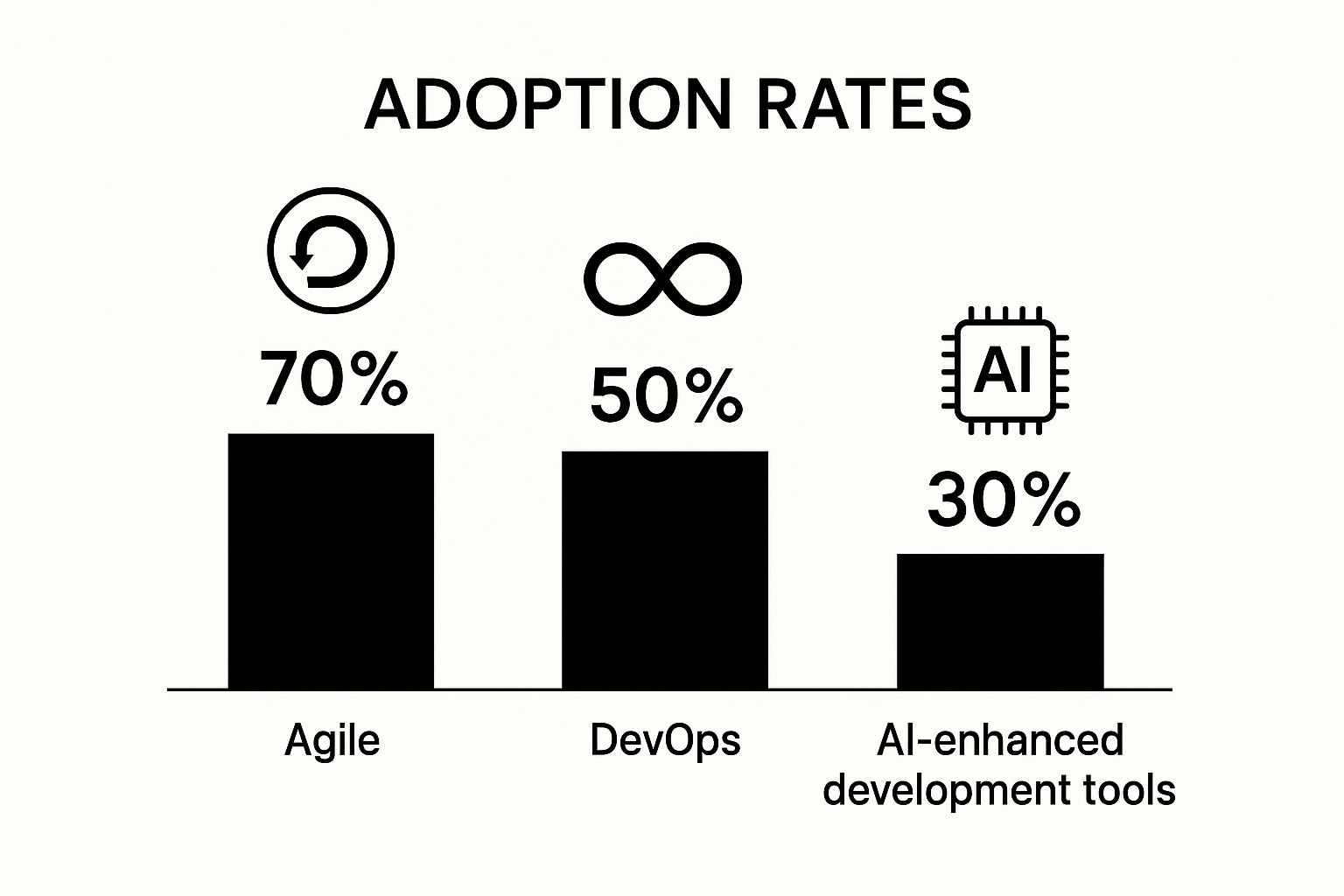
As you can see, while Agile has become standard practice, the adoption of more advanced methods like DevOps and AI-powered development is still on the rise. This signals a huge opportunity for teams willing to get ahead of the curve.
By blending the adaptive philosophy of Agile, the collaborative culture of DevOps, and the resilient structure of microservices, you create an environment where software development innovation isn't just possible—it's inevitable. To find the right tech to support this shift, check out the Vibecoding VIP directory of development tools, a curated list for forward-thinking engineering teams.
Unlocking Innovation with Key Technologies
If innovative methodologies are the blueprint, then groundbreaking tools and technologies are the actual building materials. Real software development innovation happens when smart frameworks get paired with equally smart tech. Right now, two types of tools are completely changing how we design, build, and ship software, making everything faster, more accessible, and frankly, more intelligent.
Think of these technologies as force multipliers for developers. They amplify a programmer's ability to tackle truly complex problems. Instead of getting bogged down in routine, repetitive tasks, engineers can hand that work off to automated systems. This frees them up to focus on the things humans excel at: big-picture architecture, creative problem-solving, and strategic thinking.
AI Coding Assistants: The Developer's Expert Partner
Imagine a master woodworker with a highly skilled apprentice at their side. The apprentice handles the prep work, grabs the right tools, and even anticipates the next step. This lets the master focus entirely on their craft. That’s exactly what AI-powered coding assistants like GitHub Copilot do for today’s developers.
These tools plug directly into a developer's editor, offering code suggestions in real-time, finishing entire functions automatically, and even writing test cases from scratch. They've learned from billions of lines of public code, giving them an almost encyclopedic knowledge of common patterns and solutions.
Let’s be clear: this isn't about replacing developers. It’s about augmenting their abilities.
- Boosted Productivity: All that boilerplate code that used to take hours? It now gets written in seconds.
- Less Mental Strain: Developers don't have to keep every single syntax rule or API detail in their heads anymore.
- Better Code Quality: The AI can spot common pitfalls and suggest best practices as you type.
- Quicker Onboarding: Junior developers can get up to speed much faster by seeing how the AI approaches different problems.
By taking the tedious parts of coding off their plate, these assistants empower developers to pour their energy into the more challenging and creative aspects of the job. That’s a direct line to software development innovation.
The Rise of Low-Code and No-Code Platforms
Another massive shift is happening thanks to the rise of low-code/no-code (LCNC) platforms. These tools offer visual, drag-and-drop interfaces that let people with little to no formal programming experience build fully functional applications.
It’s like the difference between a professional chef cooking a complex meal from scratch versus using a high-end meal kit. The kit comes with pre-chopped, pre-measured ingredients and simple instructions, dramatically cutting down the time and skill needed to create something delicious. LCNC platforms do the same, providing pre-built components and logic blocks that can be snapped together to create powerful software.
This movement is fundamentally changing who gets to be a creator. It gives business analysts, marketers, and other subject-matter experts the power to build the tools they need, right when they need them, without getting stuck in a long IT queue.
This isn't just a minor trend—it's a seismic shift. Projections show that by 2025, an astonishing 70% of new business applications will be built using low-code or no-code technologies. This incredible growth is fueled by a company's need to be more agile and deliver value faster. You can dig deeper into how these platforms are reshaping the industry in this full report on software development statistics. This allows professional developers to concentrate on the complex, mission-critical systems while everyone else is empowered to solve their own application needs.
How AI Is Transforming the Entire Lifecycle
Artificial intelligence is making waves in software development, but its impact goes far deeper than just writing code. Think of AI as a new, incredibly intelligent team member that's present from the initial brainstorming session all the way to deployment and beyond. It’s this full-cycle integration that represents a massive leap forward in software development innovation.
Instead of just automating repetitive tasks, AI brings a layer of predictive intelligence to the table. It spots patterns, anticipates potential problems, and highlights risks a human team might not see until it's too late. It’s not just a tool; it's a strategic partner.
Beyond Code Generation
While AI coding assistants are getting all the attention, the real story is how AI is weaving itself into every stage of development. It’s becoming essential for project management, quality assurance, and security, creating a smarter and more connected workflow from start to finish.
This is why teams are scrambling to adopt AI-powered systems. Tools like GitHub Copilot give developers a major boost with real-time code suggestions, but that's just the beginning. AI-driven project management tools use predictive analytics to sharpen timelines and allocate resources more effectively. In fact, over 30% of software development teams now have dedicated departments for security monitoring, often powered by AI. For more on this, you can check out these insights on software development trends from Bairesdev.
Smarter Project Management and Planning
In the early planning stages, AI acts like a project manager with a crystal ball. We've all been on projects where planning was based on gut feelings and past experiences, only to see them derailed by unexpected issues.
AI-powered project management tools are changing that game. By crunching the numbers on past projects, team performance, and real-time progress, these systems can:
- Predict Project Delays: AI algorithms can spot potential bottlenecks in the workflow long before they grind everything to a halt.
- Optimize Resource Allocation: The system can suggest the right person for the right job based on skills, availability, and past performance.
- Identify Risks Early: By analyzing project complexities and dependencies, AI can flag high-risk areas that need extra attention.
This shifts the team from a reactive "firefighting" mode to a proactive one, where problems are solved before they can impact a release.
By forecasting potential roadblocks and optimizing task distribution, AI helps ensure that projects stay on track and within budget. It turns project data into actionable intelligence, making the entire process more predictable and efficient.
Intelligent Quality Assurance and Testing
Testing is another area getting a serious upgrade from AI. Manual testing is a grind—it’s slow, expensive, and often misses those tricky edge-case bugs that only pop up under very specific conditions.
AI-driven testing tools tackle this head-on. They can intelligently generate thousands of unique test cases, exploring scenarios a human tester would never even think of. The AI can actually analyze the application's code to understand its logic and then design tests to deliberately poke at its weak spots. To see how AI assistants play a role, take a look at our Vibecoding VIP guide on GitHub Copilot.
A Proactive Stance on Security
In a world of ever-present cyber threats, a reactive approach to security is a losing battle. Here, AI has become an essential line of defense. AI-powered security tools watch over applications and infrastructure 24/7, learning the digital heartbeat of what constitutes normal behavior.
The moment something deviates from that baseline—like a strange login attempt from an unusual location or odd data traffic—the AI can flag it instantly for a human to review. In many cases, it can even take automated action to block the threat immediately. This kind of continuous, intelligent monitoring provides a security posture that periodic manual checks just can't compete with, making AI an indispensable partner for building safer software.
Building a Culture of Continuous Innovation
All the innovative methods and technologies in the world won't get you very far without the right team culture. You can think of new tech as the engine of progress, but it’s the culture that provides the fuel. If your teams don't feel safe enough to experiment, question the status quo, and even fail once in a while, the best tools will just sit there collecting dust. At its heart, software development innovation is a human process, built on a foundation of trust and a genuine desire to always be learning.
This means you have to do more than just talk about it; you have to take real, practical steps to weave innovation into your team's DNA. It's about intentionally creating a space where curiosity is encouraged and new ideas are treated as exciting opportunities, not just annoying disruptions. This kind of shift doesn't happen overnight or by accident—it’s built on purpose, with strong leadership and consistent effort.
Fostering a Safe Space for Experimentation
If there's one thing you need for an innovative culture, it's psychological safety. It's that simple. When developers are worried they'll be blamed or punished for an experiment that doesn't pan out, they'll just stop taking risks. To build this safety net, leaders need to actively foster an environment where failure is seen for what it is: a valuable piece of data, not a personal screw-up.
One of the best ways to do this is with blameless post-mortems. When something breaks—an outage, a critical bug—the goal isn't to point fingers. It's to figure out what in the system or the process allowed the failure to happen in the first place. This moves the conversation away from individual blame and toward collective improvement, which makes people far more willing to be open and honest about mistakes.
A culture of innovation is one where the response to failure isn't "Whose fault is this?" but "What did we learn, and how can we get better?" This blameless approach is what unlocks genuine creativity and resilience within a team.
Making Innovation a Team Sport
Innovation isn't something that should be locked away in an R&D department; it's a company-wide sport. When you actively create chances for everyone to get involved in creative problem-solving, you'll be amazed by the brilliant ideas that come from the most unexpected places. Plus, it’s a fantastic way to build stronger teams.
- Host Regular Hackathons: Set aside a day or two for everyone to drop their regular tasks and just build something cool. It could be a new feature, a helpful internal tool, or a clever fix for a problem that's been bugging everyone. It gives the whole team a chance to put on their innovator hat.
- Invest in Upskilling: Give your team a budget and, just as importantly, the time to keep learning. When people are encouraged to explore a new programming language, play with a new tool, or learn a new methodology, they bring that fresh perspective right back to their projects.
- Create Innovation Sprints: Dedicate entire sprints to pure experimentation. The main goal isn't to ship a feature but to try out a new technology or prototype a high-risk, high-reward idea.
Measuring the Impact of Your Culture
A strong innovation culture feels good, sure, but it also delivers real business results. If you want to prove its value and make the case for investing in it, you need to track metrics that connect your cultural efforts to actual performance.
Start by looking at things like development velocity, which tells you how much work your team can get done in a single iteration. As your culture gets stronger and psychological safety improves, you should see that number go up. Another killer metric is Mean Time to Recovery (MTTR)—how fast can your team bounce back from a failure? A low MTTR is a clear sign of a resilient, high-performing team that deploys with confidence because they trust their ability to fix things quickly. By tracking these numbers, you can draw a straight line from a healthy culture to a successful business.
Got Questions About Innovation? Let's Get Them Answered.
Putting big ideas about software development innovation into action always brings up some real-world questions. How do you actually get started? What do you do with your old, reliable systems? And what about the elephant in the room—AI? Here are some straightforward answers to the challenges teams run into most often.
We're a Small Business. Where Do We Even Begin?
If you're a small business, the golden rule is to start with a project that offers a big impact for a low risk. The goal here isn't to rebuild your entire tech stack overnight. That's a recipe for disaster.
Instead, find one specific, nagging pain point in how you work right now. For example, is your team still deploying code manually, a process that’s slow and full of "oops" moments? A perfect first innovation project would be setting up a simple CI/CD pipeline. This gives you a quick, tangible win, proves the value of a new approach, and builds the confidence to tackle bigger things—all without breaking the bank or burning out your team.
Is AI Going to Take My Developer Job?
Nope. But it is going to change it—for the better. Think of AI coding assistants not as replacements, but as the most capable junior developers you’ve ever worked with. They can handle the grunt work, the boilerplate code, and the repetitive tasks that eat up a developer's day. This frees up human developers to focus on what they do best.
The developer’s role is evolving to be more about:
- System Architecture: Designing the high-level blueprints for strong, scalable, and secure applications.
- Creative Problem-Solving: Untangling the kind of complex business logic that AI can't touch.
- Strategic Oversight: Acting as the project lead for AI tools—guiding their work, checking the output, and making sure the final product actually solves the business problem.
The developer of tomorrow isn't just a coder; they're an architect and a strategist.
The rise of AI doesn't diminish the developer; it elevates them from a builder to a master craftsperson. By automating the tedious parts, it clears the way for the creativity, critical thinking, and architectural vision that truly fuels innovation.
How Can We Innovate While Still Supporting Our Old Systems?
This is the classic balancing act: how do you introduce new features when your business runs on a stable (but aging) legacy system? The "Strangler Fig" pattern is a fantastic, battle-tested strategy for this. Instead of a high-stakes, all-or-nothing rewrite, you slowly and carefully build new services around the old system.
Picture your legacy app as a sturdy tree trunk. You start by wrapping a single, small vine—a new microservice—around it to handle just one function. Maybe it’s a new reporting feature or an API endpoint. Over time, you add more vines, with each one taking over another piece of the old system's responsibilities. Eventually, the new, modern services completely surround and "strangle" the original application, which can then be safely shut down. It's a brilliant way to innovate piece by piece without ever putting your core business at risk.