When we talk about user-centered design, we're not just talking about making things look good. We're talking about a fundamental shift in perspective. It's an approach that puts real people—their needs, their frustrations, and their goals—right at the heart of everything you create.
Think of it this way: you’re designing with your users, not just for them. It’s about ditching your own assumptions and instead diving deep into understanding user needs, behaviors, and motivations at every single step of the journey.
What Are User Centered Design Principles?
At its core, user-centered design (UCD) is a philosophy. It means every decision, from the grandest feature concept to the tiniest micro-interaction, is guided by the people who will actually use the product. The old way was to build something cool and then hope you could find an audience for it. UCD flips that script entirely. It insists that you start by getting to know your users first.
Let’s use an analogy. Imagine an architect is hired to design a new family home. A standard approach might start with blueprints, building codes, and current architectural trends. A user-centered architect, on the other hand, starts by spending time with the family. They watch how the parents cook together, see where the kids instinctively drop their backpacks after school, and listen to their frustrations about their current living space.
The final design isn't just a house; it's a direct response to those lived experiences. It’s a home that feels like it was built just for them, because it was. That’s the magic of UCD in action.
The Core Pillars of User Centered Design
To really get this right, you need to internalize the core pillars of UCD. These aren't just checkboxes on a project plan; they're a mindset that should guide your work from the first sketch to the final launch and beyond.
Here's a quick look at the foundational concepts that define this approach.
The Core Pillars of User Centered Design
| Pillar | Description | Key Goal |
|---|---|---|
| Relentless User Focus | Every decision is constantly measured against real user needs, goals, and context. | To ensure the final product solves a genuine problem for its intended audience. |
| Iterative Design | The design process is a continuous cycle: build a version, test it with users, learn from their feedback, and refine. | To improve the solution progressively and avoid investing heavily in a flawed idea. |
| Direct User Feedback | Insights are gathered directly from users through methods like interviews, surveys, and usability testing. | To replace assumptions and internal biases with evidence-based data. |
| Holistic Experience | The entire user journey is considered, from first awareness to long-term use, ensuring a seamless and intuitive experience. | To create a cohesive and accessible product that feels supportive at every touchpoint. |
Adopting these pillars is about more than just a process; it's about building a product that solves real-world problems and earns you a loyal following.
By putting users first, you're not just improving usability; you're building trust. When users feel seen and understood by a product, they are more likely to become advocates. In fact, some studies show that 70% of customers point to user experience as a key reason for their brand loyalty.
This approach also has a major business benefit: it makes sure your time and money are spent on features that actually deliver value. You stop wasting resources on things nobody asked for, which dramatically increases your chances of success.
For vibe coding projects, where the feel and flow of the experience are just as important as the function, these user centered design principles are absolutely essential. They provide the necessary structure to turn a creative vision into something that’s not only innovative but also genuinely helpful and a delight to use.
A Look Back: The Evolution of Designing for People
To really get a handle on modern user-centered design principles, it’s helpful to understand where they came from. This isn't some new fad that popped up with the first iPhone; it's a philosophy that’s been honed for decades, long before we were all staring at screens. The whole journey started with a simple, yet profound, idea: design should serve people, not the other way around.
Even before the computer mouse was a thing, pioneers like industrial designer Henry Dreyfuss were already fighting this good fight. He famously argued that the best products are the ones that just fit into our lives. Dreyfuss believed things should feel safe, comfortable, and easy to use, laying the groundwork for an approach that put the human experience first. This was the seed that would eventually blossom into user-centered design.
The Digital Shift and Making It Official
The real game-changer was the personal computer. As technology started moving from giant mainframes into our homes and offices, the need for intuitive, non-frustrating interaction became crystal clear. This is when the early, informal ideas that Dreyfuss championed began to get formalized.
The 1970s and 80s were a pivotal time. In 1986, cognitive scientist and designer Don Norman literally wrote the book on it—or at least, a book that gave the movement its name: User Centered System Design. He made a powerful case that a user's needs and mental models should always win out over a system's technical quirks. Just a few years later, in 1993, Norman became the first-ever "User Experience Architect" at Apple, weaving these principles directly into the fabric of legendary products like the Macintosh. If you're curious, you can discover more about the history of UX design and the key people who shaped it.
This whole timeline is about designers watching how real people interact with prototypes and using those insights to make things better. It’s all rooted in empathy.
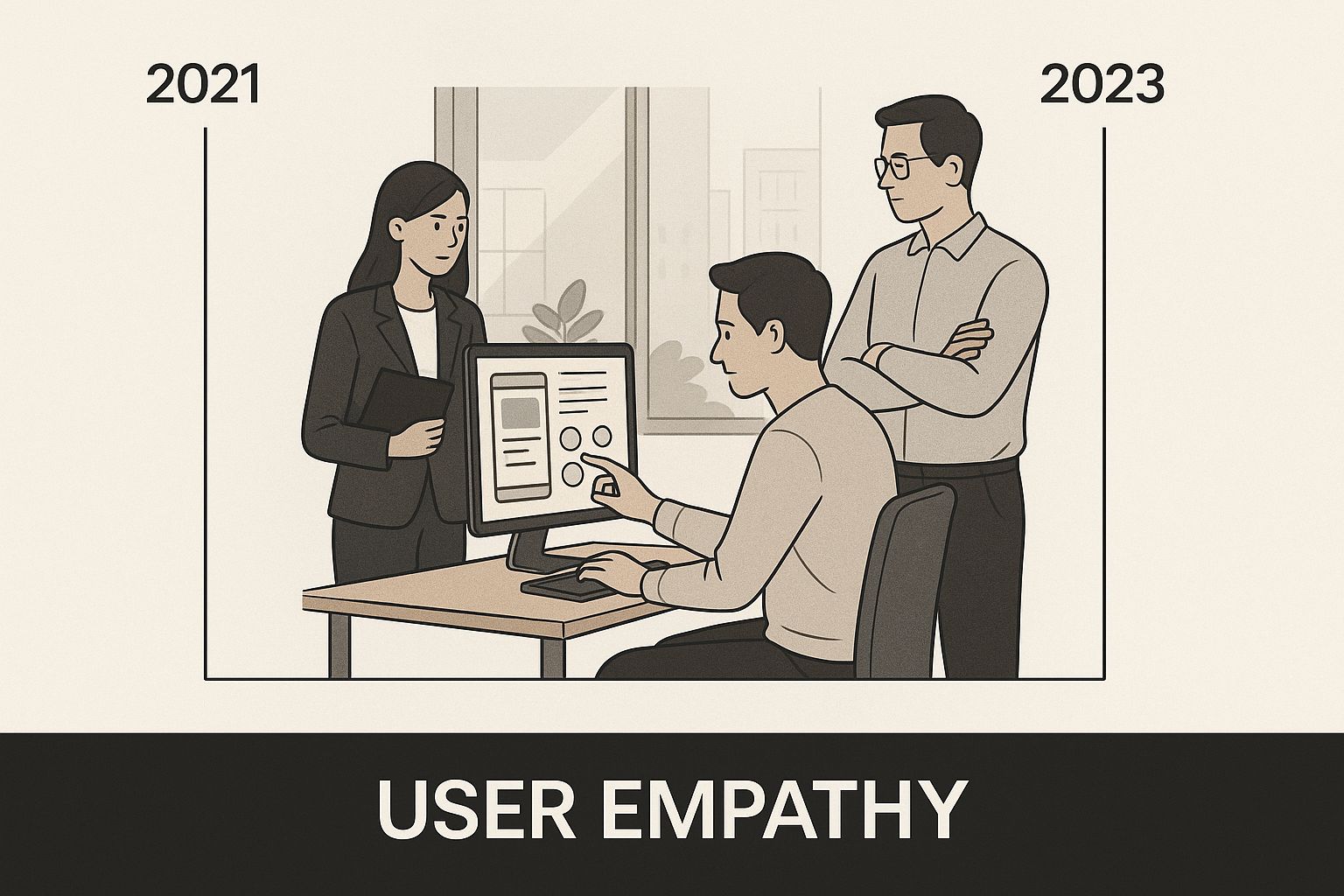
As the infographic shows, user-centered design is so much more than just making things look pretty. It's a deep, empathetic cycle of observing, understanding, and refining.
From Niche Idea to Industry Standard
What started as a pretty radical concept has now become the gold standard for creating successful products. The history of UCD reveals a clear trend: the more complex our technology gets, the more we crave simplicity, clarity, and a human touch.
The core lesson here is that technology changes, but fundamental human needs don't. UCD gives us a timeless roadmap for meeting those needs, no matter what we're building.
Today, these principles are more critical than ever, especially for something like vibe coding. You can't build an immersive, emotionally resonant experience with code alone. It requires a genuine understanding of the person on the other side of the screen. This journey through history proves that focusing on the user isn't just a "nice-to-have"—it's the most surefire way to create things people don't just use, but absolutely love.
The Key Principles of Modern Product Design
Knowing the history of user-centered design gives us the "why," but to actually build something incredible, we need the "how." This is where theory gets its hands dirty. All great modern product design is built on a handful of core ideas that make sure every decision serves the real person on the other side of the screen.
Think of these not as rigid rules, but as a reliable compass. They’ll help you navigate the tricky process of making something that’s not just useful, but genuinely delightful to use. It’s the framework you can lean on to gut-check your own work and push your designs from pretty good to truly great.
Maintain a Relentless Focus on the User
First things first: you have to be absolutely obsessed with your user. This is so much more than just asking them what they want. It's about diving deep to understand their world—their goals, their hang-ups, what makes them tick, and what drives them crazy. Assumptions are the absolute enemy of good design; empathy is your greatest superpower.
To pull this off, you need to bake user involvement into your entire workflow. It’s not some box you check off a list. It’s a continuous conversation that shapes every feature, layout, and interaction you create. This is the bedrock of all other user centered design principles.
"The user’s experience is important, but UCD takes it a step further by emphasizing real users’ input throughout the… process. This makes UCD a crucial part of creating better user experiences, as it allows designers to build solutions that genuinely reflect what users need."
This deep understanding doesn't always require massive, formal studies. For vibe coding projects, it might be as simple as watching a fellow creative coder wrestle with a clunky interface or listening to an artist describe the "flow state" they’re chasing. The goal is to get inside their head and start designing from their point of view.
Embrace Iterative Design and Prototyping
Amazing products almost never spring to life fully formed. They are sculpted, refined, and polished over time through a cycle of building, testing, learning, and doing it all over again. That's the whole idea behind iterative design. Instead of disappearing for months to build a "perfect" final product in a vacuum, you build a simple version, get it in front of real people, and see what happens.
This approach is a game-changer for a few reasons:
- It Slashes Risk: By testing small, you avoid dumping huge amounts of time and money into an idea that might be a total dud.
- It Gathers Real-World Data: You get to replace endless internal debates and pure guesswork with cold, hard proof of what works and what doesn't.
- It Builds Momentum: Every little tweak and test moves the project forward, creating a real sense of progress and enabling constant improvement.
Prototyping is the engine that keeps this cycle running. You can use one of the many available design and collaboration tools for developers to quickly mock up and test your ideas without writing a single line of production-ready code. These prototypes don’t have to be pixel-perfect; they just need to be real enough to get honest, unfiltered feedback.
Champion Clarity and Simplicity
In a world overflowing with digital noise, clarity is king. A product that is simple, intuitive, and easy to figure out will always win against one that’s confusing and complicated. It’s like the difference between a well-designed road sign and a dense, terribly written instruction manual. One gets you where you're going effortlessly, while the other just causes a headache.
This principle is all about cutting away the fluff so the essential stuff can shine. Every single element on the screen—every button, icon, and piece of text—needs to have a clear job. If it isn't helping the user achieve their goal, it's just getting in the way.
While this push for simplicity feels very modern, its roots go way back. Way back. In 1955, the legendary industrial designer Henry Dreyfuss published Designing for People, a book that laid out ideas we still rely on today. He argued for making things that feel safe, comfortable, and efficient, all while creating a genuinely satisfying experience. You can see how long these ideas have been brewing in this short history of UX design.
Ironically, achieving simplicity is incredibly hard work. It demands that you truly understand your user's most critical needs and have the discipline to be ruthless with your editing. It’s not about randomly hacking away features, but about thoughtfully arranging everything to create a smooth, frictionless path for the user. By following these user centered design principles, you create experiences that feel less like a chore and more like a natural extension of a person's own thoughts.
How Winning Products Put UCD into Practice

It’s one thing to talk about design principles in theory, but where the rubber really meets the road is seeing them in action. The products we use and love every day didn't just appear out of thin air. They were carefully crafted around a deep, almost obsessive, understanding of the people they were built for.
Let's pull back the curtain on a couple of giants—Spotify and Airbnb—to see how they've baked user-centered design principles into their very core. By looking at specific features we all recognize, we can see exactly how UCD translates from a concept into real-world success.
Spotify: A Masterclass in User Context and Behavior
Spotify’s magic isn't just its massive song catalog. It's the platform's uncanny ability to make you feel like it gets you. This isn't an accident; it's a direct result of putting the user's listening habits and context front and center.
Think about the "Discover Weekly" playlist. For many, it's a beloved weekly ritual. But it's far more than a simple algorithm. It's UCD in its purest form.
- Anticipating User Needs: Spotify figured out that people don't just want a library; they crave the joy of finding their next favorite song without having to work for it.
- Constant Iteration: Every time you play, skip, or save a track, you're teaching the system. This creates a powerful feedback loop that refines its suggestions over time, making each playlist better than the last. This is iterative design, live and in real time.
- Giving Users Control: While the playlist is automated, you're still in the driver's seat. You can "like" songs to influence future picks or simply ignore the list. It’s the perfect balance of helpful guidance and user freedom.
Spotify doesn’t just see what you listen to; it pays attention to how you listen. It notices the time of day and connects the dots between your different playlists to build an experience that feels less like a piece of software and more like a friend who knows your taste inside and out.
Airbnb: Engineering Trust Between Strangers
Airbnb tackled one of the biggest human-centered challenges imaginable: how do you convince millions of people to sleep in a stranger's house? Their entire business is built on trust, a fragile concept that technology alone can't solve. Their platform is a brilliant case study in designing for safety and peace of mind.
To crack this nut, Airbnb applied core user-centered design principles to every single step of the journey. They systematically dismantled the fear and anxiety of the unknown.
The core challenge for Airbnb wasn't technological; it was psychological. Their success demonstrates that when you design for fundamental human needs like safety and trust, you can create entirely new markets and behaviors.
They built this foundation of trust through several deliberate design choices:
- Verified Profiles: By asking users to link social media and verify their identity with government IDs, Airbnb establishes a baseline of authenticity. It’s a way of saying, "these are real people."
- A Fair Review System: The two-way review system is a work of genius. Reviews are only published after both the guest and host have submitted theirs. This simple rule prevents retaliatory feedback and encourages far more honest and helpful assessments.
- Secure In-App Messaging: Keeping all pre-booking conversations on the platform creates a secure, monitored space. It lets guests and hosts build a rapport and get comfortable before any money or keys change hands.
Each of these features came directly from understanding the user's biggest fears. They aren't just bells and whistles; they are specific, empathetic solutions to real human problems.
Ultimately, these examples show that UCD is about more than just a pretty interface. It's about getting to the heart of the complete human experience—whether that’s discovering a new band or feeling safe in an unfamiliar city. For more great ideas, check out these other fantastic user-centered design examples that show how empathy is the true engine of innovation.
The Business Case for User-Centered Design
While a passion for great design is a fantastic starting point, investing in user-centered design principles is also one of the savviest financial moves a business can make. This isn't just about good intentions; a user-first approach delivers tangible, bottom-line results that directly fuel growth and profitability. Simply put, when you design for your users, you are designing for business success.
A relentless focus on the user isn't an expense line item—it's a high-return investment that strengthens your product from every conceivable angle. It creates a virtuous cycle: better experiences lead to happier customers, which in turn drives the business metrics that matter most.
The Quantifiable Return on Investment
Don't just take my word for it; the proof is in the numbers. Companies that truly bake a user-centered approach into their process don't just create well-loved products. They build healthier, more resilient businesses. The financial upside is significant, touching everything from top-line revenue to day-to-day operational efficiency.
The economic impact is staggering. Companies that prioritize user experience see an average revenue bump of 37% over those that don't. On the flip side, 88% of online consumers say they are less likely to return to a site after a single bad experience, directly tying UX to customer retention. You can explore more user experience research to see just how deep this market impact goes.
That data paints a clear picture: a poor user experience isn't just a minor annoyance. It's a direct threat to your revenue stream.
Turning User Empathy into Business Assets
The benefits go far beyond the initial sale. A user-centered mindset builds long-term value by transforming user satisfaction into measurable business assets that pay dividends across the entire organization.
- Drastically Reduces Development Waste: By testing ideas with real users early and often, you stop wasting time and money building features nobody actually wants. Research shows that catching and fixing usability issues during the design phase can slash development costs by up to 50%.
- Boosts Customer Loyalty: A smooth, intuitive experience makes people feel understood and valued. With 70% of customers pointing to user experience as a key driver of their brand loyalty, UCD is a powerful engine for reducing churn and increasing lifetime value.
- Creates a Strong Competitive Advantage: In a crowded marketplace, a superior user experience is one of the most powerful ways to stand out. It becomes a core differentiator that is incredibly difficult for competitors to copy, giving you a genuine, sustainable edge.
By focusing on the user, you're not just improving a product; you're building a brand that people trust and want to advocate for. This transforms one-time buyers into loyal fans who drive organic growth.
Ultimately, every dollar invested in understanding and serving your user is an investment in your company’s future. It proves that empathy isn't just good ethics—it's exceptional business strategy. For those looking to put these ideas into action, we've gathered a collection of helpful tools and guides in our Vibecoding VIP resources section.
Weaving UCD into Your Development Workflow
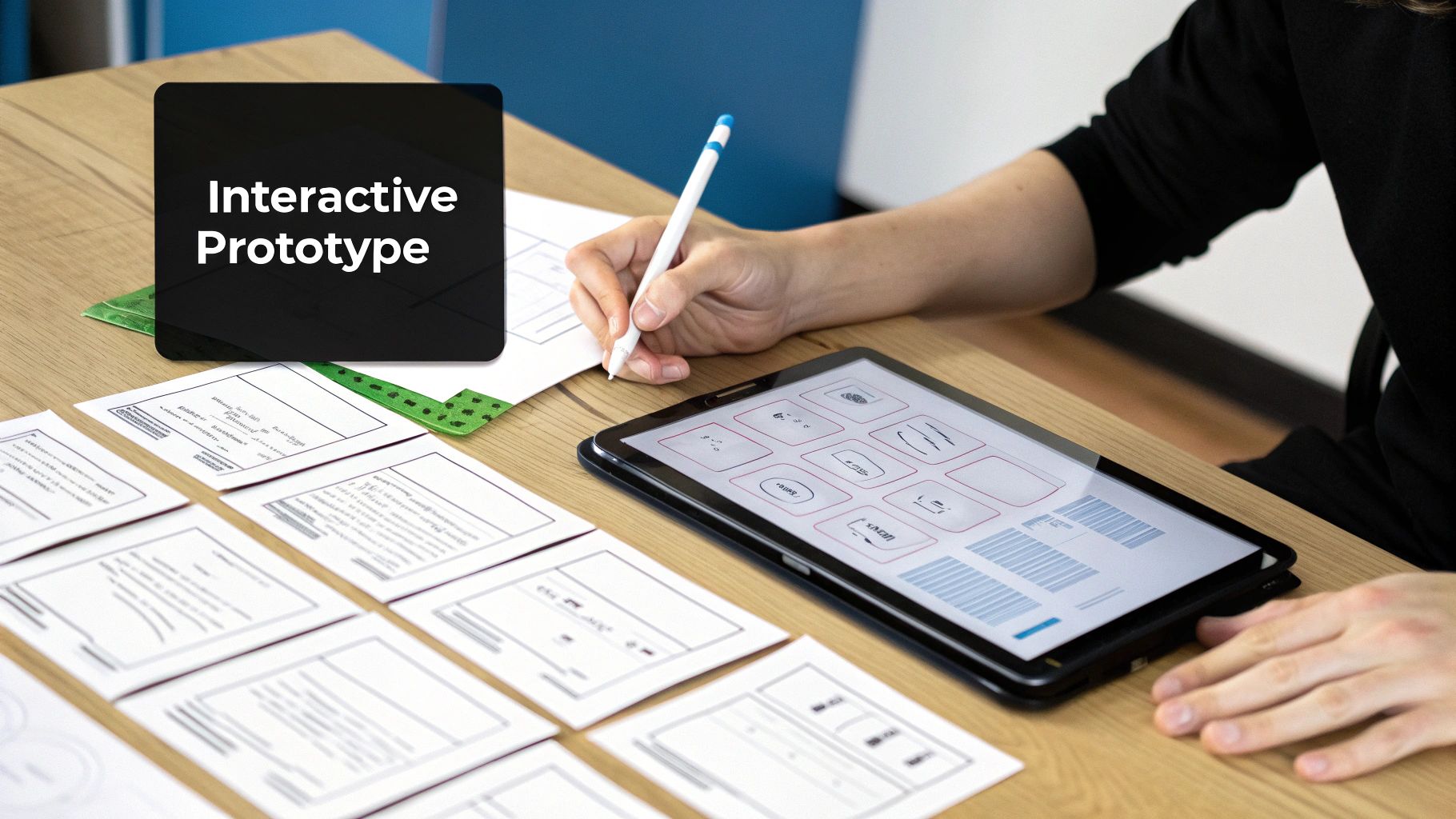
It's one thing to agree with user centered design principles, but how do you actually put them to work without bringing your project to a screeching halt? Here's the good news: UCD and fast-paced development models like Agile aren't enemies. When you learn to blend them correctly, they become powerful partners.
The trick isn't to add heavy, months-long research phases. It's about weaving quick, continuous user feedback into the natural rhythm of your sprints. Think of it as making user empathy a team habit, not a one-off task. This simple shift turns UCD from a lofty idea into a practical tool that adds real value, even when the pressure is on.
So, instead of a giant research project at the start, you're just collecting small, frequent insights. This keeps the user's voice in the room for every single sprint and decision.
Make User Insights Lightweight and Actionable
You don’t need a massive budget or a dedicated research department to get going. The real key is using efficient methods that give you just enough insight to take the next step confidently. We're aiming for "good enough" information that points you in the right direction right now.
- Guerilla Testing: Seriously, just grab your phone, pull up a simple prototype, and head to a coffee shop. Offer to buy someone a coffee in exchange for five minutes of their time. The feedback you'll get on a single feature can be incredibly revealing.
- Analyze Existing Feedback: Your customer support tickets, app store reviews, and social media comments are a goldmine. They are overflowing with real user pain points and feature wishes. Set aside a little time each week to sift through this data and build personas based on what people are actually saying.
- Low-Fidelity Prototyping: Sketch your ideas on paper or use a basic wireframing tool before a single line of code is written. Testing these rough concepts is fast, cheap, and stops you from sinking development hours into an idea that's fundamentally flawed.
By focusing on the user, you're not just improving a product; you're building a brand that people trust. This transforms one-time buyers into loyal fans who drive organic growth through positive word-of-mouth.
Build a Continuous Feedback Loop
True UCD integration means creating a system where user feedback is a constant, expected part of the process. You're essentially building a loop: design, test with users, learn from what they do, and then repeat in small, quick cycles.
Start small. Dedicate a tiny portion of each development sprint to a user-focused activity. Maybe one team member conducts two quick user interviews, or another tests a prototype of a single new feature. This regular cadence keeps the team grounded in reality and stops them from working off of outdated assumptions.
A simple checklist can keep everyone on the same page. Before kicking off work on any new feature, just ask:
- What specific user problem are we solving?
- What's our evidence that users actually want this?
- How are we going to test our solution with a real person?
- From the user's point of view, what does success look like?
Asking these questions consistently embeds user centered design principles into your team's daily work, turning it into an invaluable and, more importantly, an achievable asset.
Answering Common Questions About User-Centered Design
As teams start weaving user-centered design into their workflow, a few questions pop up time and time again. Getting straight answers to these is a game-changer, helping you sidestep common hurdles and put these principles to work, whether you're on a massive project or a tiny one.
Let's break down some of the most frequent queries. Clearing up the confusion here will give you the confidence to make this approach a real, living part of how you build things.
What's the Real Difference Between User-Centered and Human-Centered Design?
You'll often see these two terms thrown around as if they mean the same thing, but there's a subtle yet important difference. Think of Human-Centered Design (HCD) as the big-picture philosophy. It's about designing for people in the broadest sense, taking into account the whole range of human factors—from psychology and ergonomics to general accessibility.
User-Centered Design (UCD), on the other hand, is a focused subset of HCD. It zooms in on a specific user of a specific product. So, while HCD is the overarching idea to "design for humans," UCD is the hands-on process you use when building, say, a mobile banking app for first-time investors.
For all practical purposes, when you're building a product, you're almost always practicing user-centered design. You’re tackling problems for a particular group of people with their own unique goals and environments, and that’s the essence of UCD.
How Can I Actually Do UCD on a Shoestring Budget?
This is a big one. The good news is you don't need a massive research budget to be user-centered. In fact, some of the most powerful insights come from quick, scrappy, low-cost methods. The real goal is to connect with your users, not to conduct a formal, multi-million dollar academic study.
Here are a few budget-friendly tactics that work wonders:
- Guerilla Usability Testing: Head to a coffee shop and offer to buy someone a latte in exchange for five minutes of their time to get feedback on a prototype. It's fast, cheap, and surprisingly effective.
- Mine Your Support Tickets: Your customer support inbox is an absolute goldmine. It's packed with real user frustrations, feature ideas, and unfiltered feedback.
- Leverage Free Survey Tools: Use tools like Google Forms or Tally to send out simple surveys. You can quickly gather data on what users want and where they're getting stuck.
Honestly, even just a handful of informal chats can uncover game-changing insights that stop you from building the wrong product entirely.
How Does UCD Fit into an Agile Workflow?
UCD and Agile aren't just compatible; they're a perfect match. Think of them as two sides of the same coin. The user research you do in a "Sprint Zero" can directly shape your initial product backlog, making sure you're heading in the right direction from day one.
From there, UCD integrates beautifully into each sprint. For instance, a user story in your backlog can be accompanied by a simple, low-fidelity prototype. You can then test that prototype with a few users before a single line of code is written. This approach creates a powerful feedback loop, ensuring every feature you ship is validated by real people. It drastically cuts down on rework and keeps the entire project grounded in what users actually need.