Where Code Meets Canvas
Discover how coding and art intersect to create innovative digital art forms. This list explores seven key areas where code fuels artistic expression, from generative art to AI-generated masterpieces. Learn about creative coding, data visualization art, interactive installations, algorithmic design, live coding performances, and the exciting potential of AI art. Explore these dynamic fields and see how you can blend technology with your artistic vision.
1. Generative Art
Generative art represents a fascinating intersection of coding and art, where the artist relinquishes some degree of control to the algorithm. Instead of directly crafting the artwork, the artist designs a system—a set of rules, parameters, and constraints encoded in software—that produces the artwork autonomously or semi-autonomously. This approach harnesses the power of computation to explore aesthetic possibilities beyond the limits of human dexterity and imagination. This unique blend of mathematical concepts, randomness, and artistic vision makes generative art a compelling entry in our exploration of coding and art.
The core of generative art lies in its algorithm-driven creation process. This involves defining a set of instructions that the computer follows to generate visual outputs. These instructions can incorporate randomness and emergence, allowing for unpredictable and surprising results. The artist manipulates the parameters of the system—variables that control aspects of the artwork like color, shape, and complexity—to guide the generative process. This parameter-based control allows artists to fine-tune the system's output and explore a vast range of variations within the defined rules. One of the striking features of generative art is its ability to create complex patterns and forms with remarkable efficiency. Think of the intricate fractals generated by simple mathematical formulas or the mesmerizing tessellations produced by algorithmic manipulation of geometric shapes. This power to generate complexity from simple rules is a hallmark of generative art.
The advantages of this approach are numerous. It allows for the scalable production of unique variations, essentially providing an endless source of artistic inspiration. This can be particularly useful for creating large-scale installations, dynamic digital content, or even personalized artwork. Furthermore, the reproducible yet unique nature of generative art ensures that each output, while stemming from the same code, possesses its own distinct characteristics. This aspect opens up intriguing possibilities for digital ownership and provenance, as seen in the rise of generative art NFTs.
However, generative art also presents certain challenges. It requires technical programming knowledge, which can be a barrier to entry for artists without a coding background. The indirect nature of the creative process also means that the artist has less direct control over the final output compared to traditional art forms. This can sometimes lead to a feeling of detachment or a perception that the artwork is impersonal or mechanistic, lacking the emotional depth often associated with hand-crafted pieces.
Successful implementations of generative art abound in the contemporary art scene. Casey Reas' generative installations, for example, showcase the power of code to create dynamic and evolving visual experiences. Mario Klingemann's AI-generated portraits explore the intersection of artificial intelligence and artistic expression, blurring the lines between human and machine creativity. Tyler Hobbs’ Fidenza NFT collection demonstrates the commercial viability of generative art, while Zach Lieberman's interactive installations invite viewers to participate in the generative process, adding another layer of engagement.
For those interested in exploring generative art, several tips can help you get started. Begin with simple algorithms and gradually add complexity as you become more comfortable with the process. Study natural patterns and mathematical sequences for inspiration. Experiment with different random seed values to discover unexpected variations within your system. Importantly, strive for a balance between randomness and intentional design constraints. This will allow you to guide the generative process while still leaving room for emergent beauty. Finally, meticulously document your parameter settings to ensure reproducible results and to track your artistic evolution.
The following infographic visualizes the key concepts driving generative art: Algorithm-driven Creation, Randomness & Emergence, and Parameter-based Control, and how they are interlinked.
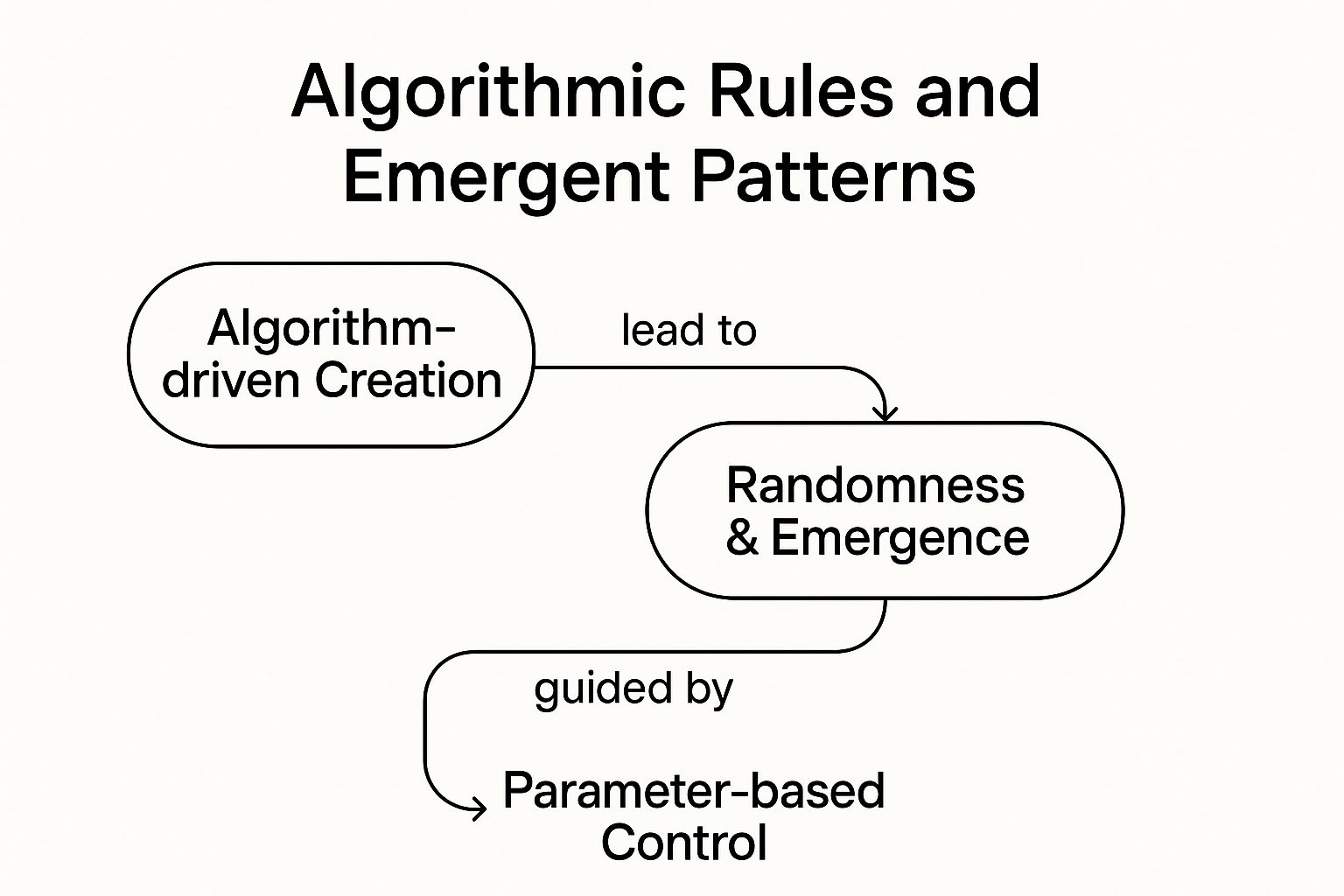
The infographic illustrates how the artist uses 'Parameter-based Control' to influence the 'Algorithm-driven Creation' process, which in turn leads to 'Randomness & Emergence' in the final artwork. The central focus on 'Algorithm-driven Creation' reinforces the core principle of generative art. This interplay of controlled parameters and emergent randomness highlights the unique dynamic between artist and algorithm in the creation of generative art. This method stands as a testament to the powerful synergy between coding and art, paving the way for new forms of artistic expression and pushing the boundaries of creativity in the digital age. Pioneered by artists like Casey Reas, Ben Fry, Mario Klingemann, Tyler Hobbs, and Helena Sarin, generative art continues to evolve and inspire, offering a compelling blend of technical skill and artistic vision.
2. Creative Coding
Creative coding represents a fascinating intersection of art and technology, where the lines between programmer and artist blur. It’s the practice of using code not just for functional purposes, but as a medium for artistic expression. Instead of building software applications or websites, creative coders write programs to generate visual art, interactive experiences, animations, multimedia installations, and even music. This approach leverages the logic and structure of programming languages to explore aesthetic possibilities, creating works that can be both beautiful and thought-provoking. Creative coding treats code as both the tool and the medium, empowering artists with unprecedented control over their digital creations.
This approach to art making offers a unique blend of technical skills and artistic vision. It involves understanding programming concepts such as variables, loops, and functions, and applying them in visually interesting and innovative ways. For instance, a simple loop can be used to generate a complex pattern, or a variable can control the color and intensity of a light source in a virtual environment. The real-time manipulation and experimentation afforded by coding environments further enhances the creative process, allowing artists to tweak parameters and immediately see the results. This dynamic feedback loop fosters exploration and discovery, pushing the boundaries of what's possible with code. It's a truly cross-disciplinary approach, combining elements of computer science, visual arts, design, and often music and other disciplines.
Creative coding’s inherent digital nature allows for easy sharing and distribution of works, fostering a strong sense of community. Platforms like OpenProcessing showcase a wide range of projects and provide a space for artists to connect, learn, and collaborate. This community-driven aspect is crucial for beginners, offering support and inspiration. Learn more about Creative Coding and find examples of how others are using code to create stunning visuals and interactive experiences.
The possibilities within creative coding are virtually limitless. Imagine generating intricate fractal patterns that evolve over time, designing interactive installations that respond to the viewer's movements, or creating generative music visualizations that pulse with rhythm and light. Examples of creative coding in action include Processing sketches and installations, interactive museum exhibits utilizing sensors, live coding performances with Sonic Pi, web-based art projects with p5.js, and projection mapping installations that transform physical spaces.
While the potential of creative coding is immense, it's important to be aware of the challenges. The initial learning curve can be steep for those without prior programming experience. Overcoming this requires patience and dedication. Technical limitations of specific software or hardware can sometimes constrain artistic vision, requiring creative problem-solving. Furthermore, the field is constantly evolving, meaning continuous learning is essential to stay up-to-date with new technologies and techniques. Finally, the screen-based nature of much of creative coding can sometimes lack the tactile qualities of traditional art forms, although this is increasingly being addressed through interactive installations and physical computing.
Despite these challenges, the benefits of creative coding are undeniable. It empowers artists with a powerful new toolkit for expression, offering unlimited creative possibilities through programming. The ability to create interactive and responsive art opens up entirely new avenues for audience engagement. Compared to traditional art supplies, the cost of entry is relatively low, requiring only a computer and access to free software tools. The ease of sharing and distributing digital works online facilitates wider reach and exposure. And finally, the strong online communities provide invaluable support and inspiration for both beginners and experienced coders.
So, when should you consider using creative coding? If you’re an artist looking to explore new forms of digital expression, a developer interested in applying your skills to creative projects, or simply someone curious about the intersection of art and technology, then creative coding could be the perfect avenue for you. Whether you’re interested in generating mesmerizing visuals, building interactive installations, or composing algorithmic music, creative coding offers a unique and powerful way to bring your artistic vision to life. Don’t be afraid to experiment, embrace the learning process, and most importantly, prioritize your creative expression over achieving technically perfect code. Start with beginner-friendly environments like Processing or p5.js, join online communities, and practice regularly with small, experimental sketches. Study existing creative coding projects for inspiration, and remember that the journey of discovery is just as important as the final product.
3. Data Visualization Art
Data visualization art represents a compelling intersection of coding and art, transforming raw data into visually stunning and insightful narratives. It transcends the limitations of traditional charts and graphs, employing artistic principles to craft interactive experiences, installations, and abstract compositions that reveal hidden patterns, relationships, and stories embedded within datasets. This practice isn't just about making data pretty; it's about making it understandable, engaging, and ultimately, meaningful. It allows us to grasp complex information in a way that words and numbers alone often cannot achieve. This unique blend of analytical thinking and creative expression makes data visualization art a powerful tool for communication, exploration, and even social impact.
The process involves more than simply plotting data points. It requires a deep understanding of the data itself, alongside a keen eye for aesthetics. Artists working in this space skillfully employ coding languages like Processing, Python (with libraries like matplotlib and seaborn), and JavaScript (with libraries like D3.js) to manipulate and visualize data. They carefully consider color palettes, typography, visual hierarchies, and interactive elements to create engaging and informative pieces. The transformation of abstract data into visual forms emphasizes aesthetic beauty alongside informational clarity, often incorporating interactive exploration capabilities that empower viewers to delve deeper into the data themselves.
Data visualization art finds its power in its ability to tell stories through visual narratives. Multi-dimensional data representation allows artists to showcase complex relationships and patterns that might be missed in traditional data analysis. For example, Stefanie Posavec’s literary data visualizations translate the structure and style of novels into beautiful abstract forms, revealing hidden connections within the text. Giorgia Lupi's Dear Data project, a year-long correspondence with Stefanie Posavec, documented everyday life through hand-drawn data visualizations, demonstrating the power of personal data storytelling. Aaron Koblin’s Flight Patterns visualization, using data from air traffic control, transforms the invisible paths of airplanes into mesmerizing light trails, highlighting the interconnectedness of our globalized world. Nadieh Bremer pushes the boundaries of data art with her intricate and stunning visualizations of astronomical data, transforming complex scientific information into captivating visual experiences. Even publications like The New York Times leverage data visualization art with their interactive election maps, making complex political data accessible and engaging for a wider audience.
This powerful approach to coding and art offers several advantages. It makes complex data accessible and engaging, transforming potentially dry information into compelling visual narratives. It reveals hidden patterns and insights that might otherwise go unnoticed, offering new perspectives on familiar datasets. The process combines analytical thinking with creative expression, fostering a unique synergy between left and right brain functionalities. In our increasingly data-driven society, data visualization art holds immense relevance, providing a crucial bridge between raw information and human understanding. It can even influence public understanding of important issues, from climate change to social inequalities, by presenting data in a compelling and emotionally resonant manner.
However, there are potential downsides. The risk of misrepresenting data for aesthetic purposes is a significant concern. The pursuit of visual appeal should never compromise the accuracy or integrity of the underlying data. Creating effective data visualization art requires a strong understanding of both data analysis and design principles, a skillset that takes time and dedication to cultivate. Overly complex or poorly designed visualizations can overwhelm viewers, hindering rather than enhancing understanding. Finally, there’s a temptation to prioritize beauty over accuracy, which can lead to misleading or even manipulative representations of data.
For aspiring data visualization artists, several tips can help navigate these challenges. Thoroughly understanding the data before embarking on the visualization process is paramount. Choosing visualization methods that best serve the data's inherent story is crucial. Color and form should be used purposefully to enhance understanding, not merely for decorative effect. Testing interactivity with actual users ensures a smooth and engaging experience. Above all, maintaining data accuracy while pursuing aesthetic goals is essential for ethical and effective data visualization. By following these guidelines, artists can harness the power of coding and art to create impactful and insightful data-driven narratives.
4. Interactive Media Art
Interactive media art represents a dynamic intersection of coding and art, pushing the boundaries of creative expression by blurring the lines between artist, artwork, and audience. Unlike traditional static art forms, interactive media art responds to and changes based on user input, environmental conditions, or real-time data. This responsiveness is achieved through the integration of sensors, programming, and artistic vision, creating immersive experiences where the audience becomes an active participant rather than a passive observer. The artwork evolves and transforms based on interaction, making each experience unique and deeply personal. This active participation transforms the viewer from an observer to a co-creator, fostering a deeper engagement with the artwork and its message.
At the heart of interactive media art lies the principle of real-time responsiveness. Through coding, artists can create systems that react dynamically to various inputs. These inputs can range from simple button presses and touch interactions to complex sensor data capturing movement, sound, or even biofeedback like heart rate. This dynamic feedback loop allows the artwork to adapt and evolve in response to the audience's actions, making each encounter unpredictable and engaging. Sensor integration and environmental awareness further enhance the immersive nature of these experiences, allowing the artwork to react to changes in light, temperature, or even the presence of people in the surrounding space.
Successful implementations of interactive media art can be seen in the works of artists like Rafael Lozano-Hemmer, known for his pulse-responsive installations that visualize the heartbeat of participants. TeamLab's immersive digital art spaces create fantastical environments that react to visitors' movements, while David Rokeby's "Very Nervous System" uses computer vision to translate body movements into sound and visuals. Camille Utterback's interactive projections transform walls into responsive canvases, and Random International's "Rain Room" allows visitors to walk through a downpour without getting wet, demonstrating the playful possibilities of blending the physical and digital. These examples showcase the diverse range of experiences achievable through interactive media art, from introspective and personal interactions to large-scale, shared immersive environments.
Interactive media art’s strength lies in its ability to create engaging and memorable experiences. It encourages active audience participation, fostering a sense of connection and ownership with the artwork. This approach to art can adapt to different users and contexts, making it relevant for a wide range of audiences. Furthermore, it bridges the physical and digital realms, offering unique storytelling possibilities that transcend traditional media. Learn more about Interactive Media Art and explore the tools used to create these experiences.
However, this medium is not without its challenges. The technical complexity of interactive installations can lead to failures, requiring careful planning and robust backup systems. A solid understanding of both hardware and software is essential for creating and maintaining these works. Installation and maintenance can be challenging, often requiring specific environmental considerations and calibration for different spaces.
For those interested in exploring interactive media art, meticulous planning is key. Plan for technical failures with backup systems and test extensively in the actual installation environment to anticipate potential issues. Design intuitive interactions that don't require lengthy explanations, ensuring a seamless and enjoyable experience for all users. Consider the physical space and audience flow to optimize engagement and immersion. Finally, focus on creating meaningful connections between input and output, ensuring that the audience's actions have a clear and impactful effect on the artwork. By addressing these considerations, artists can harness the power of interactive media art to create compelling and transformative experiences. This approach is particularly valuable for creating engaging public installations, interactive museum exhibits, personalized marketing campaigns, and educational tools, adding a layer of active engagement that captures the attention of today’s digitally savvy audiences. Interactive media art stands as a testament to the powerful synergy between coding and art, offering a glimpse into the future of creative expression.
5. Algorithmic Design: Weaving Code and Art
Algorithmic design represents a fascinating intersection of coding and art, where mathematical precision meets creative expression. It’s a design approach that leverages algorithms, formulas, and rule-based systems to generate form, pattern, and structure. Instead of manually crafting each element, designers create parametric systems—sets of interconnected parameters—that can produce a wide range of variations and iterations automatically. This powerful technique is transforming fields like architecture, product design, graphic design, and even fashion, offering new possibilities for artistic exploration and optimized design solutions. This approach firmly cements its place on any list exploring the fascinating interplay of coding and art.
At its core, algorithmic design involves defining a set of rules and parameters that govern the creation of a design. These parameters can control anything from the dimensions and proportions of an object to the color, texture, and density of its surface. By manipulating these parameters, designers can explore a vast design space, generating numerous variations with minimal manual effort. This allows for rapid prototyping and experimentation, pushing the boundaries of traditional design processes.
The power of algorithmic design lies in its ability to generate complex and intricate designs that would be difficult or impossible to create by hand. For example, Zaha Hadid’s fluid and dynamic architecture, often described as “parametric architecture,” showcases the potential of this approach. Her designs, such as the Heydar Aliyev Center in Baku, Azerbaijan, utilize complex algorithms to generate sweeping curves and organic forms, blurring the lines between building and sculpture. Similarly, Greg Lynn, a pioneer of "blob architecture," employs algorithms to create smoothly undulating surfaces and biomorphic shapes.
Beyond architecture, algorithmic design finds applications in various other fields. Nike uses algorithms to design optimized shoe patterns, improving performance and minimizing material waste. The Sagrada Familia, Antoni Gaudí's iconic basilica in Barcelona, features facades adorned with intricate geometric patterns generated through mathematical principles, showcasing the historical precedent for algorithmic thinking in design. Even at a smaller scale, Nervous System, a design studio, uses algorithms to create unique, 3D-printed jewelry inspired by natural forms, demonstrating the versatility of this approach for bespoke creations. (Visit their website for examples: Nervous System)
For aspiring "vibe coders" and digital artists eager to explore this intersection of coding and art, algorithmic design offers exciting possibilities. However, navigating the complexities of parametric systems requires a blend of artistic vision and technical skill. Here are some essential tips for incorporating algorithmic design into your creative workflow:
- Start Simple, Build Complexity: Begin with a small set of parameters and gradually introduce more complexity as you gain experience. This iterative approach allows for greater control and understanding of the system.
- Maintain Creative Control: Remember, the algorithm is a tool. You, the artist, should always maintain creative control over the design process. Use the algorithm to explore possibilities, not dictate the final outcome. Avoid becoming overly reliant on the algorithm to make aesthetic decisions.
- Iterative Exploration is Key: The beauty of algorithmic design lies in its ability to generate a wide range of variations. Embrace this iterative process, exploring different parameter combinations to discover unexpected and innovative design solutions.
- Document Your Process: Keep meticulous records of your parameter relationships and algorithms. This documentation will be invaluable for future modifications, collaborations, and understanding the evolution of your designs.
- Balance Optimization and Aesthetics: Algorithmic design can optimize for specific criteria like structural integrity or material efficiency. However, always balance these functional goals with aesthetic considerations. Over-optimization can lead to sterile or impractical designs that lack artistic merit.
While algorithmic design offers numerous benefits, it’s important to acknowledge its limitations. It can sometimes produce results that feel sterile or formulaic if not carefully balanced with human intuition. It often requires a degree of mathematical and programming knowledge, which can be a barrier to entry for some artists. Furthermore, over-reliance on algorithms can risk sacrificing the emotional resonance and nuanced expression that often characterize handcrafted art.
Ultimately, algorithmic design represents a powerful new tool in the artist’s arsenal. By understanding its capabilities and limitations, and by embracing a thoughtful and balanced approach, artists and coders can harness the power of algorithms to create stunningly intricate and innovative works that blur the lines between code and art, pushing the boundaries of creative expression in the digital age. This method deserves its place on this list because it exemplifies the exciting potential for innovation at the intersection of art and technology.
6. Live Coding: Programming as Performance Art
Live coding pushes the boundaries of both coding and art, transforming the act of writing software into a real-time performance. This dynamic approach blurs the lines between creation and presentation, offering a unique fusion of technology and artistic expression. For those seeking innovative ways to blend coding and art, live coding presents a compelling avenue for exploration, offering a direct and engaging way to connect with audiences while showcasing technical prowess. This approach rightfully earns its place among the most exciting intersections of coding and art because of its immediacy, transparency, and collaborative potential.
At its core, live coding involves writing and modifying code on-the-fly to generate visuals, music, or other artistic outputs. Unlike traditional coding where the process remains hidden, live coding brings the creative process to the forefront. The audience often witnesses the code being written, providing a transparent view into the artist's decision-making and technical skills. This transparency demystifies programming for the general public, making it accessible and engaging.
The real-time nature of live coding encourages improvisation and experimentation. Artists respond to the evolving output, tweaking parameters and adding new code segments to create dynamic and unpredictable results. This element of surprise and risk-taking is a core part of the live coding experience, both for the performer and the audience. The integration of coding skills with performance art adds another layer of complexity, requiring performers to be both technically proficient and comfortable engaging with a live audience.
Live coding has found fertile ground in various artistic communities. Alex McLean's Algorave performances, known for their rhythmic and algorithmic music generation, are prime examples of this approach. Similarly, Andrew Sorensen's Extempore concerts showcase the potential of live coding for creating complex musical compositions in real-time. The TOPLAP community, a global network of live coders, actively fosters collaboration and innovation within this field, organizing events and providing resources for practitioners. Further examples include Fluxus live coding performances, which often incorporate elements of chance and interactivity, and Gibber collaborative coding sessions, which demonstrate the power of collective creation in a live setting. These examples, spanning music, visuals, and performance art, highlight the versatility and reach of live coding as a creative medium.
When and Why to Use Live Coding:
Live coding offers a powerful way to explore the creative potential of code in a dynamic and interactive setting. Consider this approach if you are interested in:
- Creating generative art: Live coding enables the creation of evolving and unpredictable artworks based on algorithms and real-time input.
- Developing interactive installations: The responsive nature of live coding makes it ideal for designing installations that react to audience participation.
- Composing algorithmic music: Live coding provides a platform for creating music based on mathematical patterns and code-driven processes.
- Exploring performance art with a technological twist: Live coding offers a unique way to integrate programming skills into performance, creating a captivating spectacle of both technical and artistic skill.
Tips for Successful Live Coding:
While live coding offers immense creative potential, it also presents unique challenges. To navigate the complexities of this art form:
- Practice Extensively: Rehearse your code and performance flow to minimize the risk of errors during a live setting. Familiarity with your tools and codebase is crucial for a smooth performance.
- Prepare Code Templates and Building Blocks: Having pre-written code snippets and functions can significantly speed up the creative process during a performance. This allows you to focus on the artistic aspects rather than getting bogged down in basic syntax.
- Learn to Recover Gracefully from Errors: Mistakes are inevitable in live coding. Develop strategies for handling errors smoothly and incorporating them into the performance, turning potential setbacks into opportunities for improvisation.
- Engage with the Live Coding Community: Connect with other live coders for support, inspiration, and collaboration. The TOPLAP community is an excellent resource for connecting with like-minded individuals and learning from experienced practitioners. (Unfortunately, a specific website link for TOPLAP isn't readily available at this time, but a quick web search will reveal numerous resources.)
- Balance Complexity with Reliability: While complex algorithms can generate fascinating results, prioritize reliability during a live performance. Start with simpler code and gradually increase complexity as you gain experience.
Pros and Cons of Live Coding:
Pros:
- Unique fusion of technology and performance art
- Encourages experimentation and risk-taking
- Demystifies programming for general audiences
- Enables complex audiovisual synchronization
- Builds strong collaborative communities
Cons:
- High risk of technical failures during performance
- Requires advanced programming skills under pressure
- Limited to audiences who appreciate technical artistry
- Steep learning curve for both coding and performance skills
Live coding, with its inherent blend of coding and art, provides a powerful platform for creative expression in the digital age. By embracing its unique challenges and opportunities, artists and programmers can push the boundaries of both disciplines and engage audiences in new and exciting ways.
7. AI-Generated Art
AI-generated art represents a fascinating intersection of coding and art, pushing the boundaries of creative expression and challenging traditional notions of artistic creation. It leverages the power of artificial intelligence, specifically machine learning models, to produce novel visual content, opening up a world of possibilities for artists, designers, and anyone interested in exploring the creative potential of code. This burgeoning field is rapidly evolving, transforming how we create, experience, and even define art in the digital age.
At its core, AI-generated art involves training algorithms on vast datasets of existing artworks. These algorithms, often based on Generative Adversarial Networks (GANs), neural style transfer, or large language models, learn the underlying patterns, styles, and features within the data. GANs, for example, consist of two competing networks: a generator that creates new images and a discriminator that tries to distinguish between real and generated images. This adversarial process pushes the generator to produce increasingly realistic and sophisticated artwork. Neural style transfer, on the other hand, allows artists to apply the stylistic elements of one image to another, creating unique blends and interpretations. Large Language Models (LLMs), while traditionally used for text generation, can now interpret text prompts into visual representations, further expanding the possibilities of AI-generated art.
The impact of AI-generated art is evident in numerous examples. Mario Klingemann, a pioneer in the field, uses GANs to create mesmerizing portraits that blur the line between human and machine creativity. Robbie Barrat’s work explores the intersection of AI and fashion, generating unconventional and thought-provoking designs. The sale of "Portrait of Edmond de Belamy," an AI-generated artwork, at Christie's auction house marked a significant moment, highlighting the growing recognition and value of this new art form. Other noteworthy examples include the dreamlike, psychedelic imagery produced by Google’s DeepDream algorithm and the highly detailed, imaginative artworks generated by platforms like DALL-E and Midjourney. These examples demonstrate the diverse applications of AI in art, from creating realistic portraits to generating abstract compositions and even designing fashion.
Learn more about AI-Generated Art
The benefits of using AI in art are multifaceted. It allows artists to explore new creative avenues, blending multiple artistic styles and producing unexpected, surprising results. It democratizes art creation by enabling individuals without traditional technical skills to generate digital art. Furthermore, AI-generated art can be scaled for various applications, from producing unique personalized artwork to creating large-scale installations. It also sparks important discussions about creativity, authorship, and the very nature of art itself.
However, the field also presents significant challenges. Copyright and ethical concerns surrounding the use of training data are paramount. Questions of ownership and authenticity arise when AI is involved in the creative process. There's also the risk of perpetuating biases present in the training data, leading to skewed or unfair representations. Furthermore, some argue that AI-generated art, despite its technical complexity, may lack the intentionality and emotional depth of human-created art. The potential for devaluing human artistic labor is another concern that needs careful consideration.
For those interested in exploring AI-generated art, here are some practical tips:
- Understand the ethical and legal implications of your training data: Ensure you have the right to use the data and consider the potential biases it might contain.
- Experiment with different model architectures and parameters: Explore various GANs, neural style transfer methods, and LLMs to find the best approach for your project.
- Combine AI generation with human curation and refinement: Use AI as a tool to enhance your creative process, adding your own personal touch and artistic vision.
- Document your process for transparency: Be open about how you use AI in your artwork to foster understanding and address concerns about authorship.
- Engage critically with questions of authorship and creativity: Participate in the ongoing dialogue about the role of AI in art and its impact on human creativity.
AI-generated art deserves its place in the realm of "coding and art" because it exemplifies the innovative potential that emerges when technology and creativity converge. It’s not just about creating visually appealing images; it's about exploring new ways of thinking about art, pushing creative boundaries, and prompting crucial conversations about the future of artistic expression in a world increasingly shaped by artificial intelligence. This field offers exciting opportunities for aspiring vibe coders, experienced software developers, digital artists, creative technologists, educators, students, and anyone seeking to explore the dynamic interplay between code and creativity.
7-Concept Comparison: Coding & Art
| Concept | 🔄 Implementation Complexity | 💡 Resource Requirements | ⭐ Expected Outcomes | 📊 Ideal Use Cases | ⚡ Key Advantages |
|---|---|---|---|---|---|
| Generative Art | Moderate to high – requires programming skills and algorithm design | Moderate – coding environments, math knowledge | Unique, scalable, emergent artwork | Experimental visual art, pattern generation | Infinite variations; explores beyond human imagination |
| Creative Coding | Moderate – coding skills needed with focus on creative expression | Low to moderate – accessible tools and communities | Interactive, experimental multimedia outputs | Visual art, interactive installations | Unlimited creative possibilities; strong community support |
| Data Visualization Art | Moderate – requires data analysis and design expertise | Moderate – data processing and visualization tools | Clear, engaging data-driven art | Storytelling, public info, complex data | Reveals insights; combines analytics with aesthetics |
| Interactive Media Art | High – integrates hardware, sensors, and software | High – sensors, microcontrollers, maintenance | Immersive, evolving, user-responsive experiences | Immersive exhibitions, audience participation | Engaging and personalized; bridges physical and digital |
| Algorithmic Design | High – demands programming and mathematical knowledge | Moderate to high – parametric modeling software | Optimized, consistent design variations | Architecture, product design, fashion | Rapid design exploration; data-driven optimizations |
| Live Coding | High – advanced programming and performance skills | Moderate – live coding platforms and setups | Real-time audiovisual performances | Live music/visuals, experimental art | Immediate creative expression; interactive audience engagement |
| AI-Generated Art | High – requires understanding of ML models and training | High – computational resources, AI frameworks | Novel, machine-enhanced art | Digital art creation, style blending | Surprising outputs; accessible to non-programmers |
The Future is Coded
The fusion of coding and art is transforming the creative landscape, offering new avenues for expression and innovation. From generative art and creative coding to the exciting possibilities of AI-generated art, the convergence of these two disciplines is redefining how we create and experience art. This article has explored seven key areas where coding and art intersect, revealing the power of algorithms, data, and interactivity to generate captivating visuals, immersive experiences, and thought-provoking designs. Mastering these concepts, whether it's understanding the nuances of algorithmic design or harnessing the potential of live coding, empowers artists and coders alike to push the boundaries of creativity.
The key takeaway is that the synergy between coding and art is not just a trend; it's a fundamental shift in how we approach creative endeavors. By understanding the principles of generative art and creative coding, we can unlock new forms of visual storytelling and artistic exploration. Data visualization art transforms raw information into compelling narratives, while interactive media art creates immersive experiences that blur the lines between the physical and digital worlds. Algorithmic design brings precision and complexity to creative projects, while live coding offers a dynamic and improvisational approach to creating art in real-time. Finally, the emergence of AI-generated art is opening up entirely new possibilities, sparking discussions about the nature of creativity itself.
So, what's next? Dive deeper into the area of coding and art that resonates most with you. Experiment, explore, and connect with the vibrant communities shaping this evolving field. Platforms like Vibecoding VIP, curated by experts like @slhomme, offer a valuable compass for navigating this exciting frontier, connecting artists and coders with the tools, inspiration, and community they need to create and explore. Whether you're a seasoned developer looking to infuse your work with artistic flair, or an artist eager to harness the power of code, the world of coding and art awaits your unique contribution. The future is coded, and it's brimming with creative potential.