Why Every Artist Should Embrace Code in 2024
The intersection of art and technology has created exciting new avenues for creative expression. Coding, a skill once primarily associated with engineers, is becoming an increasingly valuable tool for artists. It offers ways to push creative boundaries and explore new artistic territories. Rather than replacing traditional art mediums, coding enhances and expands the artist's toolkit.
Expanding Artistic Possibilities
Coding empowers artists to create works that would be impossible using traditional methods alone. Imagine generating complex, evolving patterns, designing interactive installations that respond to viewer movement, or building immersive virtual worlds. These are just a few examples of how coding unlocks artistic potential. An artist might use code to create a generative art piece that changes based on real-time data, like stock market fluctuations or weather patterns.
The field of creative coding provides artists with specialized platforms and languages designed specifically for visual expression. Tools like Processing and p5.js offer intuitive ways to translate artistic visions into code, bridging the gap between concept and creation. These tools allow artists to focus on the artistic elements, without getting lost in complex technical details.
New Avenues for Growth and Reach
Coding offers more than just artistic exploration; it provides tangible career benefits. In 2025, an estimated 29% of digital artists incorporated AI tools, including code-based algorithms, into their workflows. This highlights a growing trend toward digital and computational creativity. Find more detailed statistics here. This growing demand increases opportunities for artists with coding skills.
Coding also opens doors to new revenue streams. Artists can sell generative art prints, create interactive digital experiences for clients, or design custom software for artistic applications. This expands the market for artistic work beyond traditional galleries and exhibitions, allowing artists to reach a global audience and gain recognition for their unique skills.
Addressing Concerns About Authenticity
Some artists express concern that using code compromises the authenticity of their work. However, coding is simply another tool, much like a paintbrush or a chisel. The artistic vision originates from the artist; code simply provides a new medium for expression. The core elements of artistic intent and creative process remain essential.
Many artists find that coding actually enhances their creative process. The ability to experiment, iterate, and generate unexpected results can spark new ideas and lead to innovative artistic discoveries. Embracing technology's possibilities can further expand artistic expression.
Getting Started with Coding for Artists
Artists interested in exploring code can find valuable resources online. Platforms like Vibecoding VIP (https://vibecoding.vip) offer curated collections of tools, examples, and educational materials. These platforms provide guidance and support for artists beginning their coding journey. It’s an exciting time to be an artist, with coding playing an increasingly important role in the creative landscape.
Coding Fundamentals That Actually Make Sense to Artists
Forget dry tutorials. This section translates programming concepts into a language that resonates with visual and creative thinkers. We will explore how coding principles mirror artistic processes, revealing the surprising similarities between the two. We'll also discuss the mental shifts that can help artists grasp programming more intuitively.
Variables, Functions, and the Artistic Process
Coding, at its core, involves manipulating variables and functions. Think of variables as your color palette. Just as you mix colors to create new hues, variables store information that can be changed and combined. A variable might represent the redness of a digital brushstroke or the position of an element on a canvas. You can adjust these "colors" within your code.
Functions, on the other hand, are like repeatable techniques in your artistic repertoire. Perhaps you have a signature brushstroke or a preferred method of layering colors. A function encapsulates a set of instructions that can be executed multiple times with different inputs, much like applying your signature technique to different parts of a painting.
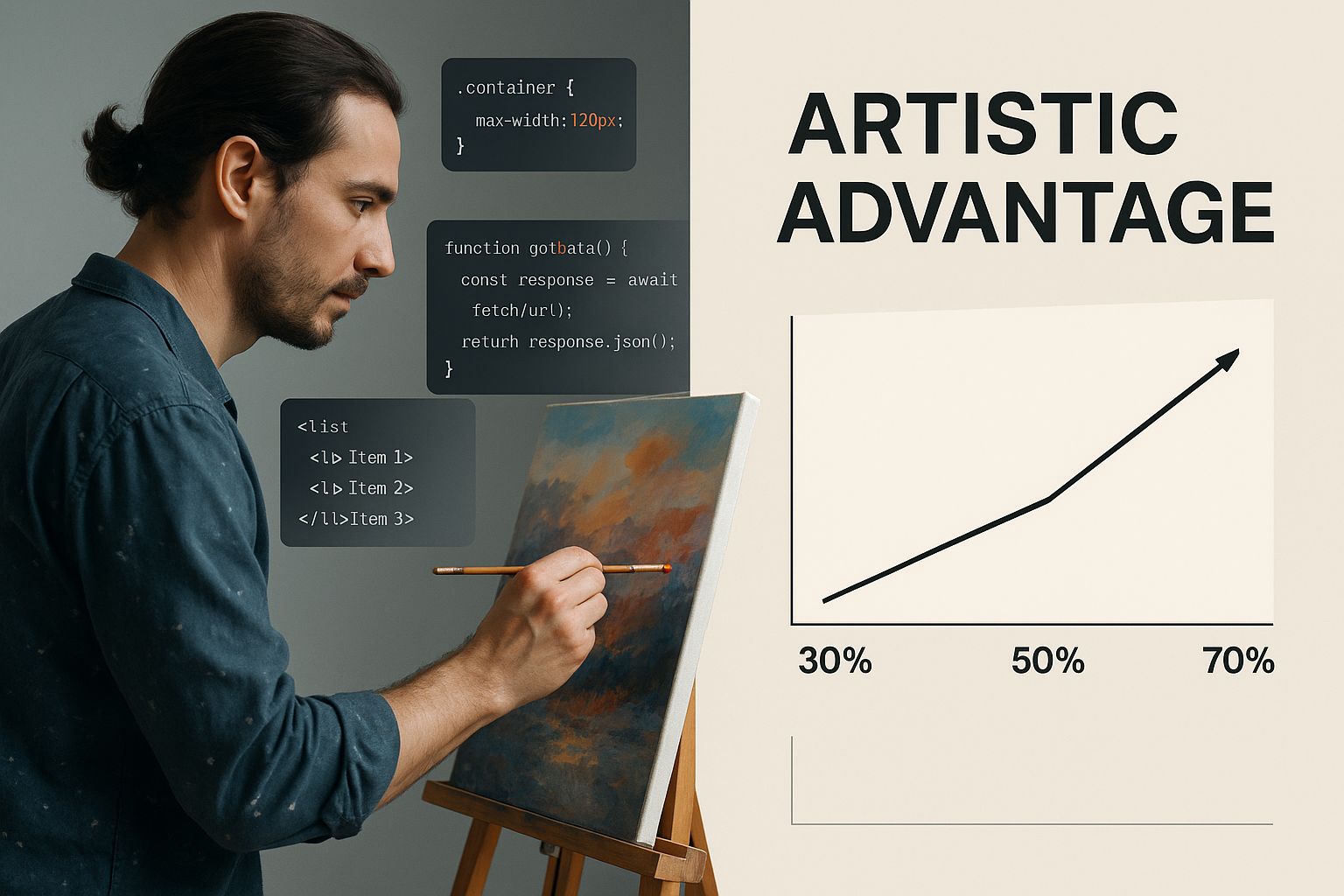
This infographic visualizes the relationship between coding and art. It showcases how an artist can use code to create something new and dynamic. The infographic depicts an artist surrounded by code snippets, illustrating the integration of programming into the creative process. This merging of traditional artistic techniques with digital elements showcases the potential for exciting new forms of expression. Check out our guide on exploring example projects in different coding languages.
Overcoming Coding Roadblocks for Artists
Many artists initially struggle with the logical, structured nature of coding. The shift from free-flowing creativity to the precise syntax of programming can feel jarring. However, artists possess unique strengths that can be advantageous in coding. Their visual thinking abilities allow them to conceptualize complex systems more readily. Their comfort with experimentation and iteration translates well to the debugging process. This means the very qualities that make someone a good artist can also make them a successful coder.
Learning Pathways for Visually Rewarding Results
The key to engaging artists with coding is to provide learning pathways that produce visually rewarding results early on. By focusing on projects that generate interesting visuals, artists can stay motivated while building their technical skills. This positive feedback loop reinforces learning and keeps the creative spirit alive.
For example, a beginner project might involve creating generative patterns or manipulating images with code. Additionally, a focus on creative coding tools, such as Processing, can help ease the transition into programming.
To help illustrate the various languages artists might consider, let's look at the following table:
Best Programming Languages for Artists by Application: A comparison of programming languages based on their suitability for different artistic applications.
| Language | Best For | Learning Curve | Visual Output | Community Support |
|---|---|---|---|---|
| Processing | Beginners, Visualizations, Generative Art | Easy | Excellent, built-in rendering | Large, active community |
| p5.js | Web-based projects, Interactive art | Easy | Excellent, utilizes JavaScript canvas | Growing community, good documentation |
| OpenFrameworks | Advanced visualizations, Installations, Interactive applications | Moderate | Excellent, hardware integration | Strong community, geared towards professionals |
| Cinder | Similar to OpenFrameworks, Performance-intensive applications | Moderate | Excellent, C++ based | Active, developer-focused community |
| Python | Data visualization, Generative art, Machine learning for art | Moderate | Good, requires external libraries | Massive community, extensive libraries |
This table summarizes the strengths and weaknesses of various programming languages commonly used in the art world, giving a quick overview for artists to choose from. As shown, each language caters to a different set of needs and skill levels.
Building Bridges Between Creative and Technical Thinking
Bridging the gap between artistic vision and technical execution is crucial for successful coding for artists. It's about learning to deconstruct a visual idea into its programmable components. Think of it like planning a complex artwork. You wouldn't start painting without first sketching out the composition and considering the colors and techniques you'll use.
Similarly, coding requires breaking down the desired outcome into smaller, manageable steps that the computer can understand. This process of deconstruction, while initially challenging, ultimately empowers artists to bring their most ambitious visions to life through code.
Creative Coding Tools That Won't Crush Your Artistic Spirit
Choosing the right coding environment is a key step for artists exploring the world of code. It's essential to find platforms that prioritize creative expression and offer intuitive ways to translate artistic visions into reality. This section explores artist-friendly coding tools, highlighting popular choices like Processing, p5.js, TouchDesigner, and openFrameworks.
Processing and p5.js: A Dynamic Duo
Processing, launched in 2001, provides a simplified coding language and development environment specifically designed for visual artists. It emphasizes real-time feedback, allowing artists to see their code come to life instantly, making the learning process more engaging.
p5.js, a JavaScript library based on Processing, extends this functionality to web browsers. This accessibility means artists can create interactive web-based art and easily share their work online.
Algorithmic and generative art have deep roots in both research and artistic communities. The popularity of these art forms surged after 2010, fueled by the growing use of creative coding frameworks. Processing and p5.js now boast active user communities in the hundreds of thousands. You can learn more about this fascinating art form here: algorithmic art.
-
Processing: Ideal for beginners, data visualizations, and generative art, with a large, supportive community.
-
p5.js: Perfect for web-based projects and interactive art, benefiting from a growing community and extensive documentation.
Both tools offer a gentle learning curve, allowing artists to focus on the creative aspects of coding rather than getting bogged down in technical details.
TouchDesigner and openFrameworks: Power and Flexibility
For artists seeking more advanced capabilities, TouchDesigner and openFrameworks provide robust platforms for creating interactive installations, real-time performances, and complex visual effects.
-
TouchDesigner: This node-based visual programming language excels at creating interactive multimedia experiences and complex visual systems. Its intuitive interface allows artists to connect different modules to manipulate data and control visual outputs, simplifying complex coding tasks and making experimentation easy.
-
openFrameworks: This C++ toolkit empowers artists to create high-performance applications and integrate with various hardware devices. This makes it well-suited for large-scale installations and interactive projects that require precise control over physical elements. It does, however, have a steeper learning curve than Processing or p5.js.
Choosing the Right Tool for Your Artistic Vision
The best coding tool for you depends on your artistic goals and technical skills. This resource might help you decide: comparing different creative coding tools. For beginners, Processing and p5.js offer a welcoming entry point into coding. For those aiming to create large-scale installations or complex interactive experiences, TouchDesigner and openFrameworks provide the power and flexibility required.
These platforms remove technical barriers, empowering artists to express their creativity through code. They foster supportive learning environments, with active communities offering help and inspiration. More than just tools, these platforms are gateways to new forms of artistic expression, empowering artists to bring their unique visions to life.
Translating Artistic Vision Into Working Code
For artists venturing into the world of coding, transforming a creative spark into lines of code can be a daunting challenge. This section provides a practical guide to bridging that gap, drawing insights from artists who have successfully made this transition.
Deconstructing Visual Concepts
The initial step involves deconstructing your visual concept into programmable components. Much like an artist sketches a composition before painting, coding necessitates breaking down the desired outcome into smaller, manageable units. This means identifying the core visual elements, their interrelationships, and how they can be represented and manipulated through code. For example, a complex generative art piece could be deconstructed into individual shapes, color palettes, and the algorithms that govern their interaction.
Overcoming Technical Obstacles
Technical hurdles are unavoidable. However, artists possess inherent strengths—visual thinking, an iterative mindset, and a comfort level with experimentation—that can be valuable assets in coding. These qualities prove invaluable when debugging or tackling intricate coding problems. An artist’s ability to visualize spatial relationships, for instance, can be particularly helpful when working with geometric transformations in code.
Maintaining Creative Momentum
Debugging can interrupt the creative flow. To maintain momentum, embrace strategies that reflect artistic processes. Rapid prototyping and iterative development, concepts familiar to artists, are effective methods for exploring coding approaches and quickly visualizing results. This allows you to observe the impact of code changes in real-time, encouraging experimentation and nurturing the creative process. For practical exercises, explore these interactive workshop ideas.
Project Walkthroughs: From Simple To Sophisticated
Step-by-step project walkthroughs offer valuable insight into how seemingly basic code can produce surprisingly sophisticated artistic results. These walkthroughs illustrate the potential of creative coding, demonstrating how various coding concepts, applied with artistic intent, can create complex visuals and interactive experiences.
Troubleshooting For Visual Thinkers
Troubleshooting guides designed for visual thinkers can help address common coding obstacles encountered by artists. These guides utilize visual analogies and examples to explain coding concepts and provide solutions to frequent errors, making debugging less daunting and more intuitive.
Iteration Techniques For Artistic Coding
Iterative techniques from artistic practice can be readily adapted to coding. One example is version control, allowing artists to track changes to their code and revert to earlier versions if needed. This mirrors the iterative nature of artistic creation, where artists often explore variations before finalizing a piece. This systematic approach to experimentation is essential for crafting polished, refined code-based artwork.
No-Code and Low-Code: Art-Making Without the Headaches
Coding for artists is becoming more accessible thanks to the rise of no-code and low-code platforms. These platforms offer robust creative tools without requiring in-depth programming knowledge. This is empowering artists to explore complex concepts like interactive art, generative visuals, and data-driven pieces without the traditionally steep learning curve of coding.
Understanding the Difference: No-Code vs. Low-Code
No-code platforms utilize visual interfaces, allowing creators to build applications by dragging and dropping pre-built components. It's similar to assembling a collage, where existing elements are arranged to create a new composition. Think of it like building with LEGOs—you don't need to understand how the plastic is molded to create something amazing.
Low-code platforms offer a hybrid approach, combining visual interfaces with the option to write some code. This grants greater flexibility and control, much like having specialized art supplies designed for specific purposes, while still allowing for experimentation and the development of a unique style. Artists can add custom functionality where pre-built options are insufficient.
Weighing the Trade-offs: Simplicity vs. Control
Choosing between no-code, low-code, and traditional coding involves balancing simplicity and control. No-code platforms are the easiest to use, but might limit the complexity of creations. Custom coding offers maximum control and endless possibilities but demands significant technical expertise. Low-code provides a middle ground between ease of use and creative freedom, allowing artists to start quickly and explore advanced concepts as they learn.
These accessible platforms have significantly amplified coding's impact on the creative process. Projections suggest that by 2025, approximately 70% of new business applications, including those for artists and agencies, will be built using low-code or no-code technology. This signals a massive shift towards accessible programming. For further insights into these trends, see these Software development statistics.
Choosing the Right Platform: Matching Tools to Artistic Goals
The ideal platform depends on your artistic goals and technical comfort. For artists new to coding, no-code platforms offer a gentle introduction. For complex installations or interactive projects, a low-code platform or even custom coding might be necessary.
The following table provides a comparison of some popular options, highlighting their strengths and limitations for artistic applications.
Popular Low-Code and No-Code Platforms for Artists:
| Platform | Best For | Technical Requirements | Output Possibilities | Price Range |
|---|---|---|---|---|
| TouchDesigner | Interactive installations, live performances | Minimal coding, node-based visual programming | Real-time visuals, immersive experiences | Commercial |
| Vuo | Visual programming, interactive media | Node-based interface, easy to learn | Cross-platform applications, 3D graphics | Free & Commercial |
| Spark AR | Augmented reality experiences | Visual programming, JavaScript for advanced features | Interactive filters, AR effects | Free |
| Webflow | Website design, interactive web experiences | No coding required, drag-and-drop interface | Responsive websites, animations | Free & Commercial |
These platforms, diverse in their capabilities, offer compelling alternatives to traditional coding, empowering artists to focus on their creative vision while minimizing technical obstacles.
Building a Thriving Career at the Art-Code Intersection
The combination of artistic vision and coding skills creates exciting career opportunities for artists willing to explore technology. It's not simply about listing "coding" on your resume; it's about forging a distinct career path where art and technology meet.
Identifying Emerging Career Paths
Several exciting career options are developing for artists who can code. Interactive installations, for example, are transforming public spaces and museums. These projects require artists with both creative vision and the technical expertise to bring them to life. The ever-evolving field of creative technology seeks individuals who can push the boundaries of artistic expression through innovative coding.
Digital art curation demands a deep understanding of both the artistic value and the technical aspects of code-based artwork. This career path blends artistic sensibility with technical knowledge.
Immersive experience design, fueled by virtual and augmented reality (VR and AR), requires creative coders to develop engaging virtual worlds. This rapidly expanding field offers significant opportunities.
Positioning Yourself in the Art-Code Space
A strategic approach is essential for building a successful career at this intersection. Your portfolio should showcase both your artistic talent and your technical abilities. Include projects that highlight your coding skills alongside your traditional artwork. This might involve screenshots of code, videos of interactive installations, or even interactive demos embedded within your portfolio.
Consider using tools like a Case Study Generator to showcase the process and impact of your code-based art, allowing potential clients and collaborators to gain a deeper understanding of your work.
Targeting Opportunities and Valuing Your Skills
Identifying clients and grants specifically looking for artists with coding skills is essential. Many organizations recognize the value of this combined skillset. Explore resources on building a career in creative coding to learn more about available opportunities.
Creating pricing models that accurately reflect the value of your specialized skills is equally important. Don't underestimate the value of your coding abilities. Research industry standards and consider the complexity of the technical aspects when setting your rates.
Building Your Reputation and Online Presence
Strategic exhibitions and collaborations can significantly boost your reputation. Seek opportunities to present your work in venues that appreciate the fusion of art and technology. Collaborations with other artists and technologists can expand your network and introduce your work to new audiences.
A strong online presence is crucial. Develop a website showcasing your portfolio and highlighting your coding skills. Engage with online communities of artist-coders and share your work on relevant social media platforms. This will help establish your brand and connect with potential clients, collaborators, and followers.
Building a thriving career at this intersection requires a blend of artistic talent, technical expertise, and strategic self-promotion. By understanding career paths, positioning yourself strategically, and actively building your reputation, you can create a unique and rewarding career.