Why Artists Are Embracing Code as a Creative Medium
Beyond brushes and canvases, a new medium is captivating the art world: coding. Coding for artists isn't about replacing traditional methods, but expanding the horizons of creative expression. It's about using algorithms and code not as mere technical tools, but as artistic partners. This shift is transforming artistic practice, pushing boundaries, and opening new avenues for creative exploration.
Expanding the Boundaries of Art
Imagine art that reacts to a viewer's movements, shifting colors and shapes in response to their presence. This dynamic interaction is impossible with static mediums like painting or sculpture. Coding allows artists to craft experiences, not just objects.
Algorithms can generate intricate patterns and visuals that would be incredibly time-consuming, or even impossible, to create by hand. This allows artists to explore complex themes and aesthetics with unprecedented precision and detail. The possibilities become virtually limitless.
The Power of Interactivity
Coding empowers artists to create works that engage viewers in a deeply personal way. Interactive installations, powered by code, can respond to touch, sound, or even the environment, creating a unique experience for each individual.
This interactivity fosters a dialogue between the art and the audience, transforming the viewer from a passive observer into an active participant. This participatory aspect is redefining the very nature of art appreciation. It's a conversation, not just a presentation.
From Intimidation to Intuition
Many artists initially approach coding with apprehension, seeing it as a purely technical skill far removed from their creative process. However, artists are discovering that coding can be an intuitive extension of their artistic vision.
For instance, variables in code function much like mixing paints on a palette, allowing artists to control color and other visual elements with precision. Loops can create repetitive patterns, much like a printmaker uses a template. This realization empowers artists to explore code as a natural and expressive medium.
A Growing Market for Digital Art
The market for digital art forms like creative coding and AI art is booming. By 2033, the global AI art market is projected to reach approximately $40.3 billion, a significant leap from its current value. This growth underscores the increasing acceptance and demand for digitally created art.
Discover more insights about the AI art market. This burgeoning market provides new opportunities for artists who embrace coding, opening doors to exciting career paths in gallery exhibitions, commercial projects, and beyond. This dynamic field is pushing the boundaries of art, and coding is at the forefront.
From Blank Canvas to First Code: Starting Your Journey
Coding for artists might sound intimidating at first, but it’s more akin to learning a new artistic technique than deciphering a complex, unknown language. We'll translate essential coding concepts into the visual language artists already understand. Think of variables as your color palette, allowing for precise blending and adjustments of hues. Loops can be compared to the repetitive patterns in a print, automating the creation of intricate designs.
Then there are functions: consider these your reusable artistic techniques, pre-programmed actions you can call upon whenever needed in your creative process.
Understanding the Building Blocks
Let's further explore these core coding concepts through analogies familiar to the artistic mind:
-
Variables: Imagine mixing colors on your palette. A variable named "red," for instance, could represent a specific shade. You can then adjust the intensity of "red" just like you'd add white or black to physical paint, creating subtle variations and complex color schemes.
-
Loops: Think of the repetitive process in printmaking. A template is created and then used multiple times to produce a pattern. Loops in coding work similarly, repeating instructions to automate the creation of complex designs and animations.
-
Functions: Picture a function as a pre-mixed color or a specific brushstroke technique. Defined once, it can be “called” or used repeatedly throughout your artwork, ensuring consistency and saving time, especially with complex visuals.
Combined, these foundational elements of code create remarkable visual results. See how these concepts translate into practice at coding examples, turning lines of code into stunning visuals.
Your First Interactive Sketch
Forget the abstract nature of computer science textbooks. We’ll guide you in creating your first interactive sketch using artist-friendly coding platforms. These platforms provide the vital element of instant visual feedback for visual learners, eliminating much of the frustration beginners often experience. See your code come alive as you type, transforming commands into tangible visuals.
Overcoming Creative Blocks
Transitioning to coding can feel daunting for artists. Creative blocks are common, particularly with a new medium. To help navigate these challenges, we've compiled data from artists who've successfully integrated coding into their creative practices. The data chart below visualizes the challenges they faced and the strategies employed to overcome them.
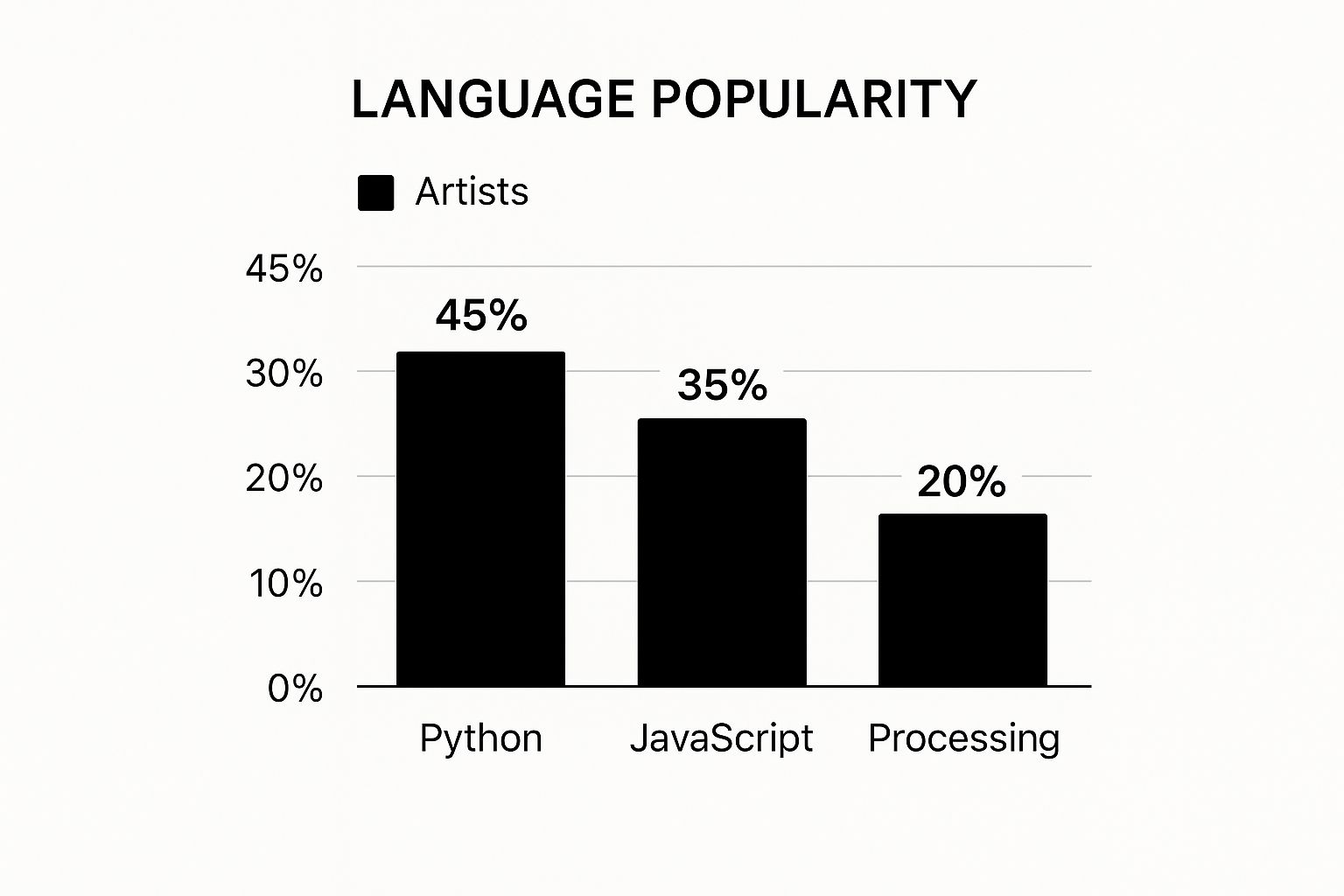
The data chart reveals that 40% of artists struggled with a lack of technical skills, and 30% experienced a fear of failure when starting to code. By utilizing resources like online tutorials and embracing experimentation, these artists overcame their initial apprehension. You can find further guidance at More examples of how to overcome…
To present a more structured comparison of popular coding languages and their artistic applications, the following table offers a detailed overview:
Programming Languages for Artists
| Language/Platform | Learning Curve | Visual Capabilities | Community Support | Best For |
|---|---|---|---|---|
| Processing | Beginner-friendly | Excellent for 2D and 3D graphics, animations | Large and active | Generative art, interactive installations |
| p5.js | Beginner-friendly | Similar to Processing, runs in web browsers | Growing community | Web-based art, creative coding |
| Cinder | Intermediate | Powerful for graphics, multimedia, and more | Active, though smaller | Advanced graphics, large-scale installations |
| openFrameworks | Intermediate | Similar to Cinder, cross-platform | Dedicated community | Interactive art, installations, performances |
| VVVV | Intermediate | Node-based visual programming | Strong community | Real-time visuals, interactive installations |
This table highlights the strengths of various coding languages, aiding artists in selecting the best fit for their skill level and project goals. Processing and p5.js offer beginner-friendly entry points, while Cinder, openFrameworks, and VVVV cater to more complex projects and installations.
The key takeaway here is to start small, experiment fearlessly, and seek support when needed. You might be surprised at the creative potential you can unlock through coding.
Creative Coding Environments That Amplify Artistic Vision
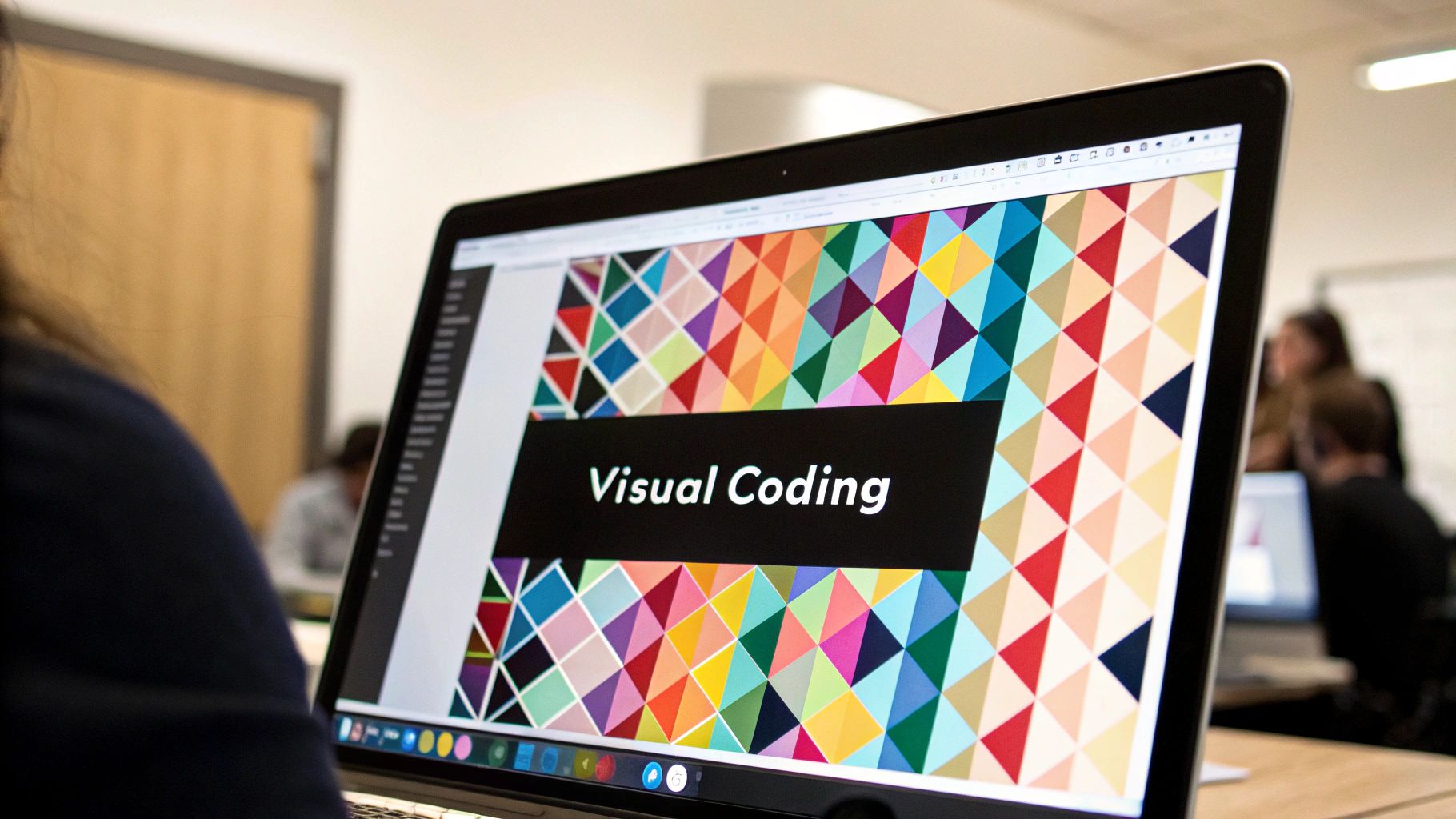
The world of coding offers artists a diverse range of tools specifically designed for creative expression. Unlike traditional software engineering tools, these environments emphasize visual and interactive exploration. This makes them perfect for artists looking to transform their vision into reality. This approach, known as algorithmic creativity, is changing the way art is made.
Generative art, a key component of creative coding, uses generative algorithms to produce unique and previously impossible artworks. This development has sparked discussion about the potential impact on traditional artists. Some worry about the devaluation of their skills, as AI can generate high-quality art quickly and affordably. Explore this topic further.
Processing: The Foundation of Visual Programming
Processing is a fundamental language for many artist-coders. Its simplified syntax and instant visual feedback make it an accessible starting point. The language excels at creating 2D and 3D graphics, animations, and interactive sketches. Being open-source, with a large and active community, provides abundant support and resources for learning. Processing allows artists to concentrate on the creative process, without getting lost in technical details.
P5.js: Bringing Creativity to the Web
Based on the principles of Processing, p5.js extends creative coding to the web. This JavaScript library empowers artists to create interactive art, animations, and visualizations directly in a web browser. This easy access simplifies the process of sharing and experiencing art online, making it more engaging. P5.js also encourages collaborative coding projects. You might be interested in exploring different coding tools for artists.
TouchDesigner: Real-Time Visual Performance
TouchDesigner is a node-based visual programming language known for its real-time capabilities. Artists can use it to create impressive interactive installations, live performances, and complex visual effects. Its visual interface allows for intuitive control over parameters, which is ideal for dynamic and evolving artwork. TouchDesigner is often the choice for large-scale projects requiring precise control and responsiveness.
Three.js: Exploring Immersive 3D Worlds
Three.js is a powerful JavaScript library for artists wanting to create immersive 3D experiences. It simplifies the development of complex 3D graphics and animations within a web browser. This allows artists to build interactive sculptures, virtual environments, and other 3D artworks accessible to a broad audience. The web-based nature of Three.js ensures easy sharing and compatibility across different platforms.
Specialized Frameworks for Artistic Exploration
Beyond these core environments, numerous specialized frameworks address specific artistic needs. These frameworks offer robust tools for sound visualizations, kinetic installations, and data-driven artwork. They provide pre-built functions and optimized workflows tailored to these artistic domains.
By understanding the strengths of each environment, artists can select the tools best suited to their artistic vision. Experienced artist-coders prioritize choosing tools based on their creative goals, not just the latest technical trends. This ensures the technology enhances the art, rather than dictating the creative process. Integrating these digital tools into existing artistic practices allows artists to maintain their unique voice while exploring new avenues of expression.
Creating Art That Responds: Interactive Installation Mastery
Coding for artists opens up a world of possibilities beyond the digital screen. It empowers the creation of compelling interactive installations that transform static art into dynamic, responsive experiences. These installations react intelligently to human interaction and environmental changes, fostering a deeper connection between the artwork and its audience. Viewers become active participants, shaping the art experience in real-time.
Sensing The World: Input and Interaction
At the heart of interactivity lies the installation's ability to perceive its environment. Sensors act as the installation's senses, collecting data from the surroundings. Various sensor types capture different forms of input.
- Motion sensors detect movement, enabling the artwork to respond to the presence and actions of viewers.
- Sound sensors register ambient noise or specific frequencies, allowing the artwork to react to music, voices, or other acoustic stimuli.
- Touch sensors capture physical contact, providing opportunities for direct interaction with the installation.
- Environmental sensors measure factors like light, temperature, and humidity, enabling the artwork to adapt to changing conditions.
The data gathered by these sensors is then processed by code, triggering pre-programmed responses in the artwork's appearance, behavior, or sound.
Data Interpretation and Meaningful Interaction
Truly effective interactive installations go beyond simply reacting to input; they interpret it meaningfully. The code functions as a translator, converting sensor data into actions that reflect the artist’s vision. For instance, a motion sensor might trigger not only a shift in lighting but a carefully orchestrated sequence of movements and sounds designed to evoke a particular emotion.
Meaningful audience interaction is crucial. The interaction design should encourage engagement and create a sense of connection between the viewer and the artwork. Careful consideration of the user experience ensures interactions are intuitive, engaging, and emotionally resonant.
Bridging the Digital and Physical
Creating interactive installations requires bridging the divide between digital code and physical materials. This connection is achieved through hardware components like microcontrollers (e.g., Arduino, Raspberry Pi) that serve as the brains of the installation, executing code and controlling physical outputs. These components interface with sensors and actuators (motors, lights, speakers), bringing the artwork to life. Robustness is key, particularly for public installations. Both the hardware and code must be designed to withstand continuous interaction and a range of environmental conditions.
Learning From Successful Installations
Studying successful interactive artworks offers valuable insights into the technical architecture behind memorable installations. Analyzing these projects helps aspiring creators anticipate and overcome common challenges throughout the creative process, from initial concept to final exhibition. Understanding how established artists have tackled sensor selection, data processing, and hardware integration is crucial for developing robust and engaging interactive art.
To better understand the essential components involved, let's examine a breakdown of the typical hardware and software elements:
The following table outlines the key components required for creating interactive installations:
| Component Type | Function | Cost Range | Technical Complexity | Examples |
|---|---|---|---|---|
| Microcontroller | Processes code, controls outputs | $5 – $50 | Beginner to Intermediate | Arduino, Raspberry Pi |
| Motion Sensor | Detects movement | $5 – $20 | Beginner | Ultrasonic, PIR |
| Touch Sensor | Registers physical contact | $2 – $10 | Beginner | Capacitive, Resistive |
| Sound Sensor | Captures audio input | $5 – $30 | Beginner to Intermediate | Microphone, Sound Trigger |
| Actuator | Creates physical actions | $5 – $100 | Beginner to Intermediate | Motor, Servo, LED |
This table provides a general overview; specific project requirements will dictate the exact components needed. The cost and complexity can vary significantly depending on the sophistication of the installation.
Through careful planning, thoughtful interaction design, and robust hardware integration, coding empowers artists to create immersive and engaging experiences that blur the lines between the physical and digital realms. The potential for creative expression is vast, limited only by the artist’s imagination.
Generative Art: When Algorithms Become Creative Partners
Imagine crafting art not through traditional means, but with lines of code. This is the core of generative art, where algorithms take on the role of creative partners. Instead of meticulously planning every stroke, artists establish parameters and rules, allowing the algorithms to produce unexpected and often captivating visual results. It's a captivating intersection of art and technology, where mathematical systems give rise to artwork impossible to create by hand.
Exploring the Creative Potential of Algorithms
Generative art thrives on the inherent unpredictability of computation. Artists leverage coding to explore concepts like randomness, noise functions, recursive patterns, and evolutionary systems, translating these computational ideas into visual forms. For instance, a noise function can generate intricate textures reminiscent of natural phenomena like clouds or marble.
This artistic practice involves carefully balancing artistic intent with the algorithm's output. Artists learn to guide the algorithms, retaining their unique artistic voice while allowing the code to inject an element of chance and surprise. This interplay of control and unpredictability is what makes generative art so intriguing.
Techniques and Tools for Generative Artists
Several fundamental techniques form the basis of generative art:
-
Randomness: Introducing controlled randomness, often through pseudo-random number generators, injects an element of surprise and variation.
-
Noise Functions: These mathematical functions create smooth, organic shifts in values, enabling artists to produce textures, patterns, and forms.
-
Recursive Patterns: Drawing inspiration from natural growth, recursive patterns generate self-similar structures, often leading to complex and detailed designs.
-
Evolutionary Systems: Mimicking natural selection, these systems enable artists to "evolve" artwork over generations, yielding unexpected and visually compelling results.
Platforms like Processing and p5.js play a vital role in this field. They offer intuitive ways to work with visuals and algorithms, empowering artists to experiment and create without requiring extensive programming knowledge. Creative coding expands beyond AI, encompassing programming techniques to create aesthetically pleasing and optimized digital art. This approach fosters interactivity and dynamism, blurring the lines between physical and digital realms. Find more detailed statistics here.
From Pioneers to Contemporary Creators
Generative art boasts a rich history of pioneering artists who have pushed the boundaries of computational creativity. From early experimenters using plotters to contemporary artists employing AI and complex simulations, the field continues to evolve. These artists represent a distinct approach to art creation, where the algorithm is not merely a tool but a collaborator.
By studying the work of these artists, we gain insights into how they harness computational unpredictability. This exploration reveals how generative art embraces the unexpected, resulting in pieces that continuously surprise and inspire, even the artists themselves. It's an ongoing journey of discovery, where human creativity and algorithmic power combine to forge new artistic frontiers.
AI as Artistic Collaborator: New Creative Possibilities

Artificial intelligence is rapidly changing how we create art, presenting exciting new avenues for exploration. Beyond the buzz, AI is a powerful tool for collaboration, enhancing, not replacing, human creativity. For artists interested in coding, AI tools unlock new ways to express themselves, generating ideas, manipulating existing work, and creating dynamic, evolving pieces.
Demystifying AI for Artists
Understanding the basics of AI empowers artists to use these tools effectively. Neural networks, modeled after the human brain, learn from data by recognizing patterns. This process, machine learning, enables AI to generate new content or analyze existing work. Computer vision, a specialized AI field, allows computers to "see" and interpret images, making image manipulation, generation, and analysis possible.
Many AI art tools don't require advanced programming skills. User-friendly platforms and libraries like Processing offer accessible interfaces. Artists can then focus on creative expression instead of the technical details of AI algorithms. This accessibility makes AI's potential in art available to a broader range of creative people. A helpful resource to explore is: How to master GitHub Copilot.
AI-Powered Inspiration and Transformation
AI’s ability to spark unexpected inspiration is one of its most exciting aspects. AI algorithms can generate novel ideas, suggest surprising color palettes, or create unique variations of existing artwork. This collaborative process can push artists beyond their usual creative limits, leading to exciting new directions.
AI also transforms existing art into new forms. Imagine applying stylistic filters to photographs, generating variations of a painting, or turning still images into animations. AI gives artists powerful tools to reimagine and reinterpret their work. Furthermore, AI enables the creation of dynamic art: pieces that evolve over time based on data, user interaction, or algorithms. This introduces a time element, allowing for ever-changing, responsive creations.
The combination of AI and creative coding has led to innovations like text-to-image technology. This technology has seen widespread adoption by artists, with 45.7% finding it very useful and 31.5% finding it somewhat useful as of 2024. Find more detailed statistics here.
Ethical Considerations and a Thoughtful Approach
As AI becomes more common in art, it's essential to consider the ethical implications of AI-augmented creativity. Questions of authorship, originality, and the potential impact on human artists need careful thought. A responsible approach to using these powerful tools involves understanding their limitations, acknowledging potential biases, and employing them ethically.
Maintaining an authentic artistic voice when using AI is also important. These tools should enhance, not control, the creative process. By working with AI as a collaborator, artists can explore its potential while preserving their unique perspectives and artistic vision. Practical approaches to using AI platforms within existing creative workflows emphasize artistic control. This ensures AI elevates, not replaces, the artist’s creative intent.