From Blank Canvas to Career Catalyst: What Makes a Winning Portfolio?
In a crowded tech market, a generic portfolio is just digital noise. The difference between a forgotten application and a callback often lies in a portfolio that tells a compelling story. It's not just about listing projects; it's about strategically showcasing your skills, problem-solving abilities, and unique professional identity. A standout portfolio acts as your digital handshake, your technical resume, and your personal brand all in one. It demonstrates competence before you even speak to a hiring manager.
This article moves beyond surface-level showcases to provide a deep strategic analysis of powerful coding portfolio examples. We'll deconstruct what makes them effective, extract replicable tactics, and offer actionable takeaways you can use to build a portfolio that not only displays your work but actively works for you. Forget generic templates and uninspired project lists. We are focusing on the specific design choices, content strategies, and technical implementations that turn a simple webpage into a career-defining tool.
Here, you will discover how to:
- Structure a narrative that guides recruiters through your best work.
- Design an interface that highlights your unique technical and creative voice.
- Implement features that prove your skills, not just claim them.
Whether you're a frontend specialist, a backend engineer, or a full-stack developer, you'll find inspiration and a clear roadmap to elevate your professional presentation. Let's dive into the examples that set the standard.
1. The Personal Branding Portfolio (Example: Brittany Chiang)
The Personal Branding Portfolio is a strategic approach that positions the developer not just as a coder, but as a distinct brand. It merges technical skill with a strong, cohesive aesthetic, telling a professional story through deliberate design choices. This type of portfolio, exemplified by developers like Brittany Chiang, uses minimalist design, elegant typography, and subtle animations to create a memorable and sophisticated user experience. It’s less of a simple project list and more of a curated digital identity.
The core idea is to build trust and authority before a recruiter even reads a single line of code. By presenting a polished and professional front end, you communicate attention to detail, a keen eye for user experience, and a high standard of quality. It’s a powerful statement that suggests your work on actual products will be just as thoughtful and well-executed.
Strategic Analysis: Why It Works
Brittany Chiang's portfolio at brittanychiang.com is a masterclass in this approach. The single-page layout guides visitors seamlessly through her journey, from a concise "About Me" section to detailed project showcases and professional experience. The clean, dark-mode design with a consistent accent color feels modern and focused, while smooth scroll-spy navigation and subtle fade-in animations enhance usability without being distracting.
This method works because it controls the narrative. Instead of letting a GitHub profile or a generic resume define you, you create a purpose-built platform that highlights your best attributes. It’s an effective strategy for front-end developers, full-stack engineers with a passion for UI/UX, and anyone looking to stand out in a crowded market of coding portfolio examples.
Actionable Takeaways
To build a similar portfolio, focus on these key elements:
- Establish a Visual Identity: Choose a limited color palette (2-3 colors) and a pair of complementary fonts. Stick to them consistently across the entire site.
- Prioritize Performance: Your personal brand is damaged by a slow website. Optimize images, minify CSS and JavaScript, and leverage browser caching to ensure near-instant load times.
- Tell a Story: Structure your content logically. Start with who you are, what you do, showcase your best work with clear descriptions of your role and the tech stack, and end with a clear call-to-action (CTA) like "Get In Touch."
- Use Animation with Purpose: Animations should guide the user's eye or provide feedback, not just exist for decoration. Simple hovers, gentle fades, and subtle transitions are highly effective.
2. The GitHub-Centric Portfolio (Example: Sindre Sorhus)
The GitHub-Centric Portfolio is a "show, don't tell" strategy that places your actual code and contributions front and center. Instead of a polished website, your GitHub profile becomes your primary showcase, demonstrating technical prowess through open-source work, repository quality, and community engagement. This approach, championed by prolific developers like Sindre Sorhus, communicates expertise through tangible, verifiable code rather than a curated presentation. It's a powerful statement for developers who value substance and deep technical skill.
This strategy hinges on the idea that for many technical roles, the quality of your code and your ability to collaborate are the most important hiring signals. A well-maintained GitHub profile with active contributions, detailed READMEs, and clean commit histories provides direct evidence of your skills. It signals to recruiters and hiring managers that you are not just a developer but an active participant in the broader engineering community.
Strategic Analysis: Why It Works
Sindre Sorhus's profile at github.com/sindresorhus is the quintessential example of this method. With thousands of repositories and a massive number of contributions, his profile is a testament to his expertise and dedication. He effectively uses pinned repositories to highlight his most impactful projects, each with comprehensive documentation and clear usage examples. This turns his profile into a living, breathing resume that is constantly updated with new work.
This approach works because it provides undeniable proof of skill. Recruiters can directly assess your coding style, your understanding of best practices, and your ability to document and maintain projects. It builds immense credibility, especially for back-end, systems, and open-source-focused roles where practical coding ability outweighs design sensibilities. For those looking for more coding portfolio examples, this method offers a highly effective, code-first alternative.
Actionable Takeaways
To build a powerful GitHub-centric portfolio, focus on these key elements:
- Curate Your Pinned Repositories: Use the "pin" feature to showcase your six best projects. Select repositories that demonstrate a range of skills, from different programming languages to complex problem-solving.
- Master the README File: Every project needs a comprehensive README.md. Include a clear project description, installation instructions, usage examples, API documentation, and a link to a live demo if applicable.
- Contribute Meaningfully: Quality over quantity. Make valuable contributions to popular open-source projects. This demonstrates your ability to collaborate, understand large codebases, and follow community standards.
- Maintain Profile Hygiene: Keep your profile professional. Use a clear profile picture, write a concise bio that states what you do, and link to your personal website or LinkedIn profile. Ensure your contribution graph shows consistent activity.
3. The Interactive Playground Portfolio
The Interactive Playground Portfolio transforms a static resume into a dynamic, hands-on experience. Instead of just describing skills, this approach demonstrates them in real-time by allowing visitors to directly engage with projects. This is achieved through embedded demos, live code editors, and gamified elements, making the portfolio a memorable destination in itself. It’s a powerful strategy for developers who want to showcase their creativity and technical prowess in a tangible way.
This method moves beyond showing and gets straight to doing. By inviting recruiters to "play," you immediately prove your ability to build engaging, complex, and performant applications. It's a bold statement that communicates not only technical competence but also a passion for user experience and a flair for innovation. This is one of the most effective coding portfolio examples for leaving a lasting impression.
Strategic Analysis: Why It Works
Bruno Simon's portfolio at bruno-simon.com is a celebrated example of this technique. Visitors don't just read his resume; they drive a 3D car through a physics-enabled world, crashing into his projects and experience sections to learn more. It’s an unforgettable experience that perfectly showcases his expertise in WebGL and 3D graphics. The "game" is the portfolio, and playing it reveals his skills and history.
This strategy works because it creates an emotional connection through delight and surprise. It breaks the mold of traditional portfolios, making the user an active participant rather than a passive observer. It's particularly effective for creative technologists, game developers, and front-end specialists who want to highlight their ability to merge code with artistry.
Actionable Takeaways
To create a compelling interactive portfolio, consider these strategies:
- Gamify the Experience: Turn navigation into a simple game or challenge. This could be a small character to control, interactive physics objects, or a puzzle to solve to reveal information.
- Embed Live Demos: Instead of linking out to a project, embed a functional version directly on your site. Allow users to interact with it, change parameters, or see code updates in real time.
- Prioritize Accessibility and Fallbacks: Ensure the core information (about, projects, contact) is accessible even if the interactive elements fail to load or are disabled. Use progressive enhancement to layer the fun on top of a solid, functional base.
- Optimize for All Devices: A great interactive experience must work flawlessly on both desktop and mobile. Pay close attention to touch controls and performance on lower-powered devices. The user journey should feel intuitive, regardless of the input method.
4. The Case Study Portfolio (Example: Alex Carpenter)
The Case Study Portfolio shifts the focus from just showing the final product to detailing the entire journey. This approach frames each project as an in-depth case study, guiding visitors through the initial problem, the thought process, the technical challenges faced, and the solutions engineered. It’s a powerful method for demonstrating not just coding ability, but also critical thinking, problem-solving, and project management skills. Rather than a gallery of finished work, it’s a library of professional stories.
This method is particularly effective because it answers the "why" behind your technical decisions. It shows recruiters and potential clients that you don't just write code; you understand business context, user needs, and technical trade-offs. By documenting your process, you prove your value as a strategic thinker who can successfully navigate a project from concept to completion, making it one of the most compelling coding portfolio examples for results-oriented roles.
Strategic Analysis: Why It Works
Developers like Alex Carpenter have perfected this strategy by transforming their portfolios into compelling narratives. Instead of a simple grid of projects, each entry on a site like alexcarpenter.me links to a dedicated page that breaks down the entire process. This includes sections for the project goal, my role, the tech stack, and a detailed look at the challenges and learnings. It shows a level of professional maturity and communication that is highly sought after.
This approach works because it preemptively answers the questions a technical hiring manager would ask in an interview. You’re providing a window into your thought process, demonstrating how you tackle ambiguity and overcome obstacles. It’s an ideal format for product engineers, senior developers, and freelancers who need to build trust and showcase their ability to deliver tangible business value, not just functional code.
The infographic below illustrates the core structure of a compelling case study.
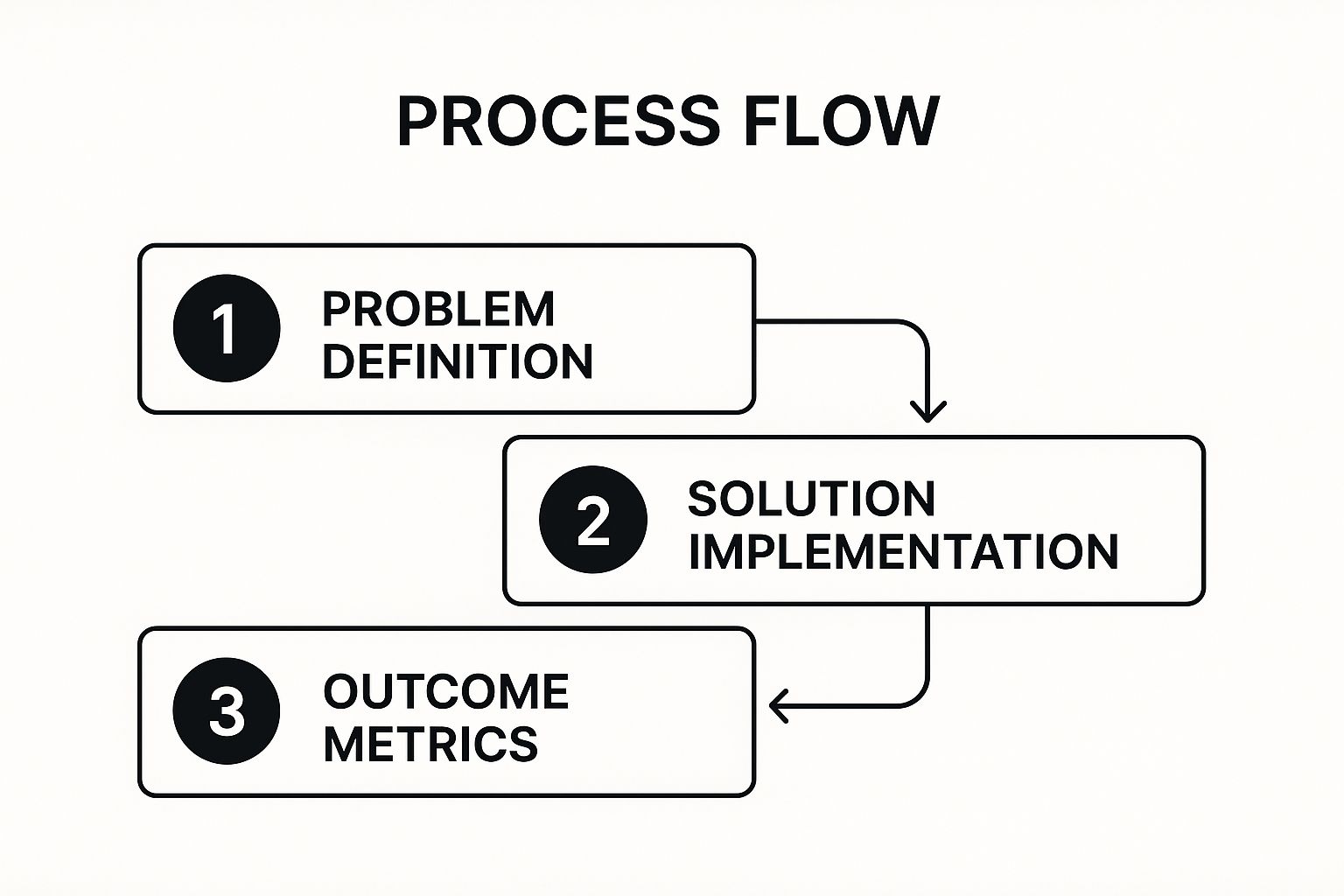
Following this simple three-step flow provides a clear, logical narrative that effectively communicates the project's impact from start to finish.
Actionable Takeaways
To build a powerful case study portfolio, concentrate on these elements:
- Structure Each Case Study: Create a consistent template for your projects. Start with the Problem/Goal, detail your Process & Technical Decisions, discuss the Challenges & Solutions, and conclude with the Outcome & Results.
- Focus on Depth, Not Breadth: Select 3-4 of your most significant projects and go deep. A few detailed case studies are far more impactful than a long list of projects with one-sentence descriptions. For more resources on this, explore our guides at Vibecoding.
- Use Visuals to Tell the Story: Break up text with screenshots, wireframes, architectural diagrams, and even short video demos. Visuals make complex information easier to digest and keep the reader engaged.
- Quantify Your Impact: Whenever possible, use metrics. Did you improve performance by 30%? Increase user engagement by 15%? Reduce server costs? Hard numbers provide concrete evidence of your value.
5. The Minimalist Resume Portfolio (Example: Rafael Conde)
The Minimalist Resume Portfolio strips away all non-essential design elements, focusing entirely on content, readability, and performance. This approach treats the portfolio as a digital resume, prioritizing the clear and efficient communication of skills, experience, and projects. Championed by developers like Rafael Conde, this style leverages strong typography, generous white space, and a logical information hierarchy to present information without distraction. It's a statement of confidence in the substance of the work itself.

The underlying principle is that clarity and speed are user experience features in their own right. By forgoing heavy graphics, complex animations, and elaborate layouts, these portfolios load almost instantly on any device. This demonstrates a deep respect for the visitor's time and a pragmatic, engineering-first mindset. It's an effective way to communicate technical proficiency and a no-nonsense professional attitude.
Strategic Analysis: Why It Works
Rafael Conde’s portfolio at rafa.design perfectly embodies this philosophy. The site is essentially a single, beautifully typeset page that reads like a well-crafted resume. There are no images or complex scripts, just exceptionally clean text organized under clear headings like "Experience," "Projects," and "Contact." The design's strength lies in its restraint, allowing the quality of the information to take center stage. The site is incredibly fast, accessible, and easy to parse in seconds.
This strategy works because it aligns with the goals of its primary audience: busy recruiters and hiring managers. It delivers the most critical information immediately and without friction. This makes it an ideal choice for back-end developers, systems engineers, or anyone whose work is more about logic and architecture than visual flair. It’s one of the most direct and efficient coding portfolio examples for communicating raw qualifications.
Actionable Takeaways
To build a minimalist resume portfolio, concentrate on these core components:
- Invest in Typography: Your entire design rests on text. Choose a highly readable, professional font and pay close attention to line height, letter spacing, and font sizing to create a clear visual hierarchy.
- Emphasize Content Clarity: Write concise, impactful descriptions for your experience and projects. Use strong action verbs and quantify your achievements wherever possible. The quality of your writing is paramount.
- Prioritize Performance and Accessibility: Use semantic HTML (like
<main>,<section>, and<article>) and a proper heading structure (H1, H2, H3). Aim for a perfect Lighthouse score, especially in Performance and Accessibility. - Keep It Simple: Resist the urge to add "just one more thing." If an element doesn't serve a direct purpose in communicating your skills or experience, remove it. The goal is intentional simplicity, not emptiness.
6. The Video/Tutorial Portfolio (Example: Traversy Media – Brad Traversy)
The Video/Tutorial Portfolio transforms a developer's website from a static resume into an educational platform. This strategy involves creating video content, such as project walkthroughs, coding tutorials, or technical explanations, to demonstrate expertise. Instead of just stating skills, this approach actively proves them while also showcasing strong communication and teaching abilities. It builds a community and establishes the developer as a go-to authority in their niche.
This method positions you as more than a coder; you become a resource. Recruiters and potential clients see not only your technical prowess but also your capacity to articulate complex ideas clearly. This dual demonstration of hard and soft skills is incredibly powerful and helps build a memorable personal brand that extends beyond a list of projects.
Strategic Analysis: Why It Works
Educators like Brad Traversy of Traversy Media have built entire careers on this model. His portfolio isn't just a website; it's an ecosystem of courses, free tutorials, and project-based learning content. By offering immense value for free through YouTube, he builds trust and credibility, which naturally funnels interested learners toward his premium courses and establishes his authority in the web development space.
This strategy works because it leverages the "show, don't tell" principle to its maximum potential. A video walkthrough of a complex project is far more compelling than a few screenshots and a paragraph of text. It allows you to explain your thought process, the challenges you overcame, and the specific technologies you used in a dynamic and engaging format. This approach is excellent for developers who enjoy teaching, public speaking, or content creation, as it turns a portfolio into a lead-generation tool for freelance work, consulting, or even a full-time role.
Actionable Takeaways
To create a compelling video-centric portfolio, concentrate on these steps:
- Focus on Audio First: Clear, crisp audio is more important than high-resolution video. Invest in a decent microphone before upgrading your camera.
- Create Project Showcase Videos: For each key project, record a concise (2-5 minute) video. Explain the project's purpose, walk through its main features, and briefly touch on the tech stack and your development process.
- Embed Videos Natively: Host your videos on a platform like YouTube or Vimeo for performance, but embed them directly within your project pages. This keeps visitors on your site.
- Add Transcripts and Captions: Make your content accessible to everyone and improve SEO by including video transcripts or closed captions. This simple step significantly broadens your audience.
7. The Full-Stack Showcase Portfolio
The Full-Stack Showcase Portfolio is a comprehensive approach designed to demonstrate end-to-end development capabilities. Unlike portfolios that isolate front-end design or back-end logic, this type proves you can conceptualize, build, and deploy a complete, functional application. It serves as direct evidence of your ability to manage everything from database architecture and server-side logic to the user-facing interface, making it a powerful tool for aspiring full-stack developers.
This portfolio style moves beyond static sites or isolated components. It features fully deployed, interactive web applications like e-commerce platforms with payment integration, social media clones with real-time updates, or collaborative project management tools. The goal is to present irrefutable proof that you can handle the entire development lifecycle, a highly sought-after skill in the tech industry. It’s one of the most compelling coding portfolio examples for showing practical, job-ready competence.
Strategic Analysis: Why It Works
This method works because it directly answers the primary question of hiring managers for full-stack roles: "Can you build and maintain a complete application?" By presenting a working product, you preemptively address concerns about your ability to connect the front-end to a back-end, manage data, handle user authentication, and deploy to a live environment. It’s a practical demonstration, not a theoretical claim.
Bootcamp graduates and self-taught developers, in particular, benefit from this approach. It levels the playing field by focusing on tangible skills over traditional credentials. A well-executed full-stack project, such as a task manager with team features or a small-scale e-commerce site, shows problem-solving ability, technical depth, and a commitment to seeing a project through from start to finish. It’s a powerful narrative that proves you can deliver value.
Actionable Takeaways
To build an effective Full-Stack Showcase Portfolio, focus on these elements:
- Build a Substantial Project: Choose a project that requires a database, user authentication, and CRUD (Create, Read, Update, Delete) operations. This complexity provides the necessary canvas to display your skills.
- Document Everything Thoroughly: Create a comprehensive README file on GitHub. Include setup instructions, an overview of the architecture, and a description of the technologies used. Document your API with tools like Swagger or Postman to showcase professionalism.
- Prioritize Deployment: A live, working application is non-negotiable. Use modern platforms like Vercel, Netlify, or Heroku and set up a CI/CD pipeline to demonstrate your knowledge of modern deployment practices.
- Showcase Both Ends: Ensure your project has a clean, intuitive user interface but also a well-structured and secure back-end. Explain the design choices for your database schema and API endpoints just as you would for your UI components.
7 Coding Portfolio Styles Comparison
| Portfolio Type | Implementation Complexity 🔄 | Resource Requirements ⚡ | Expected Outcomes 📊 | Ideal Use Cases 💡 | Key Advantages ⭐ |
|---|---|---|---|---|---|
| Personal Branding Portfolio | High – design & animation heavy | Moderate to High – design skills | Strong personal brand recognition, memorable UX | Frontend/UI developers, creative technologists | Demonstrates UI/UX and storytelling skills |
| GitHub-Centric Portfolio | Moderate – focus on code quality | Low to Moderate – coding time | Showcases actual coding skills and repo quality | Backend devs, open-source enthusiasts | Builds community reputation, low upkeep once set |
| Interactive Playground Portfolio | Very High – interactive features | High – advanced frontend skills | Engaging, hands-on evaluation of skills | Creative, game, WebGL developers | Demonstrates creativity and innovation |
| Case Study Portfolio | High – detailed project writeups | Moderate – requires thorough docs | Shows problem-solving and business impact | Full-stack devs, technical leads | Appeals to managers; highlights analytical thinking |
| Minimalist Resume Portfolio | Low – simple content-focused | Low – writing & typography focus | Fast, accessible, clear communication | Backend devs, accessibility advocates | Easy maintenance; excellent performance |
| Video/Tutorial Portfolio | High – content creation intensive | High – video production skills | Demonstrates communication & teaching abilities | Educators, developer advocates | Builds personal brand; appeals to visual/auditory learners |
| Full-Stack Showcase Portfolio | Very High – full app lifecycle | High – multi-skill, hosting costs | Demonstrates end-to-end development expertise | Full-stack devs, startups, bootcamp grads | Versatile skill showcase with deployable apps |
Synthesizing Your Strategy: Which Portfolio is Right for You?
We've journeyed through a diverse landscape of powerful coding portfolio examples, from the polished personal brand of Brittany Chiang to the minimalist efficiency of Rafael Conde. Each example serves as a strategic blueprint, not just a gallery piece. The core lesson is clear: a truly effective portfolio is not about imitation, but about intelligent synthesis. Your goal is not to clone a single design but to selectively integrate the tactics and strategies that amplify your unique skills and career aspirations.
The power lies in the mix-and-match approach. A frontend developer with an eye for design might fuse the storytelling of a 'Personal Branding Portfolio' with the engaging, hands-on elements of an 'Interactive Playground.' This combination showcases both technical prowess and a deep understanding of user experience. Conversely, a backend or DevOps engineer could strategically merge the evidence-based credibility of a 'GitHub-Centric Portfolio' with the detailed, problem-solving narratives found in a 'Case Study Portfolio,' proving their impact on complex systems.
Your Actionable Next Steps
Building an exceptional portfolio is a project in itself, one that requires a clear plan. Instead of feeling overwhelmed by the possibilities, focus on a structured approach. Breaking down the process into manageable tasks will transform this challenge into a career-defining opportunity.
Here’s how to move from inspiration to implementation:
- Define Your Core Message: What is the single most important thing you want a recruiter or hiring manager to know about you? Are you a rapid prototyper, a detail-oriented problem solver, or a full-stack architect? Your answer will dictate your strategic direction.
- Select Your Archetype(s): Based on your core message, choose one or two primary portfolio archetypes from this article to serve as your foundation. Will you lead with in-depth case studies or a minimalist, resume-first approach?
- Cherry-Pick Your Tactics: From your chosen archetypes, list the specific elements you want to adopt. This could be the interactive scroll animations from one example, the detailed project write-ups from another, and the clean navigation from a third.
- Curate Your Best Work: Choose 2-4 "hero" projects that best represent your skills and align with your core message. Prioritize quality over quantity, ensuring each project has a clear story and demonstrates tangible results.
Beyond a Static Page: Your Living Career Asset
Ultimately, the most compelling coding portfolio examples reveal a fundamental truth: your portfolio is more than a digital resume. It is your professional narrative, your technical playground, and your most potent marketing tool. By moving beyond a simple list of projects and thoughtfully engineering a user journey that tells your story, you create an active asset that works for you. It builds trust, demonstrates expertise, and starts conversations with potential employers before you even enter an interview.
The journey to building a standout portfolio is a rewarding one. It forces you to articulate your value, refine your skills, and present yourself with confidence. Embrace the process, apply these strategic insights, and craft a portfolio that not only showcases your code but also opens the doors to your next great opportunity.