Unleash Your Inner Artist: Conquering Creative Blocks
Every creator faces the dreaded creative block. This listicle provides eight effective creative block solutions to reignite your imagination. Learn how divergent thinking exercises, environment changes, constraint-based creation, incubation, cross-pollination, creative rituals, mind-body techniques, and systematic skill development can overcome creative blocks and unlock your potential. These strategies, drawing from neuroscience, psychology, and creative practices, offer practical tools to help you conquer those moments when inspiration fades and get back to creating.
1. Divergent Thinking Exercises
When creative block hits, it can feel like staring at a blank canvas, cursor blinking mockingly. One powerful solution for overcoming this hurdle is engaging in divergent thinking exercises. Divergent thinking is a creative problem-solving approach that explores multiple possible solutions. Instead of linearly searching for the answer, it generates as many ideas as possible, encouraging you to think beyond conventional boundaries and expand the pool of potential solutions before evaluating them. This process helps break through creative blocks by unearthing unexpected connections and novel approaches you might otherwise miss.
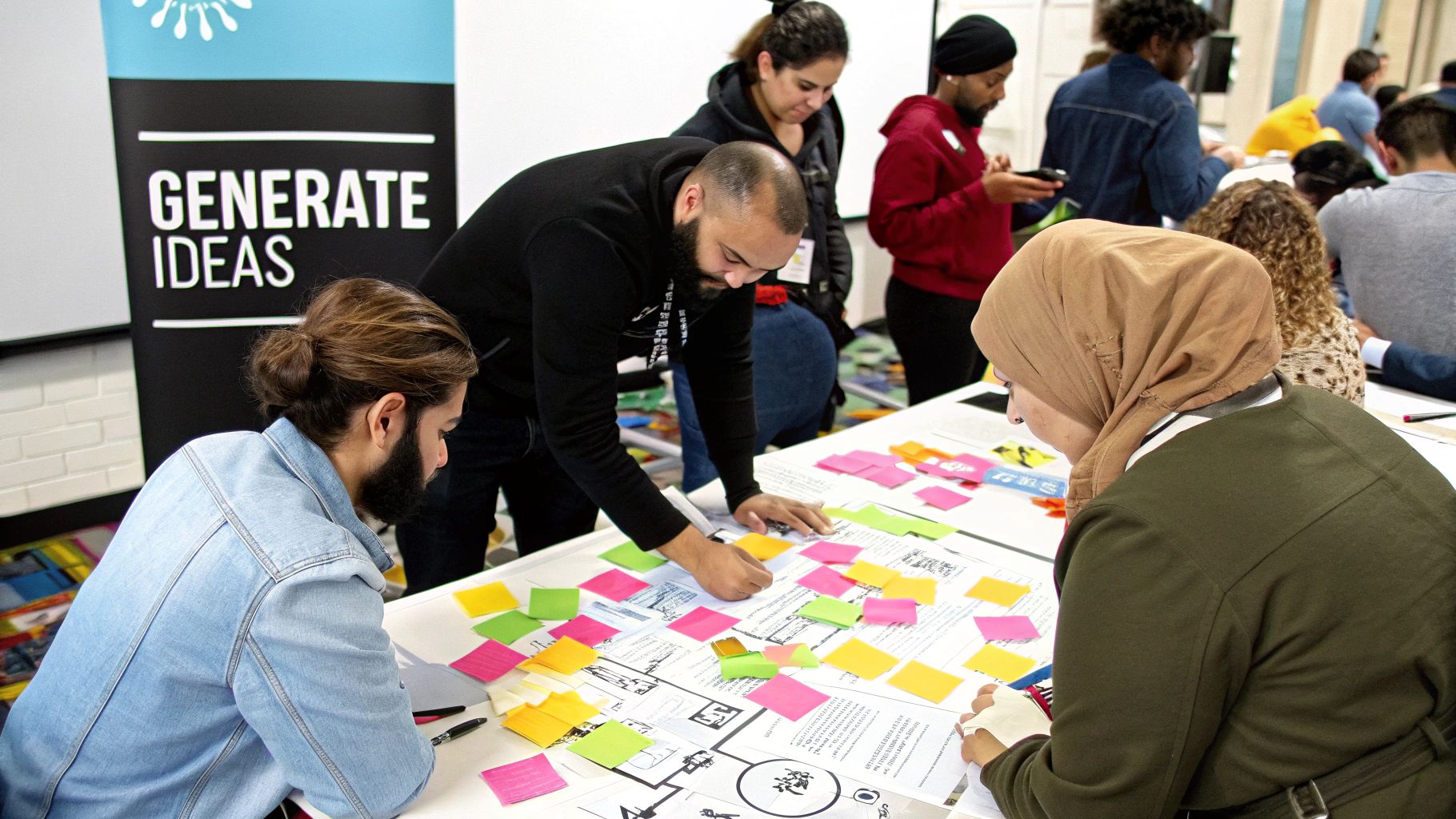
Divergent thinking relies on specific features to maximize its effectiveness. Initially, judgment is suspended. The goal is quantity over quality; the more ideas, the better, even if they seem wild or unusual. This encourages exploration without the constraint of self-criticism. Association and combination techniques, connecting seemingly disparate concepts, are also key to generating truly innovative ideas. For example, imagine combining the concept of a bicycle with the concept of virtual reality – you might arrive at a novel idea for an immersive exercise experience.
This method deserves a top spot on any list of creative block solutions because it directly addresses the root problem: a restricted thought process. By opening up your thinking, you can break habitual patterns and generate unexpected connections, often leading to breakthrough ideas and increased creative flexibility. Consider brainstorming sessions at IDEO, a renowned design firm known for its innovative products. They leverage divergent thinking to explore a wide range of possibilities before narrowing down to the most promising concepts. Similarly, Disney's creative teams utilize mind mapping, a visual divergent thinking technique, to develop intricate story narratives and world-building. Even advertising agencies employ random word association exercises to spark fresh campaign ideas. The Six Thinking Hats method, used in corporate innovation departments, provides a structured approach to divergent thinking by prompting exploration from different perspectives.
However, divergent thinking isn't without its drawbacks. While it excels at generating ideas, it requires follow-up convergent thinking to evaluate and refine those ideas into practical solutions. This process can be time-consuming. Additionally, some people may find the lack of initial structure uncomfortable. The sheer volume of generated ideas, many of which may be impractical, can also feel overwhelming.
To effectively use divergent thinking exercises, consider these tips: Set a target number of ideas (e.g., 100 ideas in 10 minutes) to push yourself beyond your comfort zone. Embrace "yes, and…" thinking, building upon others' ideas to create even more possibilities. Critically, record all ideas without filtering initially. Use prompts or constraints to spark new directions, such as limiting yourself to a specific material or timeframe. Finally, cultivate a judgment-free environment, either individually or within a team, to encourage free-flowing thought. Learn more about Divergent Thinking Exercises
Whether you’re an aspiring vibe coder wrestling with a complex animation challenge, a seasoned software developer seeking an elegant solution to a technical problem, or a digital artist searching for a fresh creative spark, divergent thinking can be an invaluable tool. Pioneered by figures like Alex Osborn (creator of brainstorming), Edward de Bono (Six Thinking Hats), IDEO, and Tony Buzan (mind mapping), this approach empowers you to navigate the murky waters of creative block and emerge with innovative solutions.
2. Environment Change Strategy
When creative block hits, sometimes the simplest solution is a change of scenery. The Environment Change Strategy, a powerful creative block solution, involves deliberately altering your physical surroundings or work environment to stimulate new ideas and break through stagnant thought patterns. This approach is based on the idea that novel environments activate different neural pathways, offering fresh stimuli and disrupting the mental ruts that contribute to creative blocks. This strategy deserves a place on this list because it's accessible, immediately effective, and requires no special skills.
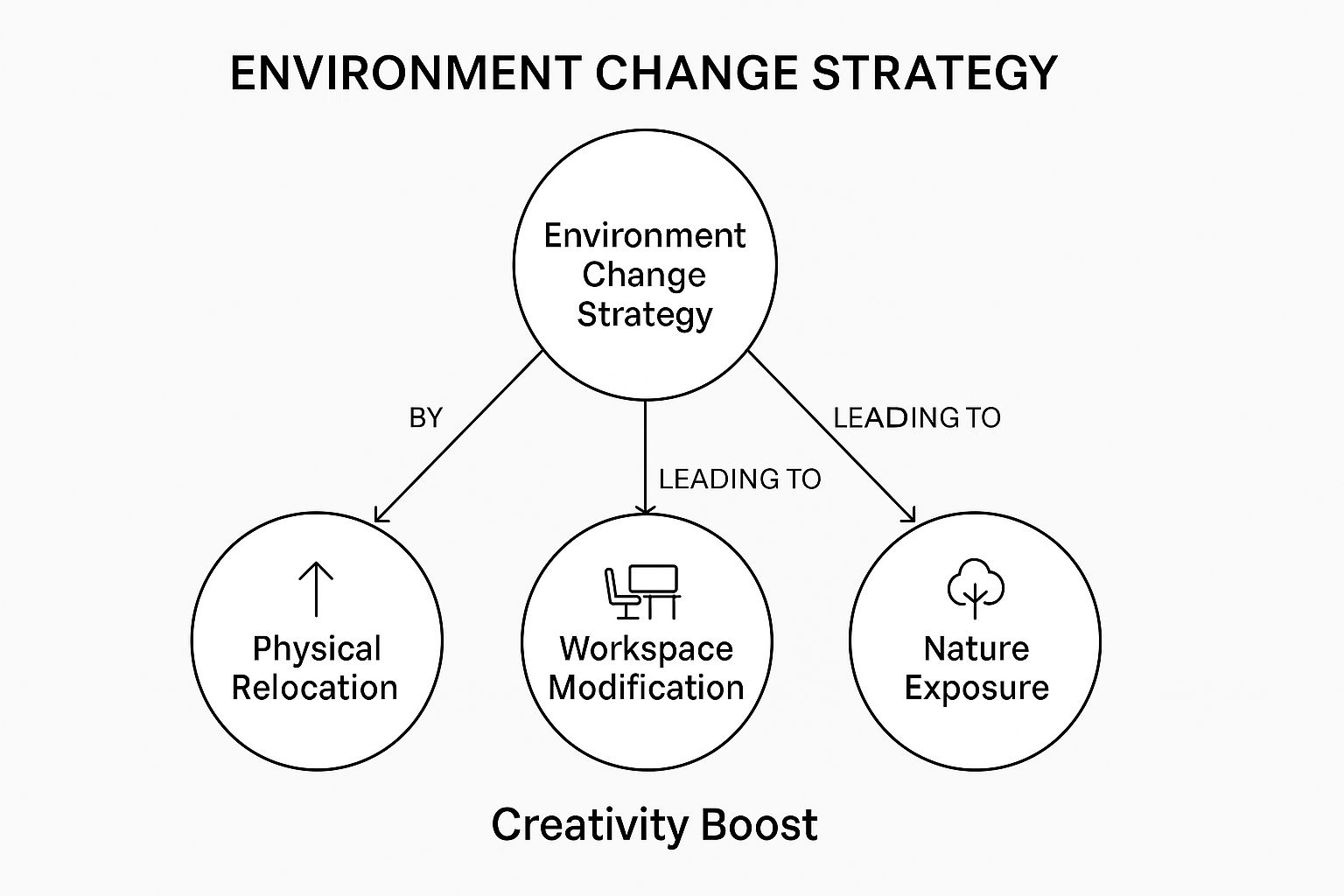
The infographic visualizes the core concept of "Environment Change" as the central idea for overcoming creative blocks. It connects this central concept to four key sub-strategies: Physical Relocation, Workspace Modification, Ambient Adjustments, and Incorporating Nature. Physical Relocation emphasizes completely changing locations, while Workspace Modification focuses on altering your existing setup. Ambient Adjustments highlight the impact of lighting, sound, and temperature, and Incorporating Nature emphasizes the benefits of natural elements. The most important relationships shown are the direct connections between the central concept and these four sub-strategies, illustrating how each contributes to a stimulating environment shift. As the infographic shows, each of these methods offers a distinct pathway to achieving a beneficial change of environment.
This strategy features several methods: physically relocating to a new space (like a coffee shop or library), modifying your existing workspace (rearranging furniture, adding plants), altering ambient conditions (adjusting lighting, playing music, changing the temperature), and incorporating natural or aesthetic elements (bringing in plants, artwork, or natural light). These changes offer an immediate shift in perspective, breaking the associations tied to unproductive thinking. This can result in a burst of inspiration, often quite quickly, and it's a technique anyone can employ.
Think of J.K. Rowling finding inspiration for Harry Potter in Edinburgh cafés, Google designing playful offices to spark creativity, Maya Angelou renting hotel rooms for focused writing, or Pixar's campus fostering "planned spontaneity." These examples demonstrate the power of a strategically chosen environment.
Pros:
- Immediate shift in perspective: A new environment can instantly disrupt stagnant thinking.
- Breaks associations with stuck thinking: Disconnecting from a frustrating workspace can free your mind.
- Can be implemented quickly: Often, a quick change of scenery is all it takes.
- Often results in immediate inspiration: The novelty of a new environment can spark fresh ideas.
- No special skills required: Anyone can benefit from this strategy.
Cons:
- May be limited by practical constraints: Not everyone has the freedom to change their workspace at will.
- Temporary effects if underlying issues aren't addressed: While helpful, environment change may not solve deep-seated creative blocks.
- Potential cost implications: Relocating to a new space can sometimes incur expenses.
- Not always feasible for team-based projects: Coordinating a change of environment for an entire team can be challenging.
Tips for Implementing the Environment Change Strategy:
- Identify environments where you've been productive before: What spaces have fostered creativity for you in the past?
- Create a dedicated creativity space free from distractions: Designate a specific area solely for creative work.
- Try working outdoors or in nature: Natural settings can be incredibly inspiring.
- Experiment with coffee shops or public spaces: The ambient hum and energy of these spaces can be stimulating.
- Change your environment before complete frustration sets in: Proactively switch locations to prevent creative burnout.
- Rotate between 2-3 different work environments: Variety keeps things fresh and prevents adaptation to any single space.
This method, popularized by figures like Stefan Sagmeister with his creative sabbaticals, Steve Jobs with his walking meetings, Google's innovative workplace design team, and even reflected in Frank Lloyd Wright's philosophy of architecture influencing creativity, offers a readily available and potent tool in your arsenal against creative block. Whether you’re an aspiring vibe coder, a seasoned software developer, a digital artist, or an entrepreneur, leveraging the Environment Change Strategy can unlock new levels of creative output.
3. Constraint-Based Creation
Feeling stifled by endless possibilities? Constraint-based creation, a powerful creative block solution, might be just what you need. This counterintuitive approach uses deliberate limitations to spark innovation. Instead of being a hindrance, well-chosen constraints can eliminate the overwhelming "paradox of choice" and channel your creative energy into focused exploration, providing a surprisingly effective remedy for creative block.
This method works by setting specific boundaries around your creative process. These boundaries can relate to your tools, resources, time, or even the subject matter itself. By limiting your options, you force yourself to think differently and discover new, innovative solutions within the defined parameters. It's like playing a game with specific rules – the rules, while seemingly restrictive, actually fuel creativity by providing a framework for exploration.
Features of Constraint-Based Creation:
- Deliberate limitations: Consciously restrict tools, time, resources, or subject matter.
- Structured creative parameters: Establish clear rules and guidelines for the creative process.
- Forced deviation from habitual approaches: Break free from ingrained patterns and explore new territories.
- Problem-specific boundaries: Tailor constraints to the specific challenge at hand.
Why This Works:
Constraint-based creation offers numerous benefits for overcoming creative block:
- Creates clear focus and direction: Boundaries provide a clear path forward, eliminating aimless wandering.
- Eliminates the paradox of choice: Reduces decision fatigue and the pressure of endless possibilities.
- Forces innovative thinking within boundaries: Challenges you to find novel solutions within the defined limitations.
- Increases efficiency of the creative process: Focused parameters can streamline the creative process.
- Produces more cohesive results: Constraints can contribute to a more unified and coherent final product.
Examples of Constraint-Based Creation in Action:
- Dr. Seuss's Green Eggs and Ham: Written using only 50 different words, demonstrating the power of limited vocabulary.
- Picasso's Blue Period: The self-imposed restriction of using primarily blue hues resulted in a distinct and evocative body of work.
- Six-Word Stories: Hemingway's famous "For sale: baby shoes, never worn" exemplifies the impact of extreme brevity.
- 48-Hour Film Competitions: Filmmakers create movies under strict time constraints, fostering rapid ideation and execution.
- Jack White's Limited Equipment: The musician is known for using limited and often unconventional equipment to fuel his creativity.
Actionable Tips for Implementing Constraint-Based Creation:
- Choose constraints that challenge rather than cripple: The goal is to stimulate creativity, not stifle it. Start with manageable limitations.
- Try time constraints (e.g., 30-minute sessions): This can be particularly effective for overcoming perfectionism.
- Limit your tools or materials: Force yourself to think outside the box with limited resources.
- Create artificial parameters (e.g., must include three specific elements): Introduce specific requirements to guide your creative process.
- Use frameworks like "SCAMPER" (Substitute, Combine, Adapt, Modify, Put to other uses, Eliminate, Reverse) to apply specific constraints: This structured approach can help you systematically explore possibilities within limitations.
When and Why to Use This Approach:
Constraint-based creation is particularly useful when:
- You're feeling overwhelmed by too many options.
- You're stuck in a creative rut and need a fresh perspective.
- You're working on a project with vague or undefined goals.
- You want to push your creative boundaries and explore new approaches.
Who Popularized It?
The power of constraints in creativity has been recognized by various figures and movements, including:
- Igor Stravinsky: The composer famously stated, "The more constraints one imposes, the more one frees oneself."
- Jack White: A musician renowned for embracing self-imposed limitations.
- Oulipo literary group: This group creates works based on specific constraints.
- Design thinking methodology (Stanford d.school): Emphasizes the use of constraints to drive innovative problem-solving.
Constraint-based creation deserves a place on this list of creative block solutions because it offers a powerful, counterintuitive, and effective way to break through creative barriers. Whether you're a seasoned developer, a digital artist, or an aspiring entrepreneur, embracing limitations can unlock unexpected creative potential and lead to truly innovative results.
4. Incubation and Unconscious Processing
Facing a creative block? Sometimes the best solution is to step away from the problem entirely. This is the core principle behind incubation and unconscious processing, a powerful technique for overcoming creative block solutions. It involves deliberately disengaging from active problem-solving to allow your unconscious mind to take over. By shifting your focus elsewhere, you give your brain the space it needs to process information in the background, forging new connections and often leading to those "aha!" moments upon returning to the task.

This method leverages the "diffuse mode" of thinking, a more relaxed and associative state where the brain can wander and explore different possibilities. This contrasts with the "focused mode," which is essential for analytical tasks but can hinder creativity when we get stuck in unproductive thought patterns. Strategic disengagement, coupled with mental rest periods between focused work sessions, allows this diffuse mode to flourish. Engage in unrelated activities during your breaks – anything from a walk in nature to listening to music or even taking a shower. These seemingly unproductive periods are actually crucial for cultivating breakthrough insights.
This approach has a proven track record. Think of Archimedes' "Eureka!" moment in the bath, Dmitri Mendeleev conceiving the periodic table in a dream, or Paul McCartney composing "Yesterday" after waking up with the melody in his head. Even Einstein's famous thought experiments often occurred during his long walks. Modern-day examples include Silicon Valley companies incorporating relaxation spaces to encourage this type of unconscious processing.
Why this technique deserves a place on this list: Incubation and unconscious processing offers a unique approach to creative block solutions by acknowledging the power of the subconscious mind. It provides a structured way to move past frustrating roadblocks and discover innovative solutions. This method is particularly valuable for complex problems where traditional brainstorming or linear thinking falls short.
Features and Benefits:
- Strategic disengagement: Intentionally stepping away from the problem.
- Mental rest periods: Allowing the brain to relax and recharge.
- Diffuse thinking: Enabling the exploration of unconventional connections.
- Reduced fixation: Breaking free from unproductive approaches.
- Minimized burnout: Preventing creative fatigue and frustration.
- Improved productivity: Leading to more novel and effective solutions.
Pros:
- Fosters novel connections unconsciously.
- Reduces fixation on unproductive approaches.
- Minimizes frustration and creative burnout.
- Can produce breakthrough insights.
- Improves overall creative productivity.
Cons:
- Requires patience and trust in the process.
- Can be mistaken for procrastination.
- Difficult to predict the timing of insights.
- May not work under tight deadlines.
Tips for Implementation:
- Schedule incubation periods: Build deliberate breaks into your creative process.
- Engage in light physical activity: Walk, shower, or do some stretching.
- Switch between projects: Avoid forcing progress on a single task.
- Capture insights immediately: Keep a notebook or voice recorder handy.
- Practice mindfulness: Enhance your awareness of subtle insights.
- Sleep on it: Literally! Let your subconscious work overnight.
This technique, popularized by figures like Graham Wallas (who formalized it in his creative process model), Barbara Oakley (known for her "Learning How to Learn" course), Salvador Dalí (who used hypnagogic sleep for inspiration), and James Webb Young (author of "A Technique for Producing Ideas"), is a valuable tool for anyone seeking to unlock their creative potential. Whether you're a seasoned coder, a digital artist, or an aspiring entrepreneur, incorporating incubation and unconscious processing can significantly enhance your ability to generate innovative ideas and overcome creative block.
5. Cross-Pollination and Interdisciplinary Learning: Breaking Creative Blocks with Outside Inspiration
Feeling stuck in a creative rut? Cross-pollination and interdisciplinary learning offer a powerful solution for overcoming creative blocks by borrowing inspiration from unexpected sources. This approach involves deliberately seeking knowledge and perspectives from fields outside your primary area of focus. By importing concepts, methods, and perspectives from unrelated disciplines, you create novel combinations and fresh insights that shatter established thinking patterns and open up exciting new avenues for creativity. This technique is particularly effective for aspiring vibe coders, experienced software developers, digital artists, creative technologists, educators, students in tech, innovative entrepreneurs, and hobbyists looking for fresh perspectives.
How it Works:
Cross-pollination leverages the power of analogical thinking, enabling you to see your problem through a different lens. By mapping concepts and solutions from one field onto another, you can identify unexpected parallels and generate truly original ideas. The core of this approach lies in combining disparate concepts through metaphorical mapping between fields, leading to breakthroughs that would be impossible within the confines of a single discipline.
Examples of Cross-Pollination in Action:
- Biomimicry in Product Design: Velcro, the ubiquitous fastener, was inspired by the tiny burrs that clung to the inventor's dog's fur. This is a classic example of nature-inspired design, showcasing how observing biological systems can lead to innovative engineering solutions.
- Steve Jobs and Calligraphy: Apple's iconic typography owes its elegance to Steve Jobs's interest in calligraphy. He applied the principles of letterforms and spacing learned in a calligraphy class to the design of computer fonts, revolutionizing the way we interact with digital text.
- Psychology in UX Design: User experience (UX) design relies heavily on principles of cognitive psychology to create intuitive and user-friendly interfaces. Understanding how people perceive and process information allows designers to optimize digital experiences for maximum effectiveness.
- Pixar's Interdisciplinary Teams: The animation studio Pixar is renowned for assembling teams comprised of individuals from diverse backgrounds, including architects, musicians, and scientists. This deliberate cross-pollination of expertise fuels their creative storytelling and technical innovation.
- Cirque du Soleil's Artistic Fusion: Cirque du Soleil redefined circus performance by blending traditional circus arts with elements of theater, dance, music, and storytelling. This interdisciplinary approach created a unique and captivating art form.
Actionable Tips for Cross-Pollination:
- Diversify Your Reading List: Explore books and journals from fields completely unrelated to your work. You never know where you might find a spark of inspiration.
- Attend Unfamiliar Conferences and Workshops: Stepping outside your disciplinary comfort zone exposes you to new ideas and perspectives.
- Collaborate Across Disciplines: Partner with professionals from different backgrounds to brainstorm and problem-solve together.
- Forge Metaphorical Connections: Create metaphors that link your creative challenge to other domains. For instance, if designing a website, think about it as an architectural structure or a musical composition.
- Forced Connections: Use techniques like 'forced connections', where you randomly select an object (e.g., a stapler) and try to find connections between its properties and your creative problem. This can spark surprisingly innovative solutions.
- Curiosity Journal: Maintain a journal where you record interesting concepts, ideas, and observations from diverse fields. This becomes a valuable resource for future creative endeavors.
Pros and Cons:
Pros:
- Creates truly original combinations and innovative solutions
- Breaks field-specific mental loops and biases
- Develops broader creative thinking skills
- Accesses proven solutions from other domains, preventing reinventing the wheel
Cons:
- Requires time investment in learning the basics of other fields
- Can be challenging to identify relevant connections
- May produce ideas that are difficult to implement practically
- Risk of superficial understanding of borrowed concepts
Why This Approach Deserves Its Place on the List:
In a world increasingly demanding innovative solutions, cross-pollination provides a crucial skillset for anyone facing creative blocks. This approach not only helps generate novel ideas but also cultivates a more adaptable and resilient creative mindset. By embracing the power of interdisciplinary learning, you equip yourself with the tools to overcome creative challenges and unlock your full innovative potential. This technique is particularly effective for the target audience due to its inherent blend of technical problem-solving and artistic expression, often requiring innovative and original approaches to thrive. The diverse backgrounds and perspectives within this audience make cross-pollination a natural and effective creative block solution. Inspired by figures like Leonardo da Vinci, Frans Johansson (The Medici Effect), Steven Johnson (Where Good Ideas Come From), Brian Eno (Oblique Strategies cards), and the MIT Media Lab's antidisciplinary approach, cross-pollination stands as a proven method for generating groundbreaking ideas and breaking free from creative stagnation.
6. Structured Creative Rituals
Struggling with creative block? Sometimes the hardest part of the creative process is simply starting. Structured creative rituals offer a powerful solution to this common problem, providing a reliable pathway to bypass psychological resistance and unlock your creative flow. This strategy involves designing personalized routines and habits that signal to your brain it's time to create. By developing these procedural triggers, you create psychological and neurological conditions conducive to generating innovative ideas and reducing decision fatigue. This makes structured rituals a valuable tool for aspiring vibe coders, experienced software developers, digital artists, and anyone working in a creative field.
This method works by leveraging the power of habit and conditioning. By consistently engaging in a specific sequence of actions before creative work, you essentially train your mind to associate those actions with the creative process. This bypasses the conscious decision-making process that often leads to procrastination and creative blocks. Consistent preparatory sequences, specific environmental and behavioral cues, and temporal and spatial consistency all contribute to the effectiveness of this technique. For instance, you might establish a mini-ritual of making a specific type of tea, listening to a particular playlist, and then opening your coding environment. Over time, this sequence becomes a trigger, signaling to your brain that it's time to focus and create.
History is rife with examples of prominent creatives using structured rituals. Maya Angelou famously rented hotel rooms to write undisturbed from 7 am to 2 pm daily. Stephen King adheres to a rigorous writing schedule, producing exactly 2,000 words every day before noon. Haruki Murakami maintains a strict routine involving a 5 am wake-up, a precise running schedule, and dedicated writing time. Even Beethoven had a ritual, meticulously counting 60 beans for each cup of coffee. These examples demonstrate the power of rituals to establish a sustainable creative practice. Learn more about Structured Creative Rituals and see how they can be applied to digital design and development workflows.
Actionable Tips for Implementing Structured Creative Rituals:
- Identify Your Specific Block: Determine whether your ritual should address starting, continuing, or finishing a project.
- Incorporate Physical Movement: Engage in activities like walking, stretching, or yoga to shift your mental state and prepare for creative work.
- Engage Your Senses: Use specific music, scents, or textures to create a conducive environment for creativity.
- Start Small: Begin with mini-rituals of 5-10 minutes and gradually build upon them as you discover what works.
- Document Your Process: Keep a creative process journal to track the effectiveness of different rituals and identify patterns.
- Maintain Consistency: Adhere to your chosen time and environment as consistently as possible to reinforce the association with creative work.
- Establish an Ending Ritual: Create a clear ending to your creative sessions to psychologically "complete" the process and prepare for a break.
Pros and Cons of Structured Creative Rituals:
Pros:
- Bypasses psychological resistance to starting.
- Reduces decision fatigue and willpower depletion.
- Creates Pavlovian creative conditioning.
- Establishes a sustainable creative practice.
- Can trigger flow states more reliably.
Cons:
- Can become superstitious rather than functional.
- May take time to establish effectiveness.
- Potential for rigidity if over-relied upon.
- Disruption of rituals can be destabilizing.
Structured creative rituals are a powerful tool for anyone seeking consistent creative output. By understanding the principles behind this technique and implementing the tips provided, you can develop personalized rituals that help you overcome creative block and unlock your full creative potential. These strategies aren't just for established artists; they can be incredibly beneficial for educators, students, entrepreneurs, and hobbyists seeking creative "creative block solutions" in their respective fields.
7. Mind-Body Intervention Techniques
Feeling stuck in a creative rut? Sometimes the best way to overcome a creative block isn't through more brainstorming, but through changing your physical state. Mind-body intervention techniques offer potent creative block solutions by leveraging the connection between your body and mind. Based on embodied cognition theory, this approach recognizes that our cognitive processes are deeply intertwined with our physical states. By intentionally altering our physical conditions, we can influence thought patterns and unlock creative flow. This makes it a valuable tool for aspiring vibe coders, experienced software developers, digital artists, creative technologists, educators, students, entrepreneurs, and hobbyists alike.
How It Works:
Mind-body interventions utilize a variety of techniques to shift your physiological state and, in turn, your mental state. These include:
- Movement-based creativity boosters: Simple acts like walking, stretching, or dancing can dramatically impact creative thinking.
- Breathwork and physiological regulation: Controlling your breath can influence your nervous system and reduce stress, paving the way for clearer thinking.
- Somatic awareness practices: Paying attention to internal bodily sensations can help identify and release physical tension that might be hindering creativity.
- Neurologically-informed physical interventions: Techniques like the Feldenkrais Method and the Alexander Technique use specific movements to re-educate the nervous system and improve coordination and flexibility, both physically and mentally.
Why This Approach Deserves Its Place on the List:
This method offers a unique advantage over purely cognitive approaches to creative block solutions. It bypasses mental resistance by working directly with the body, creating immediate state changes that can quickly unlock creative flow. The benefits extend beyond just overcoming creative blocks and contribute to overall wellbeing, making it a sustainable and valuable practice.
Examples of Success:
- A Stanford study showed a 60% increase in creative output after walking. This demonstrates the powerful impact of movement on creative thinking.
- Actors commonly utilize breathing techniques before improvisation exercises to enhance spontaneity and creative expression.
- Companies like Google and Apple incorporate movement breaks into work schedules to promote employee wellbeing and boost creativity.
- The Alexander Technique is used by musicians to overcome performance blocks and improve technical skill.
- The Feldenkrais Method is increasingly applied in artistic education to enhance creativity and expressiveness.
Actionable Tips:
- Integrate bilateral movement: Engage both sides of your body in activities like walking, swimming, or drumming to activate whole-brain thinking.
- Practice box breathing: Use the 4-4-4-4 pattern (inhale for 4 seconds, hold for 4, exhale for 4, hold for 4) before tackling difficult creative challenges.
- Strike a power pose: Hold a confident posture for two minutes to boost self-assurance before presenting ideas or starting a creative project.
- Try inverted positions (safely): Headstands or shoulder stands can increase blood flow to the brain (consult a healthcare professional before trying inversions).
- Vary your work posture: Alternate between sitting, standing, and moving while working to prevent physical stagnation and maintain mental agility.
- Use "body storming": Physically act out potential solutions to problems. This kinesthetic approach can lead to unexpected breakthroughs.
Pros and Cons:
Pros:
- Bypasses purely cognitive resistance
- Creates immediate state changes
- Can be implemented anywhere
- Addresses biological factors in creative blocks
- Beneficial for overall wellbeing beyond creativity
Cons:
- Effectiveness varies between individuals
- Some techniques require practice to master
- May feel disconnected from creative goals initially
- Some approaches require specific physical capabilities
Popularized By:
Marily Oppezzo & Daniel Schwartz (Stanford walking study), Amy Cuddy (power posing research), Moshe Feldenkrais (Feldenkrais Method), Martha Graham (movement and creative expression), Wim Hof (breathwork methods).
8. Systematic Skill Development
Feeling stuck in a creative rut? Instead of waiting for inspiration to strike, consider a more proactive approach: systematic skill development. This creative block solution reframes the problem, viewing creative blocks not as a lack of inspiration, but as gaps in your skillset. By methodically identifying and honing your technical abilities, you build a strong foundation that fosters creativity and reduces reliance on those unpredictable bursts of insight. This approach is particularly relevant for aspiring vibe coders, experienced software developers, digital artists, creative technologists, educators, students in tech, innovative entrepreneurs, and hobbyists who want to build reliable creative capacity.
This strategy works by shifting your focus from the elusive muse to the tangible realm of skill acquisition. Think of it like building a house: inspiration might provide the blueprint, but skills are the bricks, mortar, and tools that bring it to life. Through deliberate practice of fundamental skills, targeted study of technical elements, and structured skill acquisition pathways, you equip yourself with the necessary tools to execute your creative vision. Implementing progress metrics and feedback systems further refines this process, allowing you to identify weaknesses and track improvement.
Many successful creatives have employed variations of this approach. Pixar artists, for example, engage in daily sketching drills, regardless of whether they feel inspired. Ira Glass talks about “closing the taste gap” through the sheer volume of work, emphasizing consistent practice over waiting for the perfect idea. Jerry Seinfeld’s “don’t break the chain” calendar method promotes daily engagement, while Stephen King's combined reading and writing quotas demonstrate a dedication to continuous skill development. Even Mozart's prolific and seemingly “inspired” compositions were underpinned by years of rigorous musical training. Learn more about Systematic Skill Development.
Features of Systematic Skill Development:
- Deliberate Practice of Fundamental Skills: Focusing on specific areas for improvement, rather than just passively creating.
- Targeted Study of Technical Elements: Deep dives into specific techniques or technologies relevant to your field.
- Structured Skill Acquisition Pathways: Creating a roadmap for learning, from beginner to advanced levels.
- Progress Metrics and Feedback Systems: Tracking your progress and seeking feedback to identify areas for improvement.
Pros:
- Builds lasting creative capacity: It empowers you to create consistently, regardless of inspiration levels.
- Reduces dependence on fleeting inspiration: You become less reliant on unpredictable moments of insight.
- Creates confidence that overcomes hesitation: Mastery of skills empowers you to tackle new challenges with assurance.
- Allows focus on incremental improvement: Small, consistent gains lead to significant long-term progress.
- Provides tangible progress during creative dry spells: Even when inspiration is lacking, you can still make progress by honing your skills.
Cons:
- Less immediately exciting than inspiration-based approaches: It requires discipline and patience, which can feel less glamorous than waiting for the muse.
- Requires sustained effort and discipline: Consistent practice takes dedication and effort.
- May temporarily feel mechanical: Focusing on technical skills can sometimes feel less creative initially.
- Doesn't address emotional barriers to creativity: This approach primarily focuses on technical skills, not emotional blocks.
Actionable Tips:
- Identify the specific technical skills that would most improve your work: What are the weak points in your creative arsenal?
- Create a skill inventory with beginner/intermediate/advanced classifications: This provides a roadmap for your learning journey.
- Practice micro-skills in isolation before integration: Break down complex skills into smaller, manageable chunks.
- Set up quantifiable daily practice goals (time or output-based): This allows you to track your progress and stay motivated.
- Create a 'skills development only' time separate from project work: Dedicate specific time for focused skill-building.
- Use the 'copy masters, copy masterpieces' approach to skill building: Learn from the best by studying and replicating their work.
- Maintain a learning log to document progress: This helps you visualize your growth and identify areas for further development.
Systematic skill development deserves its place on this list because it provides a concrete, actionable path towards overcoming creative blocks. While inspiration can be a powerful catalyst, it's unreliable. By focusing on building a strong foundation of technical skills, you create a wellspring of creative potential that you can tap into at any time. This approach empowers you to take control of your creative journey and build a sustainable, fulfilling creative practice.
Creative Block Solutions Comparison
| Strategy | Implementation Complexity 🔄 | Resource Requirements ⚡ | Expected Outcomes 📊 | Ideal Use Cases 💡 | Key Advantages ⭐ |
|---|---|---|---|---|---|
| Divergent Thinking Exercises | Medium 🔄 | Moderate (time, facilitation) ⚡ | High idea generation, creativity boost 📊 | Creative brainstorming, idea generation sessions 💡 | Breaks habitual patterns, unexpected connections ⭐ |
| Environment Change Strategy | Low 🔄 | Low to Moderate ⚡ | Immediate perspective shift, fresh stimuli 📊 | Overcoming blocks quickly, when stuck in routine 💡 | Quick implementation, no special skills needed ⭐ |
| Constraint-Based Creation | Medium 🔄 | Low ⚡ | Focused innovation, cohesive results 📊 | Projects needing focused creativity under limits 💡 | Eliminates choice paralysis, increases efficiency ⭐ |
| Incubation & Unconscious Processing | Low 🔄 | Low ⚡ | Sudden insights, reduced burnout 📊 | Tasks allowing breaks, needing deeper insight 💡 | Enables breakthrough moments, mental rest boost ⭐ |
| Cross-Pollination & Interdisciplinary Learning | High 🔄 | High (time + learning) ⚡ | Original combinations, broad creative thinking 📊 | Long-term innovation, novel problem solving 💡 | Produces truly original ideas, diverse perspectives ⭐ |
| Structured Creative Rituals | Medium 🔄 | Low ⚡ | Reliable creative flow, reduced start resistance 📊 | Habit formation, overcoming initiation blocks 💡 | Reduces decision fatigue, triggers flow states ⭐ |
| Mind-Body Intervention Techniques | Medium 🔄 | Low to Moderate ⚡ | Immediate state change, well-being boost 📊 | Creativity affected by physical state, quick resets 💡 | Bypasses cognitive resistance, enhances neuroplasticity ⭐ |
| Systematic Skill Development | High 🔄 | High (time, effort) ⚡ | Long-term creative capacity, confidence 📊 | Skill gaps, building foundational abilities 💡 | Builds lasting capacity, reduces reliance on inspiration ⭐ |
Embrace the Journey: Creative Blocks as Stepping Stones
From divergent thinking exercises to mind-body interventions, we've explored eight powerful creative block solutions to help you reignite your innovative spark. The most important takeaway is that overcoming these blocks isn't about brute force; it's about understanding your creative process and employing the right strategies at the right time. Mastering these approaches, whether you're a seasoned software developer, a digital artist pushing the boundaries of vibe coding, or an entrepreneur seeking the next big idea, allows you to navigate the inevitable hurdles of the creative process with resilience and intention.
Remember the key strategies we discussed: shifting your environment, embracing constraints, allowing for incubation, cross-pollinating ideas from different fields, establishing creative rituals, utilizing mind-body techniques, and consistently developing your skills. Each of these creative block solutions offers a unique pathway to unlock your potential. By incorporating these techniques into your creative workflow, you transform frustrating roadblocks into opportunities for growth, innovation, and deeper self-discovery. If you're still feeling stuck, check out this helpful resource with more strategies for overcoming creative blocks from 2025 Creative Block Solutions: Ignite Your Genius by Bulby.
Ultimately, creativity thrives on exploration and experimentation. Just as vibe coding at Vibecoding VIP blends technical expertise with artistic expression, so too does navigating creative blocks allow you to refine your craft, discover new perspectives, and ultimately, produce work that resonates with authenticity and brilliance. The next time you face a creative challenge, don't be discouraged. Instead, view it as a stepping stone on your creative journey. Choose a strategy, experiment fearlessly, and rediscover the joy of creating.