Stuck in a Creative Rut? Let's Fix That!
Creative block can stifle any project. This listicle provides seven powerful creative block solutions to reignite your creative spark. Learn practical strategies applicable to any creative field, from vibe coding to software development and digital art. Discover how techniques like the Morning Pages, mind mapping, and constraint-based creation can help you overcome obstacles and generate fresh ideas. We'll also explore how environmental changes, divergent thinking, incubation, and cross-pollination can unlock your creative potential. Stop staring at a blank canvas and start creating again!
1. The Morning Pages Technique
Feeling stuck in a creative rut? The Morning Pages technique might be just the creative block solution you need. Developed by Julia Cameron and popularized in her book The Artist's Way, this method involves writing three pages of stream-of-consciousness content first thing upon waking. It's a powerful tool for clearing mental blocks and fostering creativity across various disciplines, from coding and software development to digital art and entrepreneurial endeavors. By externalizing the thoughts, worries, and random ideas that clutter your mind, you essentially create space for fresh, creative insights to emerge.

The core of this technique lies in its simplicity. It's about unfiltered, handwritten freewriting—three full pages of it—done before you engage with the demands of the day. The content isn't meant to be shared, judged, or even reread. Think of it as a mental decluttering exercise. This consistent daily practice helps bypass your inner critic, allowing ideas to flow freely without the constraints of self-censorship.
The Morning Pages technique has proven beneficial for countless artists and writers seeking to revitalize their creative practice. High-profile figures like Tim Ferriss have incorporated modified versions into their productivity routines, while author Elizabeth Gilbert has cited a similar practice as instrumental in overcoming creative challenges. This widespread adoption speaks to its effectiveness as a creative block solution.
Features of the Morning Pages Technique:
- Handwritten: Three full pages are required.
- Stream-of-consciousness: Write whatever comes to mind without filtering.
- Timing: Done first thing in the morning.
- Privacy: Not meant to be shared or judged.
- Consistency: A regular daily practice is key.
Pros:
- Accessibility: Requires no special skills or tools, just a pen and paper.
- Insightful: Helps identify recurring patterns in your thinking.
- Habit-forming: Creates a daily creative ritual.
- Liberating: Bypasses the inner critic and promotes uninhibited expression.
- Therapeutic: Can reduce stress and anxiety.
Cons:
- Time commitment: Typically takes 30-45 minutes.
- Delayed gratification: Benefits may not be immediately apparent.
- Discipline required: Consistency is crucial for success.
- Subjective value: Can feel pointless to some practitioners.
- Physical strain: Handwriting can be challenging for those accustomed to typing.
Tips for Implementing the Morning Pages Technique:
- Use a physical notebook: Avoid digital devices to minimize distractions and engage more fully with the process.
- Write continuously: Don't stop to think or edit. Keep your pen moving.
- Embrace imperfection: Don't worry about quality, grammar, or making sense.
- Maintain privacy: Keep your pages private to ensure complete honesty.
- Commit to consistency: Try the technique for at least 30 days before evaluating its effectiveness.
This method deserves its place on this list because it offers a simple yet profound way to address creative blocks. By clearing mental clutter and fostering a daily habit of creative expression, the Morning Pages technique empowers you to tap into your creative potential and overcome the obstacles that hinder your progress. Whether you're a seasoned software developer, a budding digital artist, or an innovative entrepreneur, this technique can provide the mental clarity and creative spark you need to thrive.
2. Mind Mapping for Idea Generation
When creative block hits, it can feel like staring at a blank canvas with no inspiration in sight. Mind mapping offers a dynamic solution to this common problem. It's a non-linear brainstorming technique that visually organizes information around a central concept, mimicking how our brains naturally connect ideas. Starting with a core idea, you branch out with related thoughts, creating a visual network of keywords, images, and colors. This approach helps overcome creative blocks by stimulating free association and dismantling rigid thinking patterns, making it a powerful tool for anyone seeking creative block solutions.
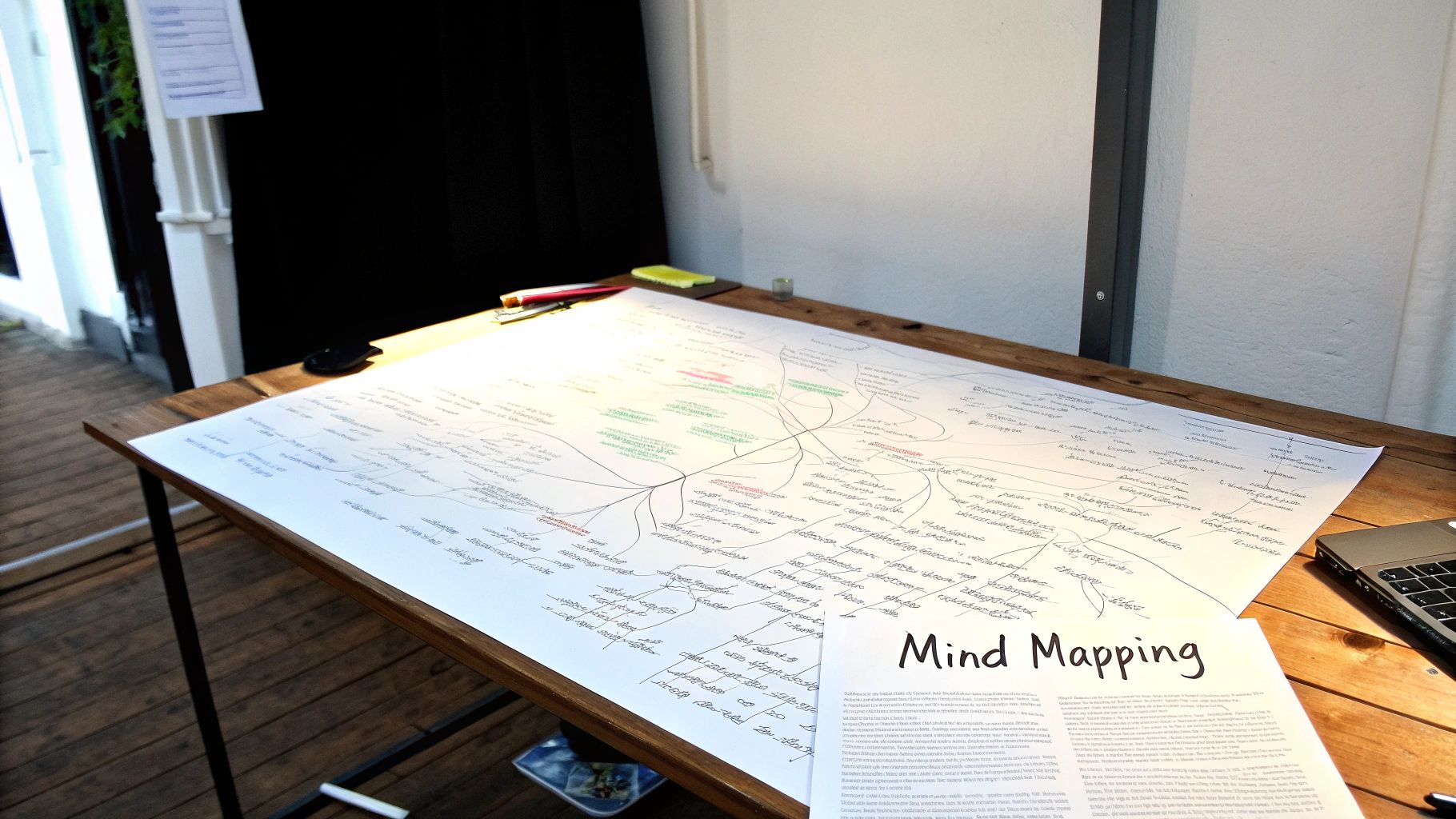
Mind mapping's radiating structure unlocks the potential for rapid idea generation. Its visual nature makes the relationships between ideas readily apparent, providing a clear overview of the brainstorming process. This technique engages both analytical and creative brain functions, fostering a holistic approach to problem-solving. Whether you're developing a software application, designing a piece of digital art, crafting a compelling story, or strategizing a business plan, mind mapping can be an invaluable asset.
Examples of successful implementation demonstrate its versatility. Disney's creative teams leverage mind mapping for story development, while advertising agencies like BBDO employ it for campaign ideation. Even acclaimed author J.K. Rowling utilized this technique to plot the intricate world of the Harry Potter series. This widespread adoption highlights the effectiveness of mind mapping across diverse creative fields.
Here are some actionable tips to maximize your mind mapping experience:
- Start with a clear central question or concept: Define the core focus of your brainstorming session.
- Use colors to categorize different types of ideas: This adds visual clarity and helps organize your thoughts.
- Don't self-censor during the initial mapping phase: Embrace the free flow of ideas without judgment.
- Review and refine your map after the initial brain dump: Organize and prioritize the generated ideas.
- Try both digital and analog methods to find your preference: Experiment with pen and paper or digital tools to discover your preferred approach. Learn more about Mind Mapping for Idea Generation for insights into digital tools like Figma.
While mind mapping offers numerous benefits, it also has some potential drawbacks. Complex topics can lead to messy and overwhelming maps, particularly for those accustomed to linear thinking. Digital tools often have learning curves, and paper versions can be limited by space. However, the advantages of mind mapping, particularly for breaking through creative blocks, often outweigh these limitations.
Pros:
- Engages both analytical and creative thinking
- Visualizes relationships between ideas
- Less restrictive than linear note-taking
- Facilitates rapid idea generation
- Useful for individual and group brainstorming
Cons:
- Can become complex with intricate topics
- May be challenging for linear thinkers
- Digital tools have learning curves
- Paper versions have space constraints
- Can feel unstructured for some
This method deserves its place on this list because it provides a structured yet flexible framework for idea generation. By visually connecting concepts and encouraging free association, mind mapping helps overcome creative blocks and unlock innovative thinking. The technique, popularized by Tony Buzan and integrated into methodologies like Design Thinking and Getting Things Done, has become a staple for creative professionals and problem-solvers across various disciplines.
3. Constraint-Based Creation
When grappling with creative block, the vast expanse of possibilities can be paralyzing. Constraint-based creation offers a powerful creative block solution by flipping this open-endedness on its head. It involves deliberately imposing limitations on your creative process to spark innovation. By working within specific boundaries—whether those are time limits, restricted materials, conceptual constraints, or defined formats—you force your brain to find novel solutions and forge new paths forward. This approach leverages the psychological principle that constraints, paradoxically, enhance creativity by eliminating the overwhelm that can come with unlimited options. Instead of feeling stifled, you'll find yourself energized by the challenge of working within a defined framework.

This method deserves a spot on any list of creative block solutions because it offers a structured, actionable approach to overcoming creative stagnation. Features like deliberately imposed limitations, the option to use time, resource, or conceptual constraints, and its adaptability to different intensity levels based on individual needs, make it a versatile tool for various creative fields. This is especially relevant for vibe coders, software developers, digital artists, and other creative technologists who often face the challenge of innovating within technical limitations. By framing these limitations as opportunities, you can transform potential roadblocks into springboards for creative breakthroughs. Learn more about Constraint-Based Creation
Think of Dr. Seuss, who wrote "Green Eggs and Ham" using only 50 different words after accepting a bet. Or consider the Dogme 95 movement in filmmaking, spearheaded by Lars von Trier, which imposed strict rules on production, forcing filmmakers to find creative solutions within those limitations. Even Instagram's initial square photo format constraint inadvertently led to a new aesthetic in photography. These examples illustrate how limitations can breed innovation.
Pros:
- Prevents analysis paralysis: By narrowing the field of possibilities, constraint-based creation eliminates the overwhelming feeling of having too many options.
- Creates focus and direction: Constraints provide a clear framework, making it easier to get started and stay on track.
- Generates unexpected solutions: Working within limitations often leads to surprising and innovative outcomes.
- Speeds up the creative process: The defined structure can streamline workflow and accelerate the generation of ideas.
- Makes starting easier: Having a set of rules or limitations can make the initial hurdle of beginning a project less daunting.
Cons:
- Initial frustration: Getting used to working within limitations can initially feel restrictive and uncomfortable.
- Overly restrictive constraints: Choosing the wrong limitations can hinder creativity rather than enhance it.
- Not always successful: Not every constraint will lead to a productive outcome.
- Potential for formulaic work: Over-reliance on specific constraints can lead to repetitive or predictable results.
- Requires practice: Identifying productive constraints requires experimentation and refinement.
Actionable Tips for Implementing Constraint-Based Creation:
- Start small with time constraints: Utilize techniques like the Pomodoro Technique (25 minutes of focused work) to create a sense of urgency and focus.
- Limit your materials or tools: Restrict yourself to a specific set of colors, brushes, software features, coding languages, or other tools.
- Create arbitrary rules: Challenge yourself with unique rules, such as writing a story without using the letter 'e' or developing a piece of software with only a limited number of lines of code.
- Use prompts or themes: Focus your work by using specific prompts or themes as starting points.
- Gradually modify constraints: If a constraint feels too limiting, adjust it to find a balance between challenge and freedom.
By embracing constraint-based creation, you can transform creative blocks into opportunities for innovation and discover new dimensions of your creative potential.
4. Physical Environment Change
When creative block hits, sometimes the best solution is to physically change your surroundings. This powerful method exposes your brain to new stimuli, disrupting habitual thinking patterns and offering fresh perspectives. It works by essentially forcing your brain out of its rut. Novel surroundings require your brain to process new information, sparking creative connections and insights that may not have been accessible in familiar settings. This could involve something as simple as relocating to a different room in your house or as dramatic as traveling to a new country.

This technique offers a range of implementation options, from minor adjustments to major shifts. It engages different sensory inputs – sights, sounds, smells, even textures – all contributing to the disruption of routine thought. These changes can be temporary, like working from a coffee shop for an afternoon, or more permanent, like redesigning your workspace. The change can involve immersing yourself in nature, exploring a bustling urban environment, or simply finding a new workspace.
This method deserves its place on this list of creative block solutions because of its immediacy and effectiveness. It offers a readily accessible way to jumpstart creativity, often requiring minimal effort yet yielding significant results.
Features and Benefits:
- Variable Scale: Adapt the change to your needs and resources, from minor tweaks to major overhauls.
- Sensory Engagement: Stimulate multiple senses, providing a richer and more immersive experience.
- Routine Disruption: Break free from ingrained thinking patterns that may be hindering creativity.
- Flexibility: Implement changes temporarily or permanently based on your preferences and situation.
- Versatility: Explore diverse environments, including natural settings, urban landscapes, and various workspaces.
Pros:
- Immediate Perspective Shift: Experience a rapid change in viewpoint and thought processes.
- Enhanced Sensory Stimulation: Ignite creativity through novel sights, sounds, smells, and textures.
- Quick Implementation: Easily incorporate small changes without significant disruption.
- Spontaneous Insights: Facilitate unexpected breakthroughs and new ideas.
- Synergy with Other Techniques: Combine with other creative block solutions for enhanced effectiveness.
Cons:
- Cost and Practicality: Major changes, like travel, can be expensive and logistically challenging.
- Temporary Effects: The benefits may be short-lived, requiring ongoing environmental shifts.
- Potential for Distraction: New environments can be overstimulating for some, hindering focus.
- Comfort Zone Challenge: Stepping outside of familiar surroundings can be uncomfortable for some individuals.
- Feasibility Constraints: Work and life commitments may restrict the ability to implement certain changes.
Examples:
- J.K. Rowling famously finished writing the Harry Potter series in cafés when struggling with writer's block at home.
- Ernest Hemingway frequently changed his writing locations to overcome creative stagnation.
- Steve Jobs utilized walking meetings to foster innovative thinking and problem-solving.
- Pixar designed its office space to encourage serendipitous encounters and collaboration among employees.
Tips for Implementation:
- Start Small: Rearrange your furniture, work from a café, or find a new spot in your home.
- Embrace Nature: Incorporate natural elements into your environment whenever possible—visit parks, beaches, or forests.
- Vary Time and Location: Experiment with working at different times of day in various settings.
- Dedicated Creative Space: Create a specific area solely for creative pursuits, separated from your everyday life.
- Virtual Environments: When physical travel is impractical, use ambient sounds or virtual reality to simulate new environments.
Popularized By:
- Stefan Sagmeister, who famously closes his design studio every seven years for a sabbatical year.
- The digital nomad movement, embracing location independence and remote work.
- Ray Oldenburg's "Third Place" theory, highlighting the importance of social spaces beyond home and work.
- Coworking spaces like WeWork, providing flexible and collaborative work environments.
- Creative retreats and artist residency programs, offering dedicated spaces for artistic exploration.
This approach is particularly relevant for our target audience of aspiring vibe coders, software developers, digital artists, creative technologists, educators, students, and innovative entrepreneurs. These individuals often face demanding creative challenges and can benefit significantly from the fresh perspective and inspiration that a change of environment can offer. By strategically altering your surroundings, you can unlock new levels of creativity and overcome the frustrating barriers of creative block.
5. Divergent Thinking Exercises
Feeling stuck in a creative rut? Divergent thinking exercises can be a powerful solution for overcoming creative block and igniting innovative thinking. These structured activities are designed to generate a multitude of potential solutions, rather than focusing on a single "right" answer. By pushing your brain to explore unusual connections and consider alternatives, divergent thinking bypasses the critical, analytical mind – the very thing often responsible for the block in the first place. This makes it a valuable tool for aspiring vibe coders, experienced software developers, digital artists, creative technologists, educators, students, entrepreneurs, and hobbyists alike.
How Divergent Thinking Exercises Work:
Divergent thinking operates on the principle of quantity over quality, at least initially. The goal is to generate as many ideas as possible, suspending judgment and embracing even the seemingly absurd. This process often involves specific prompts or frameworks, sometimes timed to enhance spontaneity and pressure. The playful and unusual nature of these exercises can unlock unexpected connections and fresh perspectives.
Features and Benefits:
- Focus on Quantity and Variety: The emphasis is on generating a wide range of ideas, not perfecting a single one.
- Suspension of Judgment: Critical evaluation is postponed until later stages, allowing for free-flowing ideation.
- Prompts and Frameworks: Structured exercises provide guidance and stimulate thinking.
- Timed Exercises: Constraints can boost creativity and encourage rapid idea generation.
- Playful Approach: The often-unconventional nature of these exercises can make the process more engaging and less intimidating.
Examples of Divergent Thinking in Action:
- "How Might We" Questions (IDEO): This popular framework helps reframe problems into opportunities for innovation. For example, instead of asking "How do we fix this buggy code?", you might ask "How might we create a more stable and user-friendly coding experience?"
- Crazy 8s: A rapid sketching exercise where participants generate eight quick sketches in eight minutes, forcing quick thinking and visual exploration. This is perfect for brainstorming UI/UX designs or visual effects.
- Google Sprints: These structured workshops incorporate divergent thinking exercises to rapidly develop and test new ideas within a week.
- Unusual Uses: A classic exercise challenging participants to list as many unconventional uses for an everyday object as possible (e.g., a brick). This can be adapted for software development by considering unusual applications of a particular technology.
Actionable Tips for Implementing Divergent Thinking Exercises:
- Set a Target Number: Aim for a specific number of ideas to push yourself beyond your comfort zone (e.g., 50 ideas).
- Embrace "Yes, and…": Build on existing ideas instead of shutting them down with "no, but…". This fosters collaboration and expands possibilities.
- SCAMPER Technique: Use this checklist (Substitute, Combine, Adapt, Modify, Put to other uses, Eliminate, Reverse) to generate variations on an existing idea.
- Time-Boxing: Set time limits for each exercise to increase spontaneity and prevent overthinking.
- Build on Wild Ideas: Don't dismiss seemingly impractical ideas; they can often spark more realistic and innovative solutions.
Pros and Cons:
Pros:
- Rapidly generates numerous possibilities.
- Breaks habitual thinking patterns.
- Can be done individually or in groups.
- Often produces unexpected connections.
- Accessible to people of all creative backgrounds.
Cons:
- Requires following up with convergent thinking (evaluating and selecting the best ideas) to be practical.
- Can generate many unusable ideas alongside good ones.
- May feel silly or pointless to some participants.
- Benefits from facilitation or structure.
- Quality of outcomes varies widely.
Why Divergent Thinking Deserves a Place on this List:
Divergent thinking exercises offer a concrete and accessible way to break through creative blocks. By shifting the focus from finding the "right" answer to generating a wide array of possibilities, these exercises unlock the potential for truly innovative thinking. This is crucial for anyone working in a creative field, from developing software to designing user interfaces to crafting compelling digital art. By understanding the principles and applying the techniques outlined above, you can harness the power of divergent thinking to unlock your creative potential and overcome any creative block solution you encounter.
6. Incubation and Distance: Unlock Your Creative Potential
Feeling stuck in a creative rut? Incubation and distance might be the creative block solution you've been searching for. This powerful technique leverages the incredible processing power of your unconscious mind to break through barriers and generate innovative ideas. It deserves a place on this list because it tackles the root of creative block: mental fatigue and over-focus. By strategically stepping away, you allow your brain to work its magic behind the scenes.
Incubation involves deliberately disengaging from a creative problem, allowing your subconscious to process information and forge new connections. This can range from short breaks, like a 15-minute walk, to extended periods, like sleeping on a problem. The core principle is to trust that your brain continues working on the problem even when you're not consciously focused on it. This method is particularly effective when paired with unrelated activities that engage different modes of thinking, such as physical exercise, listening to music, or socializing.
This method works because our brains often get bogged down by conscious, linear thinking when grappling with creative challenges. By shifting to unconscious processing, we open ourselves up to a wider range of potential solutions and insights that might not have been accessible through direct effort. The benefits are numerous: it reduces frustration and creative anxiety, prevents diminishing returns from forced effort, and can lead to those coveted "aha!" moments. Furthermore, it promotes overall creative well-being by fostering a healthier relationship with the creative process.
History is filled with examples of successful incubation. Archimedes' famous "Eureka!" moment came while taking a bath, a perfect illustration of how distance from a problem can spark a breakthrough. Dmitri Mendeleev conceived the periodic table in a dream, and the structure of benzene appeared to August Kekulé in a daydream about a snake biting its tail. Even Paul McCartney reportedly composed "Yesterday" in a dream. These anecdotes demonstrate the power of allowing the unconscious mind to take the reins.
Actionable Tips for Leveraging Incubation and Distance:
- Schedule deliberate breaks: Integrate short breaks into your creative workflow, even when you're not feeling blocked. These regular intervals of disengagement can prevent burnout and maintain creative momentum.
- Diversify your thinking: Engage in activities that use different cognitive functions. Physical activity, meditation, socializing, and even playing video games can all stimulate different parts of the brain and foster creative connections.
- Keep capture tools handy: Inspiration can strike at any time, especially during incubation. Keep a notebook, voice recorder, or note-taking app nearby to capture those fleeting insights.
- Set a return time: While embracing distance is crucial, setting a specific time to return to the problem prevents indefinite procrastination. This provides a structured framework for the incubation period.
- Strategic sleeping: Review the problem before bed. Sleep can be a powerful incubator for creative solutions.
Pros:
- Leverages natural brain processes
- Reduces frustration and creative anxiety
- Can lead to breakthrough "aha!" moments
- Prevents diminishing returns from forced effort
- Improves overall creative well-being
Cons:
- May feel counterproductive or like procrastination
- Requires patience and trust in the process
- Difficult to predict when insights will emerge
- Not ideal for strict deadlines
- Can be challenging to explain to collaborators or clients
Incubation and distance is a highly effective creative block solution, especially for aspiring vibe coders, experienced software developers, digital artists, and creative technologists. It's also a valuable tool for educators, students, entrepreneurs, and hobbyists who rely on innovative thinking. By understanding how to leverage the power of your unconscious mind, you can unlock new levels of creative potential and overcome even the most stubborn creative blocks.
7. Cross-Pollination and Interdisciplinary Approaches
Feeling stuck in a creative rut? Cross-pollination and interdisciplinary approaches offer a powerful solution for overcoming creative blocks and generating truly original work. This method involves deliberately exposing yourself to ideas, techniques, and perspectives from fields outside your primary creative domain. Whether you're an aspiring vibe coder, a seasoned software developer, a digital artist, or an innovative entrepreneur, embracing cross-pollination can unlock new levels of creativity and innovation.
This approach works by introducing novel concepts and methodologies that can be applied in unexpected ways to your work. By connecting previously unrelated domains—like calligraphy and computer interface design, or biology and architecture—you create the conditions for innovative breakthroughs and fresh perspectives on stubborn problems. Imagine a programmer learning music theory to improve algorithmic composition or a visual artist studying physics to understand light and form in a deeper way. These are just a few examples of how cross-pollination can spark creative solutions.
Features of Cross-Pollination:
- Intentional exploration of unrelated fields: Actively seeking out knowledge and experiences beyond your area of expertise.
- Combining techniques from different disciplines: Blending methodologies and practices from diverse fields to create something new.
- Building diverse knowledge networks: Connecting with individuals from different backgrounds to gain new perspectives.
- Seeking inspiration in unexpected places: Finding inspiration in nature, art, science, or any other field unrelated to your work.
- Translating concepts across domains: Applying principles and ideas from one field to another.
Pros:
- Creates truly original solutions and approaches.
- Develops a unique creative voice or style.
- Expands overall knowledge and perspective.
- Prevents staleness and repetition in creative work.
- Can revitalize interest in your primary field.
Cons:
- Requires time investment to learn new domains.
- May initially seem irrelevant or impractical.
- Can be difficult to explain to traditional stakeholders.
- Results may be unpredictable.
- Requires openness to unfamiliar concepts.
Successful Implementations:
History is filled with examples of how cross-pollination has fueled groundbreaking innovations. Steve Jobs famously credited a calligraphy course with influencing Apple's early focus on beautiful typography. Architect Antoni Gaudí drew heavy inspiration from natural forms and biology in his iconic designs. Pixar, known for its innovative storytelling and animation, regularly sends employees to unrelated workshops and experiences to foster cross-pollination. Even culinary arts have benefited, with chefs like Ferran Adrià incorporating industrial techniques into molecular gastronomy. Learn more about Cross-Pollination and Interdisciplinary Approaches to see how others have used this technique. Leonardo da Vinci, the archetypal Renaissance polymath, epitomizes the power of interdisciplinary thinking, as his scientific studies directly informed his artistic innovations.
Actionable Tips for Cross-Pollination:
- Read books or magazines completely outside your field: Explore topics you know nothing about.
- Take classes in unrelated subjects: Consider music for programmers, science for artists, or creative writing for engineers.
- Collaborate with people from different professional backgrounds: Engage in projects with individuals outside your usual circle.
- Practice translating concepts from one field to another: Actively look for connections and parallels between different domains.
- Create a system for collecting diverse inspirations and references: Build a repository of ideas, images, and concepts from various sources.
Cross-pollination deserves its place on this list of creative block solutions because it tackles the root of the problem: stagnation. By venturing outside your comfort zone and embracing the unfamiliar, you inject fresh perspectives and innovative thinking into your work. This approach is particularly valuable for vibe coders, software developers, digital artists, and other creative technologists who constantly seek new ways to push the boundaries of their respective fields. This method, popularized by innovators like Brian Eno and Peter Schmidt (creators of the Oblique Strategies cards), the MIT Media Lab, and David Byrne, offers a robust framework for breaking through creative barriers and generating truly original solutions. It's a testament to the power of interdisciplinary thinking and its ability to unlock human potential.
7 Creative Block Solutions Comparison
| Strategy | Implementation Complexity 🔄 | Resource Requirements ⚡ | Expected Outcomes 📊 | Ideal Use Cases 💡 | Key Advantages ⭐ |
|---|---|---|---|---|---|
| The Morning Pages Technique | Moderate (daily 30-45 min writing) | Low (notebook, pen) | Clears mental blocks, fosters daily habit | Individuals seeking mental clarity | By-passes inner critic, therapeutic |
| Mind Mapping for Idea Generation | Moderate to High (learning tools/structure) | Moderate (tools, time, creative effort) | Visualizes idea connections, spurs ideas | Brainstorming, both individual and group | Engages analytic & creative brain sides |
| Constraint-Based Creation | Moderate (designing and applying limits) | Low to Moderate (depends on constraints) | Focuses creativity, drives innovation | When stuck with too many options | Prevents paralysis, speeds creation |
| Physical Environment Change | Low to Moderate (depending on extent) | Variable (from cheap to costly) | Shifts perspective, new sensory input | When routine stifles creativity | Immediate perspective change |
| Divergent Thinking Exercises | Moderate (requires facilitation/structure) | Low (prompts, time) | Generates many possibilities rapidly | Idea generation, breaking fixed patterns | Rapid variety of ideas |
| Incubation and Distance | Low (requires intentional breaks) | None to Low | Fresh perspectives, breakthroughs | When stuck or frustrated | Leverages unconscious processing |
| Cross-Pollination & Interdisciplinary Approaches | High (time to learn/explore new fields) | Moderate to High (time, collaboration) | Original solutions, broadened perspective | Innovators seeking novel breakthroughs | Creates unique, fresh creative styles |
Ready to Unleash Your Creative Genius?
Creative blocks can feel like insurmountable walls, but as we've explored, they're merely temporary obstacles on the path to innovation. From the structured approach of mind mapping for idea generation to the liberating power of divergent thinking exercises, the creative block solutions discussed in this article provide a diverse toolkit for overcoming these hurdles. Remember the key takeaways: embracing constraints can surprisingly spark creativity, a change of physical environment can refresh your perspective, and allowing for incubation and distance can lead to unexpected breakthroughs. Mastering these techniques isn't just about overcoming a momentary block; it's about building a resilient creative practice that consistently delivers fresh ideas and innovative solutions.
Whether you're a seasoned software developer, a digital artist pushing boundaries, or an entrepreneur seeking the next big idea, these strategies are crucial for maintaining a steady flow of inspiration. Cultivating a proactive approach to creative blocks, experimenting with different techniques like the morning pages or cross-pollination, will empower you to navigate challenges and unlock your full creative potential. If you're still struggling with creative block, check out this helpful resource with more creative block solutions from Bookmarkify's article, "8 Creative Block Solutions to Spark Your Inner Genius." It offers additional strategies to help reignite your creative spark.
The ability to consistently generate innovative ideas is a valuable asset in today's rapidly evolving landscape. By integrating these creative block solutions into your workflow, you'll not only overcome creative stagnation but also cultivate a mindset of continuous innovation, ultimately propelling you towards achieving your creative goals. So, embrace the challenge, experiment fearlessly, and watch your creative genius flourish.