The Art of Creative Coding: Where Creativity Meets Code
Creative coding blends the logical structure of code with artistic expression, producing captivating digital art. This approach empowers individuals to translate their artistic visions into interactive experiences, animations, and generative art. Essentially, code becomes a tool for artistic expression in the digital realm.
Why Creative Coding Appeals to Beginners
Traditional software development prioritizes functionality and efficiency. Creative coding, however, emphasizes exploration and experimentation. This attracts individuals from various backgrounds—artists, designers, educators—who might not have previously considered programming. For instance, a visual artist could use creative coding for interactive installations, while a designer could generate unique visuals using algorithms. This visual, expressive nature makes learning more engaging.
The creative coding community also provides a supportive environment for beginners. This welcoming atmosphere fosters learning and collaboration, making the transition into coding less intimidating. This collaborative spirit distinguishes creative coding from the sometimes-isolated world of traditional development.
The creative coding community has experienced significant growth. Initiatives like Genuary 2025 attract thousands of daily participants creating generative art based on prompts. This January 2025 challenge, utilizing tools like p5.js and Three.js, focuses on hybrid workflows. AI assists with technical aspects (color palettes, positioning logic) while humans focus on the creative ideas. For more detailed information, visit: Learn more about AI and creative coding statistics. This fusion of human creativity and AI assistance suggests a promising future for the field.
Balancing Technical Precision and Artistic Spontaneity
Creative coding involves a delicate balance between technical precision and artistic spontaneity. While understanding coding principles is important, the real magic comes from experimentation and embracing unexpected results. Successful creative coders often maintain a playful approach, allowing for serendipitous discoveries to shape their work.
This iterative, experiment-focused process yields innovative and surprising results. It emphasizes that creative coding is not simply about writing code, but using it as a means of exploration, discovery, and expression. Through this process, beginners can cultivate a unique creative voice within the coding world.
Essential Tools That Transform Vision Into Reality
For those just starting out in creative coding, selecting the right tools can feel overwhelming. Instead of getting bogged down in technical details, focus on tools that align with your creative vision. This means choosing platforms and environments that encourage experimentation and offer a supportive community.
Choosing Your Creative Coding Environment
p5.js, a JavaScript library, is a popular choice for both beginners and experienced creative coders. Its beginner-friendly syntax and rich graphics libraries make it an accessible entry point. Many educational platforms are now incorporating project-based learning with creative coding.
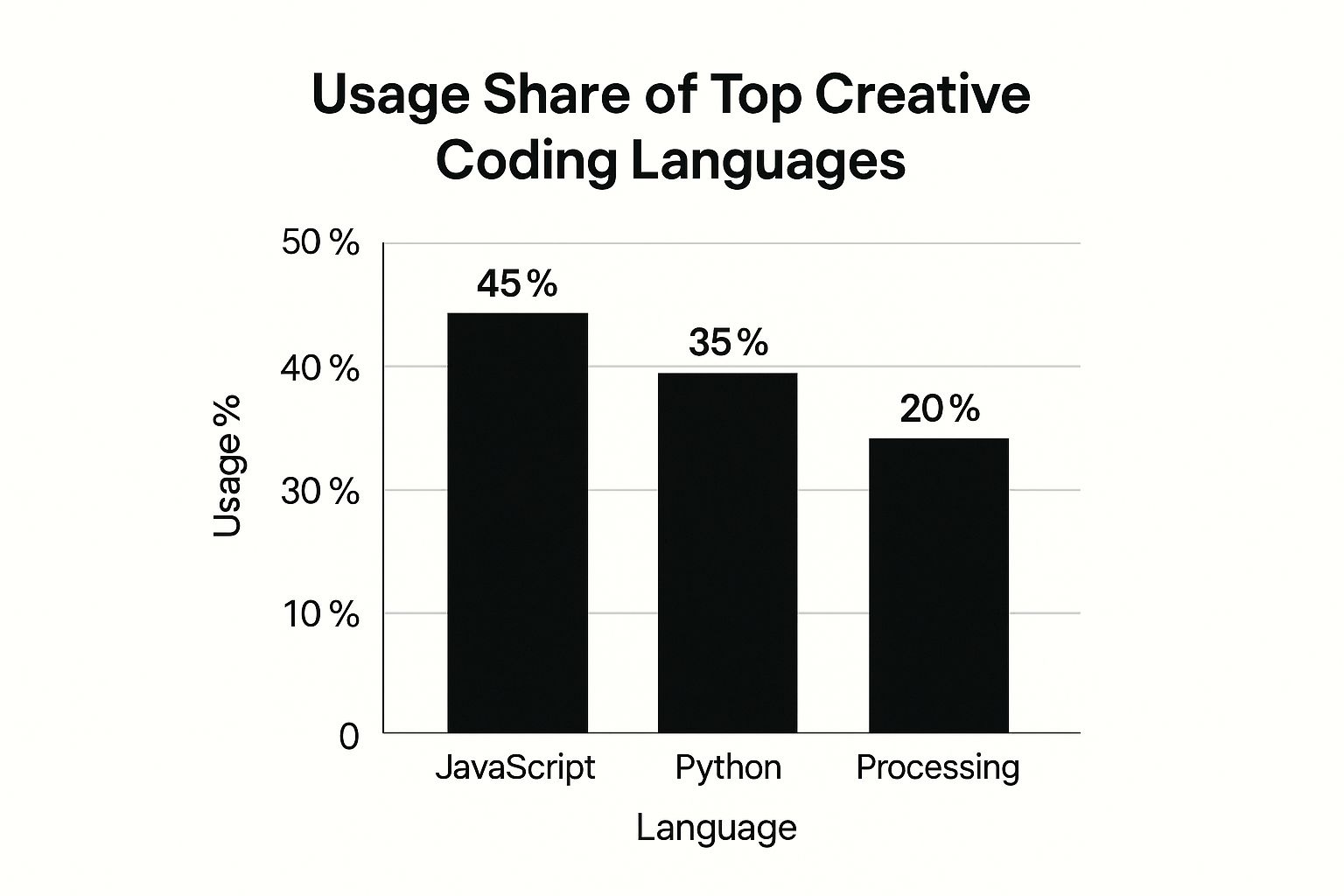
For example, freeCodeCamp and Harvard's CS50X offer modules in generative art. This demonstrates the growing recognition of this field. This growth is reflected in the fact that in 2025, over 60% of new learners began with either JavaScript (p5.js) or Python because of their accessible syntax and extensive libraries. To learn more about introducing younger audiences to this exciting field, check out this resource on creative coding for kids.
For a deeper dive into the tools available, consider this resource: How to master creative coding tools. It offers a great overview of different platforms and their strengths.
Development Environments and Community Support
The development environment you choose significantly impacts your creative coding journey. Look for environments that offer real-time feedback and make experimentation easy. This allows you to instantly see how your code changes the visuals, enabling quick adjustments and faster learning.
Finding a supportive community is equally important. Connecting with other creative coders, either online or in person, provides invaluable opportunities for learning, sharing, and collaboration. This community aspect is especially helpful for beginners, offering encouragement and guidance.
Building Your Creative Coding Toolkit
The following data chart visualizes the popularity of different creative coding languages among beginners based on a 2025 survey of 500 new learners.
| Language/Framework | Difficulty Level | Best For | Key Features | Online Resources |
|---|---|---|---|---|
| JavaScript (p5.js) | Beginner | 2D Graphics, Web-Based Projects | Visual, beginner-friendly syntax, large community | p5.js |
| Python (Processing) | Beginner – Intermediate | 2D & 3D Graphics, Data Visualization | Versatile, extensive libraries | Processing |
| Java (Processing) | Intermediate | Advanced Graphics, Complex Projects | Powerful, object-oriented | Processing |
| C++ (openFrameworks) | Advanced | Performance-Intensive Projects | Fast, low-level control | openFrameworks |
This table summarizes key information for beginners exploring different creative coding languages and frameworks. It highlights the relative difficulty, ideal use cases, key features, and provides links to official resources.
Professional digital artists often tailor their tool choices to specific project goals. Some prefer p5.js for 2D graphics, while others choose Three.js for 3D work. The key is to build a personalized toolkit that evolves with your skills. This means experimenting with different tools and finding those that best suit your creative expression.
Mastering Code Concepts Through Visual Feedback
Forget rote memorization and the struggle with abstract programming concepts. Creative coding for beginners makes learning fun and engaging through the immediate impact of visual feedback. With each line of code, the visual changes are instantly apparent, creating a more intuitive and rewarding learning process. This dynamic feedback loop transforms coding from a purely intellectual exercise into a hands-on creative exploration.
Seeing Code Come To Life: Variables, Loops, and Functions
Creative coding brings abstract programming concepts to life visually. Variables, instead of just being data containers, control the visual elements on the screen. They influence position, size, and color. Imagine a variable controlling the speed of a bouncing ball: adjusting its value directly and visibly impacts the ball’s movement.
This immediate visual connection clarifies the purpose and power of variables.
Similarly, loops become more than just abstract iterations; they are tools for creating complex patterns. A simple loop can draw hundreds of radiating lines, producing a captivating visual. This hands-on approach helps beginners understand repetition and the fundamentals of algorithmic thinking.
Functions, often a challenging concept for new coders, transform into reusable visual components. A function might contain the code for drawing a specific shape, allowing for easy reuse throughout a project. This promotes efficient coding practices and reinforces the concept of modularity.
Why Artists Excel With Creative Coding
Artists often excel in this visually driven coding environment. Their inherent visual literacy translates seamlessly into understanding and manipulating code’s visual output. This is a significant departure from traditional programming where the connection between code and result can be less clear. This visual-first method fosters a deeper, more intuitive grasp of technical concepts.
This strong link between code and visual output makes learning engaging and less abstract. Witnessing the real-time results of their code, beginners develop a stronger intuition for how programming works, building a solid foundation for more complex coding in the future.
Experimentation: The Heart of Creative Coding
The demand for creative coding skills is on the rise, reflecting the projected 60% growth in AI-related tech roles by 2025. Industries are actively seeking professionals who can bridge the gap between technical implementation and design thinking. This growing demand highlights the increasing importance of creativity in the tech sector. Find more detailed statistics here.
Practical experimentation is paramount. By adjusting parameters and observing the resulting visual changes, beginners cultivate an intuitive sense of cause and effect in code. Even small adjustments can yield dramatic changes, fostering a spirit of discovery and playful exploration. This playful exploration encourages a deeper understanding of the underlying logic. Through this process, beginners gain mastery over code parameters and develop a better feel for how subtle changes can create visually stunning effects.
Your First Creative Coding Project: From Blank Screen to Art
Creating digital art from a blank screen can be both thrilling and intimidating for those new to creative coding. This section simplifies the journey, taking you step-by-step from initial idea to a fully functional interactive drawing application. Just like experienced creative coders, we'll begin with a simple concept and build upon it, allowing for flexibility and creative discoveries along the way.
Conceptualization and Implementation
First, define your project's scope. For our interactive drawing application, we'll create a program where users draw with their mouse, changing colors and brush sizes. This provides a solid foundation while still leaving room for artistic exploration.
Next, break the project into smaller, manageable parts:
- Setting up the canvas
- Implementing mouse interaction
- Adding color controls
- Incorporating brush size adjustments
This approach prevents overwhelm and ensures steady progress. It's a common strategy used by professional coders to tackle complex projects.
Color Psychology and Coordinate Systems
Consider color psychology to enhance user experience. Warm colors can energize, while cool colors relax. Understanding the coordinate system of your coding environment (like p5.js) is essential. In p5.js, the top-left corner is (0,0), with the x-axis increasing to the right and the y-axis downwards. Mastering this allows for precise placement of visual elements.
For further inspiration, explore existing projects: How to master creative coding with examples. This resource offers a variety of examples to spark your own creative coding journey.
Adding Randomness and Artistic Control
Introducing randomness can create surprising visual effects. Use random functions to change colors, brush strokes, or element positions. Maintaining artistic control is key. Balance randomness with careful parameter adjustments to enhance, not detract from, your artistic vision.
Troubleshooting and Creative Discovery
Errors are inevitable. Experienced creative coders see errors as opportunities. Unexpected outcomes from bugs often lead to new and exciting visual effects. Troubleshooting becomes exploration. Embrace this mindset, and you'll transform coding challenges into creative advantages.
Generative Art: Creating Systems That Make Decisions
Generative art moves beyond the direct drawing of shapes with code. Instead, it allows for the creation of systems that produce art with minimal input. These systems use algorithms to generate a wide range of visual compositions, often incorporating an element of randomness. This section explores how these systems make "decisions," resulting in complex and aesthetically pleasing output.
The Power of Algorithms in Art
Generative art relies on algorithms to produce complex visuals. Think of an algorithm as a set of rules that a computer follows. Much like a recipe provides specific instructions that lead to a finished dish, algorithms in creative coding define the process of creating and arranging visual elements.
For example, a simple algorithm could dictate how circles are placed and colored on a canvas. Repeated multiple times, this simple algorithm can create intricate patterns and designs. This demonstrates how algorithms can generate visually rich art from basic instructions.
Accessible Techniques for Beginners
Several accessible techniques are fundamental to algorithmic aesthetics in generative art. These are surprisingly simple to implement, even for beginners in creative coding.
-
Random walks: Picture a point moving randomly across the screen, leaving a trail. This is the essence of a random walk, which can generate organic, unpredictable lines and shapes.
-
Cellular automata: Imagine a grid of cells, each adhering to simple rules based on its neighbors. This technique can create complex, evolving patterns, such as those seen in the Game of Life.
-
Noise functions: These functions produce smooth, random values used to create textures, landscapes, and organic forms, adding a natural, unpredictable element to generative art.
These techniques offer powerful yet accessible ways to create complex visuals. For more information and resources, check out this helpful guide: How to master generative art techniques with resources.
To further illustrate these techniques, let's look at some specific examples. The following table provides an overview of beginner-friendly generative art techniques and their applications:
Beginner Generative Art Techniques and Their Applications:
| Technique | Complexity Level | Visual Effect | Code Example (Conceptual – Processing/p5.js) | Famous Artists Using This Technique |
|---|---|---|---|---|
| Random Walks | Beginner | Organic, meandering lines and shapes | for (int i = 0; i < 1000; i++) { x += random(-5, 5); y += random(-5, 5); point(x, y); } |
Georg Nees |
| Cellular Automata | Beginner – Intermediate | Complex patterns, evolving structures | for (int x = 1; x < cols - 1; x++) { for (int y = 1; y < rows - 1; y++) { // Apply rules based on neighboring cells } } |
Manfred Mohr |
| Noise Functions | Beginner – Intermediate | Smooth, organic textures and landscapes | float value = noise(xoff, yoff); xoff += 0.01; yoff += 0.01; |
Ken Perlin (creator of Perlin Noise) |
This table demonstrates the range of visual effects achievable with these basic techniques. From the organic lines of random walks to the intricate patterns of cellular automata and the textured landscapes generated by noise functions, the possibilities are vast.
Balancing Randomness and Control
Successful generative artists balance randomness and control. Randomness introduces unpredictability and generates unique outputs, while control ensures the artwork aligns with the artist's vision. This duality creates systems that feel both organic and intentional.
A system generating random shapes without control could produce chaotic and visually unappealing results. By controlling parameters like color palette, size range, or the area where shapes appear, the artist guides the randomness, achieving a cohesive and aesthetically pleasing result. This balance allows the system to have "personality" while reflecting the artist's intent.
Capturing and Transforming Your Creations
Capturing and manipulating your generative creations is essential. Saving images or videos of your output allows you to share your work and document your process. Even slight parameter adjustments can drastically alter the visuals. This highlights the importance of experimentation and iteration.
Tweaking values in your algorithms unlocks a wide range of possibilities. A small change to a color value can shift the mood of a piece. Adjusting the parameters of a noise function can completely transform the textures. This sensitivity to change encourages ongoing experimentation, enabling you to refine your systems and discover new artistic possibilities, ultimately refining your artistic voice within creative coding.
Finding Your Creative Voice in the Coding Community
Beyond technical prowess, creative coding flourishes through community engagement. Nurturing your artistic vision within a supportive network is key to your development. This section explores how successful digital artists discovered their unique style and forged connections that propelled their learning forward. It's not solely about the code; it's about finding your niche within a dynamic and encouraging ecosystem.
Connecting With a Supportive Network
Discovering your creative voice goes beyond mastering the technical aspects of coding. It involves connecting with a community that understands and values your artistic path. This is particularly important for newcomers who might feel daunted by the initial learning process.
Luckily, the creative coding world offers many avenues for connection:
-
Online Forums: Platforms like the Processing forum and various subreddit communities focused on creative coding offer spaces to ask questions, showcase work, and learn from peers. This open exchange of information is incredibly helpful for beginners.
-
Social Platforms: Sharing your creations on platforms like Instagram, Twitter, and dedicated creative coding platforms lets you reach a wider audience, receive feedback, and find inspiration from fellow artists. For example, artists like Michelle Duong (@michelleduong__) use Instagram to display their interactive typography projects.
-
Events and Meetups: Attending workshops, conferences, and local meetups provides opportunities for in-person interaction with other creative coders. These events offer valuable networking possibilities and can ignite new collaborations.
These platforms offer structured learning paths, linking beginners with seasoned artists who offer mentorship and advice. It's a chance to learn not only from tutorials but also from the practical experience and insights of those who have successfully established themselves within the creative coding field.
Sharing Your Work and Embracing Feedback
Sharing your work can be intimidating, especially when you're just starting out. However, it's a vital step in developing your creative voice and receiving constructive criticism. The creative coding community cultivates a culture of encouragement and support, providing a safe environment to share your progress, seek guidance, and learn from others.
Constructive feedback helps you refine your techniques and expand your creative horizons. Consider it a collaborative journey where you gain knowledge from the perspectives of others, uncovering new methods and strategies to improve your work.
Participating in challenges like Genuary, which drew thousands of participants in 2025, can further accelerate your development. These challenges offer specific prompts, motivating you to explore new techniques and push your creative boundaries within a defined framework. This shared experience builds a sense of community and offers abundant opportunities for learning and growth.
Community as a Catalyst for Growth
Experienced artists often cite community involvement as a pivotal moment in their careers. Michelle Duong, for instance, attributes her internship at SchultzSchultz, a design studio that incorporates creative coding into its projects, with broadening her skills and influencing her approach to interactive design.
Community involvement can also unlock unforeseen opportunities. Sharing your work can lead to collaborations, commissions, and exposure to a larger audience. It transforms your creative coding journey from a solo endeavor into a collaborative experience with limitless potential.
By actively engaging with the creative coding community, you'll gain invaluable knowledge, build enduring connections, and create a personalized roadmap for your artistic growth. You'll be surrounded by a network of individuals who share your passion for creative coding and will support you every step of the way. It's about establishing a support system that will empower you to express your distinct creative voice and expand the possibilities of digital art.