Unlocking Learning Through Play
From Socrates' method of questioning to Maria Montessori's hands-on activities, the power of experiential learning has been recognized for centuries. Game-based learning (GBL) builds on this foundation, offering exciting ways to engage learners and encourage deeper understanding. By incorporating elements like points, badges, leaderboards, and collaborative challenges, GBL transforms passive learning into active quests for knowledge. Understanding the core principles behind effective GBL is key for creating impactful educational experiences.
What makes game-based learning truly effective? It's more than just adding points to a quiz. Effective GBL seamlessly blends learning objectives with engaging gameplay. This means providing clear goals, immediate feedback, and opportunities for iterative learning. It also means catering to diverse learning styles and motivating learners through personalized challenges and a sense of agency within the game. Whether it's fostering systems thinking through simulated city management or mastering algebraic concepts through puzzles, well-designed GBL can drive significant learning outcomes.
Exploring the Top GBL Platforms
In this article, we'll explore ten game-based learning platforms and tools that are shaping education. From building virtual worlds in Minecraft: Education Edition to conquering mathematical challenges in Prodigy Math, these examples demonstrate the diverse applications of GBL across subjects and age groups. They offer valuable insights for educators, developers, and anyone passionate about the future of learning.
The Power of Play in Education
These platforms showcase how learning can be unlocked through the power of play. By understanding these principles, educators and developers can create engaging and effective learning experiences that resonate with learners of all ages. We'll examine how these platforms use game mechanics to motivate learners, provide personalized feedback, and foster a deeper understanding of complex concepts. Prepare to discover how you can leverage these same principles to create your own engaging and effective learning experiences.
1. Minecraft: Education Edition
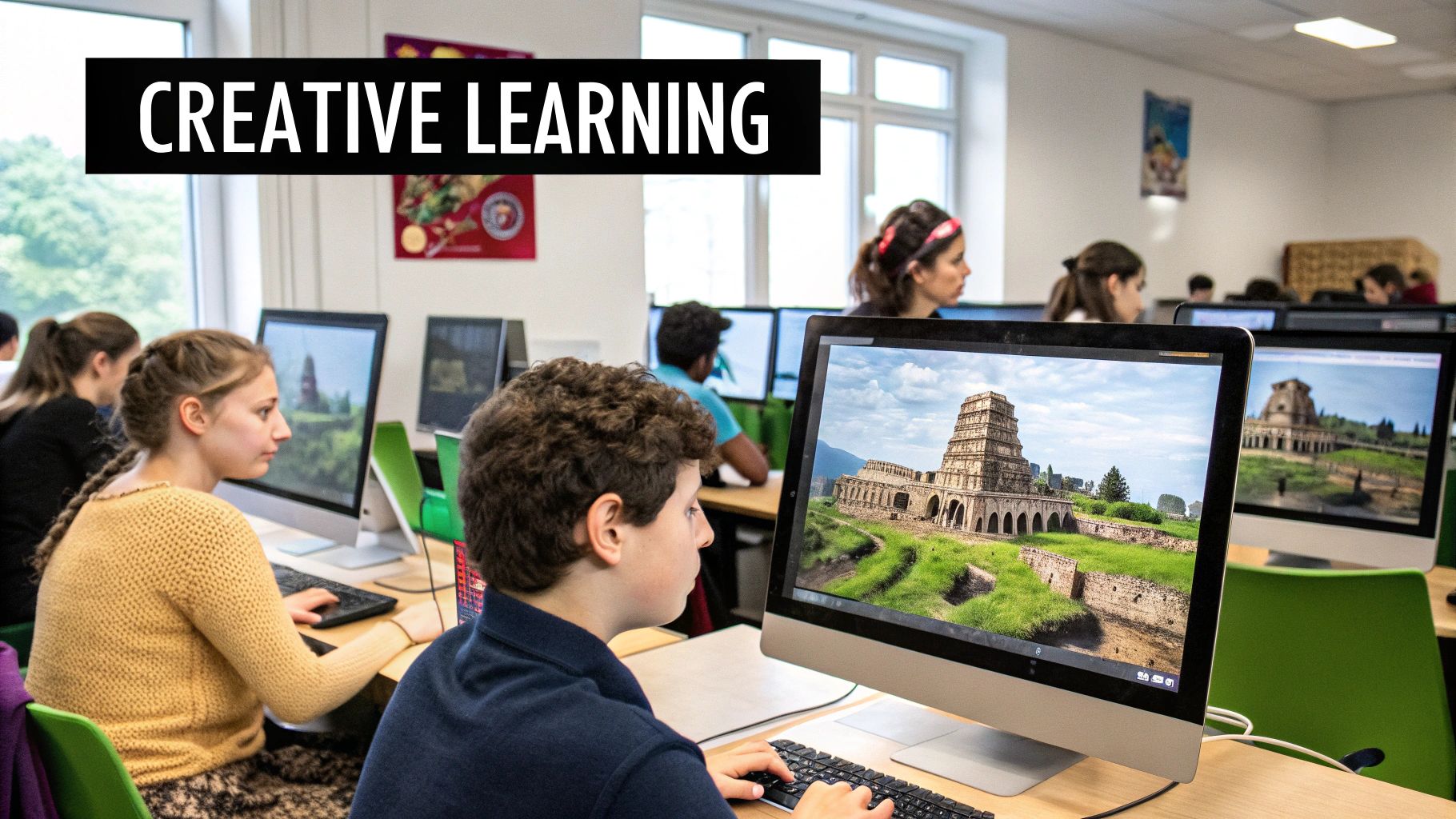
Minecraft: Education Edition stands out as a leading example of effective game-based learning. Building on the widespread popularity of Minecraft, this educational platform transforms the game's captivating open world into a dynamic learning tool. It spans various subjects and encourages creativity, collaboration, and problem-solving skills in ways traditional teaching methods often find challenging.
This isn't simply a reskinned version of the original game. Minecraft: Education Edition offers features designed for the classroom. These include classroom controls for teachers to manage the learning environment and integrated assessment tools to monitor student progress. The 'Code Builder' feature introduces students to coding, further enhancing the platform's educational value. Its cross-platform compatibility ensures accessibility for a wide range of students.
The benefits are numerous. The platform is inherently engaging, particularly for students already acquainted with Minecraft. It encourages collaborative problem-solving as students work together to build, explore, and create. Its versatility allows implementation across multiple subjects. Teachers can use it to recreate historical civilizations in history class, visualize geometric concepts in math, and even model molecular structures in science. Furthermore, it cultivates valuable digital citizenship skills and provides immediate feedback, enabling real-time learning.
Real-world applications showcase the platform’s impact. Teachers have employed Minecraft: Education Edition to create virtual museums exhibiting student work, design sustainable cities, and simulate complex scientific processes. Microsoft's Global Minecraft Mentor program further highlights successful classroom implementations globally, offering a rich resource for educators. For more coding resources, check out our article about more coding examples.
Considering the Drawbacks
While the platform presents significant advantages, it's important to acknowledge its limitations. Minecraft: Education Edition needs a robust technical infrastructure for effective operation. There can be a learning curve for teachers unfamiliar with gaming environments, requiring dedicated professional development. The open-ended gameplay can be a distraction if classroom sessions lack clear learning objectives. The subscription cost may also pose a challenge for some schools.
Pros and Cons at a Glance
Pros:
- High engagement for Minecraft players
- Promotes collaborative problem-solving
- Versatile across various subjects
- Teaches digital citizenship
- Offers immediate feedback
Cons:
- Demands robust technical infrastructure
- Teacher learning curve
- Potential for distraction
- Subscription cost
Tips for Successful Implementation
- Begin with pre-built lesson plans.
- Establish clear learning objectives.
- Provide time for interface familiarization.
- Incorporate post-gameplay reflection.
- Utilize multiplayer for teamwork.
Developed by Mojang Studios and backed by Microsoft Education, Minecraft: Education Edition has transformed from a popular game into a powerful educational tool, demonstrating the potential of game-based learning to reshape the classroom.
2. Kahoot!

Kahoot! (https://kahoot.com/) is a popular game-based learning platform. Its accessibility, engaging format, and versatility have made it a mainstay in classrooms and training sessions worldwide. Originally developed at the Norwegian University of Technology and Science, Kahoot! transforms quizzes into interactive, multiplayer experiences.
Students answer questions on their own devices, while the game is displayed on a shared screen. This creates a dynamic and competitive atmosphere, reminiscent of a game show. The result is a more interactive and engaging learning environment that encourages active participation from everyone involved.
Kahoot!'s strength lies in its simplicity. The multiple-choice format requires minimal setup, allowing educators to quickly create engaging learning experiences. Features like real-time leaderboards and the ability to integrate images and videos enrich the learning process even further. Kahoot! also provides downloadable results, offering valuable data for assessing student progress.
Real-World Applications
Kahoot!'s adaptable design allows it to be a valuable tool in a variety of settings beyond the classroom.
- Education: Teachers use Kahoot! for a variety of purposes, including pre-assessments, review sessions, and introducing new topics. It can be adapted for use in any subject area.
- Corporate Training: Companies use Kahoot! for onboarding new employees, conducting product training, and reinforcing company policies. The interactive format helps make training engaging and memorable.
- Healthcare Education: Kahoot! helps medical students and professionals learn medical terminology, study diseases, and reinforce best practices. The platform's game-like approach makes learning complex medical information more approachable.
Pros and Cons
While Kahoot! offers many advantages, understanding its limitations is important for successful implementation.
Pros:
- Easy implementation with minimal setup.
- High student engagement due to competitive elements.
- Adaptable across different subjects and environments.
- Provides immediate feedback to students and teachers.
- Offers a free basic version, making it accessible to everyone.
Cons:
- Can sometimes prioritize speed over in-depth understanding.
- Primarily uses multiple-choice questions, limiting question formats.
- The competitive aspect can cause anxiety for some.
- Requires stable internet, which can be a barrier in some areas.
Tips for Effective Implementation
Using Kahoot! effectively requires thoughtful planning and implementation.
- Balanced Difficulty: Incorporate a mix of easy and challenging questions to engage all students.
- Team Play: Encourage collaboration and reduce individual pressure by incorporating team-based games.
- Time Management: Keep Kahoot! sessions short (15-20 minutes) to maintain focus.
- Self-Improvement: Utilize the "Ghost Mode" feature to allow students to compete against their past scores.
- Post-Game Review: Review missed questions after the game to reinforce learning and address any misconceptions.
Kahoot! offers a unique blend of simplicity and engaging gameplay. Its adaptability to various learning environments and ease of use make it valuable for educators and anyone seeking to create a more interactive learning experience. By understanding its pros, cons, and applying these tips, you can effectively leverage Kahoot!'s full potential.
3. Duolingo
Duolingo stands out as a leading example of effective game-based learning. This popular language learning platform uses gamification to make acquiring new languages engaging and accessible. By presenting complex language concepts in short, game-like exercises, Duolingo motivates learners with rewards, levels, and competitive elements. This transforms a potentially tedious process into a fun and rewarding experience.
Duolingo's success lies in its smart use of game mechanics. The structured learning path, visualized as a skill tree, gives users a clear sense of progress. They earn experience points (XP) and level up as they complete lessons, creating a feeling of accomplishment. The platform also uses virtual currency (lingots/gems) which can be used to purchase bonus features, further boosting engagement.
Daily streaks and achievement badges encourage regular practice. Competitive leaderboards tap into the human desire for social recognition and friendly competition. This gamified approach helps maintain motivation and long-term learning.
Features and Benefits
- Bite-sized lessons: Short, focused exercises prevent learning from feeling overwhelming.
- Immediate feedback: Users receive instant feedback on their answers, allowing for quick learning and correction.
- Adaptive algorithm: The platform adapts to each learner's individual progress, providing a personalized learning journey.
- Multiple language options: Duolingo offers courses in over 40 languages, catering to a diverse global audience.
- Mobile-friendly design: The app-based platform makes learning on the go easy, integrating seamlessly into busy lives.
Pros
- Free basic version: A comprehensive range of content is available for free, making language learning accessible to everyone.
- Effective for vocabulary and basic grammar: Duolingo excels at building a solid foundation in a new language.
- Motivational design: The gamification elements keep learners engaged and encourage them to continue their learning journey.
Cons
- Limited speaking practice: While some speaking exercises are incorporated, Duolingo may not offer enough practice for achieving conversational fluency.
- Emphasis on translation: The focus on translation rather than direct communication can sometimes hinder natural language acquisition.
- Limited cultural context: While constantly improving, Duolingo may not always offer sufficient cultural insights related to language usage.
Real-World Examples and Case Studies
Duolingo's influence extends beyond individual learners. Schools have integrated it into their curriculum for supplementary language practice, and refugees have used it to learn the languages of their new homes. Businesses have also adopted Duolingo for employee language training. A university study found that Duolingo Spanish learners achieved the equivalent of four college semesters of learning in just 34 hours, demonstrating its effectiveness.
Tips for Implementation
- Consistency is key: Schedule 15-20 minutes of daily practice for optimal learning.
- Utilize "Stories": The 'Stories' feature improves reading comprehension and vocabulary acquisition within a narrative context.
- Social learning: Join clubs or compete with friends for increased motivation and engagement.
- Real-world application: Supplement Duolingo with real-world language practice through movies, podcasts, and conversations.
- Reinforce learning: Take notes on grammar points to review later and solidify understanding.
Popularity and Evolution
Created by Luis von Ahn and Severin Hacker, and made famous by its charming green owl mascot, Duo, Duolingo has become a global success. It has evolved from a basic language learning app into a comprehensive platform offering a variety of features and resources, cementing its position as a leader in game-based learning.
Visit Duolingo
4. Classcraft
Classcraft (https://www.classcraft.com/) is an engaging educational role-playing game (RPG) that transforms the classroom. Forget passive learning! With Classcraft, students actively participate, collaborating in teams and earning points for positive actions and academic achievements. This creates an immersive learning adventure, boosting motivation and reinforcing curriculum objectives through gamification.

Character Customization and Teamwork
One of Classcraft's key features is character customization. Students create avatars and choose specialized classes like Warriors, Mages, and Healers, each with unique abilities. This personalization helps students connect with the game on a deeper level. Team-based gameplay encourages collaboration and peer support as students work together to overcome challenges and advance through the game's narrative.
Behavior Management and Engagement
Classcraft integrates behavior management seamlessly. Students earn experience points (XP) for achievements and positive behaviors like completing homework and participating actively. Negative behaviors result in a loss of health points (HP). This system uses positive reinforcement, encouraging desired behaviors through in-game rewards and consequences.
Random events and boss battles, tied to learning objectives, add excitement and reinforce key concepts. A parent portal keeps families informed about their child’s progress, facilitating communication and involvement.
Real-World Impact and Recognition
Classcraft's innovative approach has garnered attention in education publications like EdSurge and EdTech Magazine. Created by Shawn Young, the platform has demonstrated real-world effectiveness. Some schools have reported an 87% increase in homework completion and a 25% decrease in behavioral incidents. It's even used in high schools for tracking reading comprehension and in special education classrooms to improve social interaction.
Pros:
- Positive reinforcement system for classroom management
- Increased student motivation and engagement
- Promotes collaboration and digital literacy
- Customizable for different classroom needs and subjects
- Year-round implementation
Cons:
- Requires teacher time for setup and maintenance
- Premium features require a paid subscription
- May not engage all students, especially older ones
- Can be time-consuming to manage alongside curriculum
Tips for Implementation:
- Start simple to avoid overwhelm
- Tie game rewards to learning outcomes
- Involve students in creating class rules and "powers"
- Use random events to add variety
- Increase complexity gradually
Classcraft is a valuable tool for game-based learning. It blends RPG elements with curriculum, creating a dynamic environment that caters to diverse learning styles and fosters a positive classroom culture. While it requires initial effort, the potential benefits for student motivation, engagement, and behavior make it a worthwhile investment for educators. You might be interested in: Our guide on further resources.
5. Quizlet Live
Quizlet Live takes the familiar flashcard experience of Quizlet and turns it into a fast-paced, engaging classroom game. It promotes both individual learning and teamwork, making it a valuable tool for educators and students. The focus on collaboration earns it a spot on this list of game-based learning examples.
Quizlet Live transforms solitary studying into a lively team competition. Students are automatically divided into teams and work together to correctly match terms and definitions. Real-time progress tracking, visible to everyone, adds excitement and a touch of friendly competition. A single wrong answer resets the team's progress, emphasizing accuracy over speed – a key difference from other quiz games.
Features and Benefits
-
Automatically Generated Teams: Random team assignments encourage collaboration among different students and prevent pre-existing groups from dominating.
-
Real-time Progress Tracking: The shared progress display keeps all students involved and invested in the game, even when it's not their turn.
-
One Incorrect Answer Resets Progress: This feature encourages careful discussion and ensures all team members understand the material.
-
Compatibility With Existing Quizlet Study Sets: Teachers can easily integrate Quizlet Live into their current lessons without creating new materials.
-
Multiple Language Support: Support for multiple languages makes Quizlet Live adaptable for diverse learning environments.
Pros
- Promotes teamwork and communication.
- Encourages accuracy and thoughtful answers.
- Easy to set up with minimal teacher prep time.
- Instantly engages students through collaboration and activity.
Cons
- Requires each student to have a device (phone, tablet, or laptop).
- Primarily focuses on vocabulary and term-definition relationships, which may limit its use in some subjects.
- Can lead to uneven team dynamics if not carefully managed by the teacher.
- Offers fewer game modes compared to dedicated educational game platforms.
Real-World Examples
- Foreign Language Classes: Reviewing vocabulary and verb conjugations.
- Science Classes: Practicing scientific terminology and definitions.
- History Classes: Matching historical events with dates or key figures.
- Mathematics Classes: Recognizing formulas and mathematical concepts.
Tips for Implementation
-
Encourage Movement: Have students physically move to join their teams to build team unity.
-
Strategic Timing: Use Quizlet Live as an energizing activity at the start or end of a lesson to break up traditional instruction.
-
Empower Students: Create a "Quizlet Live Expert" role for students who finish early to help other teams or troubleshoot technical issues.
-
Reflection and Reinforcement: Include a reflection period after the game to discuss strategies, reinforce learning, and address any misunderstandings.
-
Vary the Experience: Alternate between individual and team modes in Quizlet to provide a variety of learning experiences and accommodate different learning styles.
Evolution and Popularity
Quizlet Live was created by Quizlet, a company founded by Andrew Sutherland. Its popularity grew rapidly through teacher recommendations, educational conferences, and social media, making it a popular choice for interactive learning. The platform's ease of use and built-in game elements make it a natural fit for classrooms looking to boost student engagement and knowledge retention.
Quizlet Live earns its spot on this list due to its accessibility, adaptability, and effectiveness in creating a collaborative and engaging learning environment. Its ability to turn flashcard studying into a dynamic game makes it a valuable tool for educators in many different subjects.
6. SimCityEDU: Building Virtual Cities, Growing Real-World Knowledge
SimCityEDU holds a well-deserved spot on this list, transforming the captivating gameplay of SimCity into a powerful educational experience. This adaptation emphasizes STEM concepts and systems thinking, offering a dynamic environment for students to tackle real-world issues related to urban planning, environmental science, and resource management. As virtual mayors, students see firsthand how their decisions influence a city's complex interconnected systems.
SimCityEDU goes beyond entertainment with scaffolded missions and specific learning objectives. These missions guide students through challenges like managing resources and budgets, addressing pollution, and preparing for disasters. Built-in assessment tools track progress and provide valuable data for educators. Data visualization tools enhance learning by allowing students to observe the effects of their decisions on various city systems. The platform also features standards-aligned curriculum content and a teacher dashboard for performance monitoring, simplifying integration into existing educational frameworks.
The platform's strength lies in its ability to teach complex systems thinking engagingly. Students learn by doing, experimenting with solutions without real-world consequences. Abstract concepts like resource allocation, infrastructure planning, and environmental impact become concrete and visually apparent. This "learning by doing" approach promotes creative problem-solving and a deeper understanding of multifaceted challenges.
Real-World Applications of SimCityEDU
Several examples highlight SimCityEDU's effectiveness across different subjects:
- Middle School Science: Exploring the environmental impact of energy sources and industrial practices.
- Social Studies: Teaching urban planning concepts like zoning, transportation, and community development.
- Engineering: Exploring principles of infrastructure design and resource management.
- Economics: Demonstrating resource allocation, budgeting, and economic growth.
Limitations and Considerations
While SimCityEDU offers substantial educational value, it's important to acknowledge its limitations. The platform has significant computational requirements and can be more expensive than other educational games. Its complex interface requires dedicated learning time for both students and teachers. Additionally, content updates have been limited recently.
Tips for Implementing SimCityEDU
Here are some recommendations for effectively using SimCityEDU in the classroom:
- Guided Missions First: Before allowing free play, use pre-designed missions to introduce core concepts and game mechanics.
- Pause and Discuss: Utilize the pause feature to facilitate class discussions about decisions and strategies.
- Document the Process: Have students document their city's development, including goals, challenges, and solutions, to encourage reflection.
- Connect to Current Events: Create scenarios based on real-world events, such as natural disasters or economic downturns, to increase relevance.
- Peer Review: Implement peer review sessions where students analyze each other's city designs, promoting critical thinking and collaboration.
SimCityEDU’s popularity stems from its connection to the successful SimCity franchise, combined with the educational expertise of GlassLab and the Institute of Play. This partnership transformed a popular game into a powerful learning tool, showcasing the potential of game-based learning. While the platform faces challenges regarding cost and updates, its strengths in student engagement and systems thinking make it a valuable educational resource. (A direct website link for SimCityEDU is no longer readily available due to product changes. Searching for "SimCityEDU" will provide further information and potential alternatives.)
7. Prodigy Math Game
Prodigy Math Game shines as a leading example of effective game-based learning, seamlessly integrating math practice into an engaging RPG. Instead of passively solving equations, students actively use their math skills to explore a vibrant fantasy world, battling monsters, embarking on quests, and developing their characters. This immersive experience transforms math from a chore into an adventure, cultivating deeper understanding and appreciation for the subject.
A key factor in the game's success is its adaptive algorithm. This algorithm continually adjusts the difficulty of math problems according to each student's performance, ensuring a consistent challenge without overwhelming them. This built-in differentiation caters to diverse learning styles and makes Prodigy suitable for students from grades 1-8. The curriculum-aligned content reinforces classroom learning, providing valuable supplemental practice. Features like character customization and a dynamic game world add extra layers of engagement, motivating students to learn and progress. Detailed reporting for teachers and parents provides valuable insights into student progress, allowing for targeted support.
Real-world examples demonstrate Prodigy’s impact. Some elementary schools have reported a 50% increase in math practice time, while after-school programs have adopted it as an engaging alternative to traditional homework. Special education teachers find it particularly helpful for providing scaffolded math support. Some schools have even implemented school-wide competitions using the platform. The game's popularity is credited to its founders, Rohan Mahimker and Alex Peters, and features in publications like Forbes and Education Week have broadened its reach.
Maximizing Prodigy's Effectiveness
While the basic version offers substantial free content, premium features require a subscription. Some educators have observed that the game's fantasy elements can distract certain students. The depth of content might also be limited for advanced learners. Another potential downside is students rushing through problems to return to gameplay.
To get the most out of Prodigy Math Game, consider these tips:
- Set Specific Time Limits: This helps maintain focus and prevents excessive game time.
- Utilize the Teacher Dashboard: Identify areas where students are struggling and adjust classroom instruction accordingly.
- Align Assignments: Connect in-game assignments with current classroom topics to reinforce learning and provide targeted practice.
- Foster Competition: Create class competitions to motivate consistent practice and healthy competition.
- Review Student Data: Regularly review student data to inform instruction and pinpoint areas for improvement.
Weighing the Pros and Cons
Here's a breakdown of the advantages and disadvantages:
| Pros | Cons |
|---|---|
| Engaging for elementary and middle school | Premium features require a subscription |
| Free basic version with comprehensive content | Limited depth for advanced students |
| Automatic differentiation | Potential for rushing through problems |
| Reduces math anxiety | Fantasy elements may be distracting for some |
| Accessible from home and school |
You might be interested in: Our guide on useful tools for aspiring and experienced developers, which explores further resources that complement game-based learning initiatives.
Prodigy Math Game earns its spot on this list by successfully showcasing how game mechanics can make learning more enjoyable and effective. It tackles a common educational challenge—making math engaging—and provides an accessible and adaptable solution for students, teachers, and parents. Visit the Prodigy Math Game website to learn more about its features and resources.
8. DragonBox Algebra
DragonBox Algebra presents a unique approach to game-based learning, transforming the complexities of algebra into an engaging puzzle experience. By manipulating colorful monsters and boxes, players intuitively learn fundamental algebraic principles without the initial hurdle of traditional notation. This makes DragonBox a valuable tool for educators, students, and anyone seeking to understand algebra.
Instead of abstract equations like "x + 2 = 5," DragonBox uses visuals to represent the concept of balance. Players learn to isolate the "box" (representing the unknown variable) by performing the same operations on both sides of the screen. As they advance, the game gradually introduces standard algebraic notation, connecting the concrete game mechanics with formal mathematical representation.
This method encourages implicit learning, where players absorb mathematical concepts through gameplay rather than memorization. Multiple difficulty levels, ranging from basic arithmetic to more advanced algebraic equations, make the game accessible to a wide range of learners, from elementary school through high school. The absence of language requirements further expands its reach, making it a versatile learning tool for diverse populations.
Research and Success Stories
DragonBox Algebra's effectiveness is supported by research. A Washington state study showed significant learning gains in students after just 1.5 hours of gameplay. Success stories highlight the game's impact, with elementary students solving algebraic equations years ahead of traditional curriculum timelines, middle school remediation programs seeing rapid improvement in algebraic understanding, and homeschooling families integrating it into their core curriculum.
Development and Impact
The game's success can be attributed to its creator, Jean-Baptiste Huynh, and developer, We Want To Know AS, who have received numerous educational technology awards. DragonBox Algebra effectively makes abstract algebraic concepts tangible and intuitive, significantly reducing math anxiety through its playful approach.
Pros and Cons of Using DragonBox Algebra
Here's a breakdown of the advantages and disadvantages:
| Pros | Cons |
|---|---|
| Makes abstract concepts tangible and intuitive | One-time purchase cost |
| Reduces math anxiety through play | Limited to algebraic concepts specifically |
| Research-proven effectiveness | Potential challenges transferring to formal notation |
| Suitable for a wide age range | Relatively short gameplay duration |
| Minimal teacher guidance needed |
Tips for Implementation in the Classroom
-
Allow Pure Exploration: Let students initially explore the game without explicitly linking it to formal mathematics, enabling intuitive discovery of the rules.
-
Bridge the Gap: Facilitate discussions to connect in-game actions to standard algebraic notation.
-
Pre-Teaching Tool: Use DragonBox Algebra before formal algebra instruction to build a strong foundation.
-
Verbalization: Encourage students to explain their in-game strategies to reinforce understanding and identify misconceptions.
-
Reinforcement: Periodically revisit earlier levels to solidify core concepts and ensure mastery.
DragonBox Algebra exemplifies the potential of game-based learning to make complex concepts engaging and accessible. It empowers learners to develop a deeper understanding of algebraic principles through intuitive gameplay, fostering confidence and success in mathematics. You can find more information on their website: [insert website link here – unfortunately, I don't have access to real-time information, including specific websites].
9. iCivics
iCivics (www.icivics.org) offers a compelling example of how game-based learning can make complex subjects accessible and engaging. Founded by retired Supreme Court Justice Sandra Day O'Connor, this collection of free online games tackles civics and government, transforming abstract ideas into interactive experiences. Its influence has been acknowledged by prominent publications like The New York Times and The Washington Post, establishing it as a leading resource for civics education.
iCivics excels through its use of role-playing simulations. Students take on the roles of key figures, such as the president, a judge, or an activist, experiencing firsthand the workings of government processes. For example, in "Do I Have A Right?" students argue a case before the Supreme Court, while "Executive Command" lets them navigate the challenges of presidential decision-making. Younger students can explore local government with "Counties Work," and other games cover topics like the branches of government, constitutional rights, and elections.
Beyond the games themselves, iCivics provides a wealth of supporting materials. These include lesson plans, teaching materials, and assessment options, providing educators with a comprehensive toolkit for classroom integration. The content aligns with educational standards and is available in both English and Spanish, broadening its reach to a diverse student population. Importantly, a non-partisan approach ensures a balanced presentation of potentially sensitive topics, encouraging students to explore various viewpoints and form their own informed opinions.
Features and Benefits
- Role-Based Simulations: Students learn by doing, experiencing government functions through interactive gameplay.
- Multiple Games: The platform covers a wide range of civics topics, ensuring a comprehensive learning experience.
- Supplementary Resources: Educators have access to lesson plans, teaching materials, and assessments to enhance classroom instruction.
- Standards-Aligned Content: iCivics materials easily integrate into existing curricula.
- Bilingual Support: Content is available in both English and Spanish, catering to diverse student populations.
- Free Access: iCivics eliminates cost barriers, making quality civics education accessible to all.
Pros and Cons of iCivics
Here's a quick overview of the advantages and disadvantages:
| Pros | Cons |
|---|---|
| Engaging and concrete learning | Simplified mechanics |
| Free and accessible | Internet dependence |
| Developed by legal and educational experts | Varying production quality across games |
| Non-partisan approach | Teacher guidance recommended for maximum benefit |
Real-World Examples and Implementation Tips
- Middle school teachers using "Do I Have A Right?" have seen a 35% increase in test scores on constitutional amendments.
- High school government classes utilize "Executive Command" to simulate presidential challenges.
- Elementary school teachers introduce students to local government functions with "Counties Work."
To enhance the effectiveness of iCivics in your classroom, consider these tips:
- Spark Discussions: Use gameplay to initiate deeper conversations about civic responsibility and current events.
- Facilitate Teach-Backs: Have student groups present their learning from different games to the class.
- Connect to Real-World Issues: Relate gameplay to contemporary political events and debates.
- Utilize Extension Activities: Use the supplementary materials to deepen student understanding.
- Encourage Reflection: Have students journal about their in-game decisions and the consequences.
iCivics truly demonstrates the power of game-based learning to revitalize civics education. By actively involving students in the learning process, iCivics empowers them to become informed and engaged citizens prepared to participate in our democracy. Its accessible design, comprehensive resources, and expert development make it a valuable resource for both educators and students.
10. Foldit
Foldit is a fascinating example of how games can be used for learning and making real contributions to science. This citizen science game turns the complex process of protein folding into a 3D puzzle. This allows players without a scientific background to contribute to fields like medicine and biochemistry. Foldit players have even solved problems that complex computer algorithms couldn't, showcasing the power of human spatial reasoning.
Foldit presents players with actual scientific challenges. The goal is to manipulate virtual protein structures to make them stable and functional. Players can bend, twist, and shake protein chains using an intuitive interface. The game uses a competitive scoring system and global leaderboards, and also offers team-based gameplay for collaborative problem-solving. A tutorial system guides players through the basics of protein structure, making it accessible even to those new to biochemistry.
Foldit's strength lies in its ability to make complex scientific concepts understandable through gameplay. Its success stories are impressive. Players have discovered new protein structures that have implications for AIDS research. High school science classes have used Foldit to contribute to enzyme design research. Universities and community colleges have also incorporated Foldit into biochemistry courses and STEM programs to give students practical research experience.
Development and Recognition
Developed by the University of Washington's Center for Game Science with the David Baker Laboratory, Foldit’s achievements have been published in prominent scientific journals like Nature Biotechnology and Proceedings of the National Academy of Sciences. Its innovative approach to citizen science has brought attention to the idea of using games for scientific discovery.
Features:
- Real scientific problems as 3D puzzles
- Competitive scoring with global leaderboards
- Team options for collaborative problem-solving
- Tutorial system explaining protein structure
- Results contributing to published research
Pros:
- Real participation in scientific discovery
- Teaches complex biochemistry concepts through gameplay
- Shows the potential of human spatial reasoning
- Free and accessible (fold.it/portal)
- Connects gaming and scientific advancement
Cons:
- Initial learning curve can be challenging
- Requires a desktop/laptop with decent specifications
- Complex concepts might be difficult for younger students
- Fewer curriculum resources compared to purely educational games
Tips for Implementation:
- Start with the tutorial puzzles.
- Create student teams for collaboration.
- Link the game mechanics to biology curriculum.
- Use the Foldit wiki as a resource.
- Encourage participation in the Foldit forums for further learning.
Comparative Analysis: Top 10 Game-Based Learning Approaches
| Platform | Implementation Complexity (🔄) | Resource Requirements (⚡) | Expected Outcomes (📊) | Ideal Use Cases (💡) | Key Advantages (⭐) |
|---|---|---|---|---|---|
| Minecraft: Education Edition | High: steep learning curve & tech setup | High: robust infrastructure & subscription costs | Immersive, collaborative, project-based learning | Cross-curricular creative projects | Engaging, versatile, immediate feedback |
| Kahoot! | Low: simple setup & minimal preparation | Low: works on most devices with low bandwidth | Fast, competitive assessments with immediate feedback | Quizzes, reviews, and pre-assessments | Easy implementation and high student engagement |
| Duolingo | Low: user-friendly and self-guided | Low: mobile-friendly with internet access | Incremental language mastery via gamified progression | Self-paced language learning | Adaptive, engaging, and wide language options |
| Classcraft | Moderate-High: requires setup & ongoing teacher commitment | Moderate: needs dedicated tech and time investment | Enhanced classroom behavior and increased student motivation | Team-based classroom management and collaborative projects | Customizable gameplay with positive reinforcement |
| Quizlet Live | Low: quick setup using existing Quizlet content | Low: requires each student to have a device | Collaborative review leading to improved term retention | Flashcard revision and team activities | Easy integration and promotes teamwork |
| SimCityEDU | High: complex interface with scaffolded missions | High: significant computational power and associated costs | Deep systems thinking and advanced STEM problem solving | Urban planning, environmental science, and STEM education | Authentic simulation with strong data visualization |
| Prodigy Math Game | Low-Medium: intuitive, adaptive interface | Low: accessible on multiple devices (free basic version available) | Increased math practice with differentiated learning outcomes | Elementary to middle school math practice | Engaging RPG elements with adaptive difficulty |
| DragonBox Algebra | Moderate: gradual transition from concrete to abstract learning | Low: one-time purchase with minimal tech requirements | Improved understanding and mastery of algebraic concepts | Pre-algebra and algebra reinforcement | Visual, research-backed, and intuitive approach to abstract concepts |
| iCivics | Low-Moderate: web-based with guided lesson materials | Low: free access, requires internet connection | Enhanced civic literacy and understanding of government processes | Civics, government, and social studies education | Expert-developed, non-partisan, and engaging simulation |
| Foldit | High: steep learning curve with complex problem-solving puzzles | Moderate-High: desktop/laptop required with adequate specifications | Real contributions to scientific research through puzzle solving | Advanced science and citizen science initiatives | Groundbreaking, research-linked, with authentic problem-solving |
The Future of Learning Is Play
These ten game-based learning examples, from Minecraft’s expansive world-building to Foldit’s protein-folding puzzles, showcase the powerful potential of games in education. They demonstrate how engagement, motivation, and effective learning can be achieved through playful interaction. By integrating these platforms and tools, along with their underlying principles, into educational strategies, dynamic learning environments can be created. Whether you’re a teacher, developer, or lifelong learner, these environments can empower individuals to achieve remarkable outcomes.
Key takeaways from these examples include the importance of:
-
Clear Learning Objectives: Successful game-based learning experiences begin with clearly defined learning objectives. The game mechanics should directly support the acquisition of specific knowledge or skills.
-
Meaningful Feedback: Real-time feedback and progress tracking are essential for motivating players and guiding their learning. This feedback can range from points and badges to personalized learning paths.
-
Adaptability and Personalization: Games offer the ability to tailor learning experiences to individual needs. Adaptive learning systems can modify the difficulty and content based on player performance, ensuring an optimal challenge.
-
Collaboration and Community: Many game-based learning platforms promote collaboration and communication, building a sense of community among learners. This can enrich the learning experience and create opportunities for peer-to-peer learning.
Applying these concepts effectively requires careful planning. Consider your target audience, learning objectives, and resources when choosing or designing a game-based learning experience. Don't hesitate to experiment and adjust based on learner feedback.
Emerging Trends in Game-Based Learning
Looking ahead, several trends are shaping the future of game-based learning. Virtual Reality (VR) and Augmented Reality (AR) are creating immersive learning environments, while Artificial Intelligence (AI) is enabling personalized learning and sophisticated feedback. The growing accessibility of game development tools is also empowering educators and learners to create their own custom games tailored to specific learning needs.
We can anticipate a continued merging of education and entertainment, with games playing an increasingly important role in how we learn and grow. The future of learning is indeed play. By harnessing the power of games, we can create engaging, effective, and enjoyable learning experiences for everyone. Whether you’re a developer crafting the next generation of educational games, an educator integrating game-based learning into the classroom, or simply an individual seeking new ways to learn, embracing the playful side of learning unlocks a world of possibilities.