Stuck in a Creative Rut? You're Not Alone!
Feeling creatively stagnant? This listicle provides eight practical techniques to overcome creative block and reignite your inspiration. Whether you're a coder, artist, or entrepreneur, hitting a creative wall is a common struggle. Learn how to conquer these mental roadblocks with methods like Morning Pages, Mind Mapping, and the Pomodoro Technique. We'll also explore strategies like Oblique Strategies, changing your environment, and using constraints to boost creativity. These tools will help you unlock your potential and get those creative juices flowing again.
1. Morning Pages
Feeling stuck in a creative rut? Struggling to overcome creative block? Morning Pages might be the solution you've been searching for. This powerful technique, developed by Julia Cameron and popularized in her book The Artist's Way, involves writing three pages of longhand, stream-of-consciousness writing first thing every morning. It's not about crafting beautiful prose or profound insights; it's about clearing the mental clutter that often blocks creativity. Think of it as a daily brain dump, allowing you to bypass your inner critic and access deeper, more authentic creative thoughts.

Morning Pages are characterized by a few key features: three full pages of longhand writing, done first thing in the morning, and approached as a stream-of-consciousness exercise. Critically, they are not meant to be shared or judged for quality. This private nature allows for true freedom of expression, helping you overcome internal censors and tap into your raw creative potential. This method deserves its place on this list because it offers a simple yet profoundly effective way to consistently chip away at creative block and cultivate a daily creative habit.
This practice offers several benefits. It bypasses internal censors and the inner critic that can stifle creative flow. It creates a daily creative ritual, fostering consistency and momentum. It also helps process emotions that might be blocking creativity, allowing for clearer thinking and a more open mind. Furthermore, it requires no special skills or tools beyond pen and paper, making it accessible to everyone.
Of course, like any method, Morning Pages have their drawbacks. The process is time-consuming, typically taking 30-45 minutes. It requires consistency to see the real benefits, which can be challenging for some. Initially, it can feel pointless or even frustrating, especially when you're grappling with a stubborn creative block. Additionally, some individuals may find handwriting for extended periods physically uncomfortable.
The effectiveness of Morning Pages is well-documented. Author Elizabeth Gilbert credits the practice with helping her overcome writer's block while working on Eat, Pray, Love. Filmmaker Ava DuVernay uses Morning Pages to develop story ideas. Musician Amanda Palmer has also described using this technique during creative dry spells. These examples demonstrate the broad applicability of Morning Pages across various creative fields, from writing and filmmaking to music composition and software development.
Tips for Implementing Morning Pages:
- Don't re-read your pages for the first few weeks: This helps you avoid self-criticism and maintain the free-flowing nature of the exercise.
- Write without stopping, even if you just write "I don't know what to write": The act of continuous writing is key to breaking through mental barriers.
- Do them first thing before other activities to avoid procrastination: This establishes a routine and prioritizes your creative practice.
- Don't worry about spelling, grammar, or quality – nobody will see them: This is your private space to explore and express yourself freely.
Whether you're a seasoned software developer wrestling with a coding challenge, a digital artist seeking inspiration, or an entrepreneur searching for the next big idea, Morning Pages can be a valuable tool to overcome creative block and unlock your full creative potential.
2. Mind Mapping
When creative block hits, it can feel like staring at a blank canvas, cursor blinking mockingly. Mind mapping offers a powerful way to overcome this inertia and unlock your creative potential. It's a visual brainstorming technique that helps you organize thoughts, generate ideas, and forge connections between concepts. Starting with a central idea, related thoughts branch out organically, creating a radial structure that mirrors how the brain naturally processes information. This non-linear approach can bypass the logical blocks that often inhibit creative thinking, allowing for free association and unexpected breakthroughs.
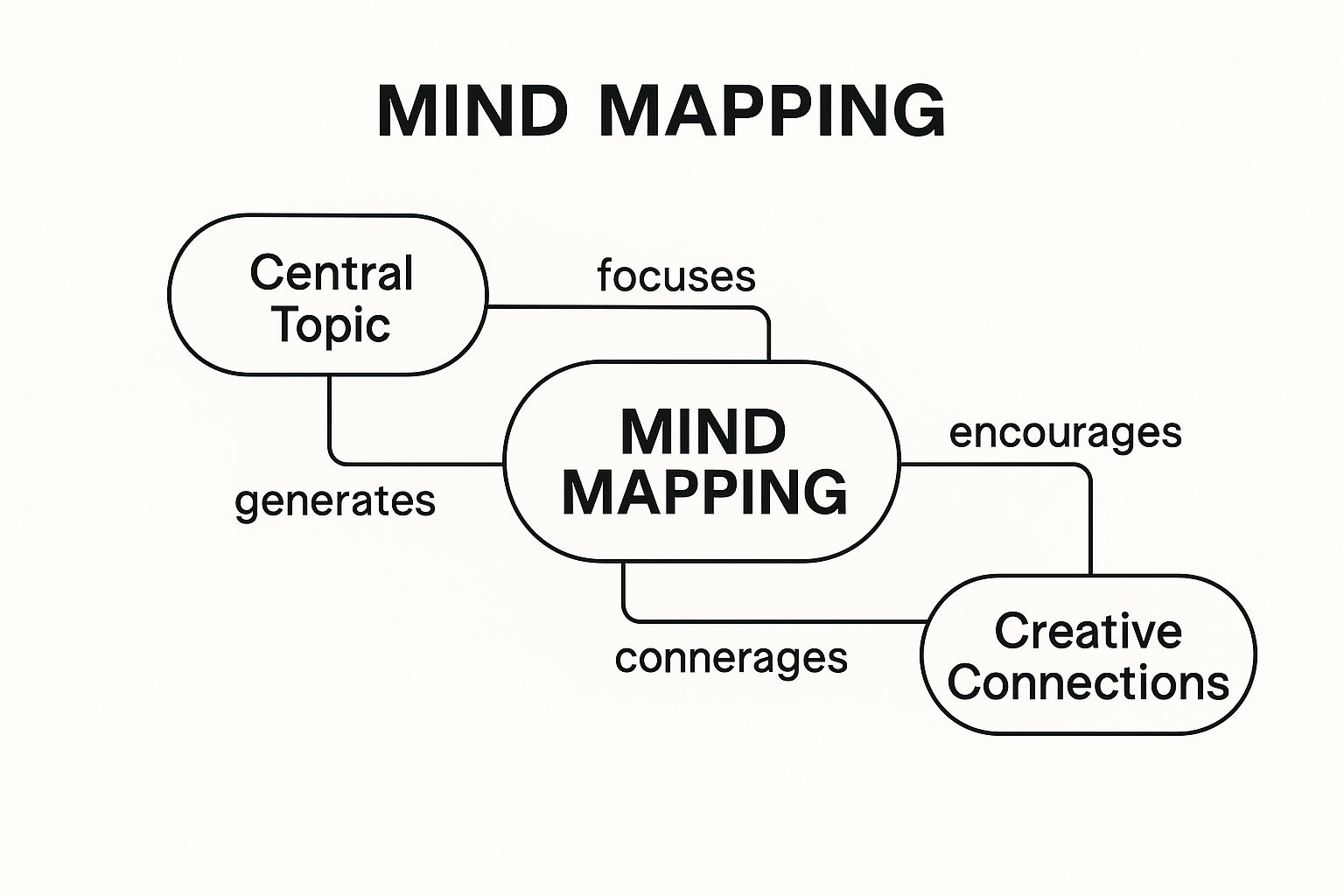
This infographic visualizes the key elements of mind mapping, showing the central topic branching out to related ideas, keywords, images, and colors. It highlights the interconnectedness of thoughts and the non-linear, radiating structure that makes mind mapping so effective for overcoming creative block. As you can see, the central concept of "Mind Mapping" radiates outwards to key features like "Visual Diagram," "Branches," and "Keywords." These features are further connected to benefits like "Generate Ideas," "Organize Thoughts," and "Solve Problems." The use of color and imagery reinforces these connections and highlights the dynamic, engaging nature of mind mapping. The infographic also showcases the practical applications of mind mapping, from boosting creativity to enhancing learning and improving productivity, demonstrating its versatility as a thinking tool.
This method deserves its place on this list because it directly addresses the core issue of creative block: the inability to generate and connect ideas. Its visual nature engages different parts of the brain, fostering a more holistic and dynamic thinking process. Features such as the use of colors, images, and keywords further enhance memory and association, helping ideas flow more freely.
Pros:
- Encourages unexpected connections between ideas
- Visually engaging, activating different parts of the brain
- Helps organize complex thoughts in an accessible format
- Can be expanded indefinitely as new ideas emerge
Cons:
- Can become cluttered and overwhelming for very complex topics
- Some people find the lack of structure confusing
- Digital mind mapping tools can have learning curves
- May be challenging for those who aren't visually oriented
When and Why to Use Mind Mapping:
Use mind mapping when you're facing a creative block, brainstorming new ideas, planning a project, solving a complex problem, or simply trying to organize your thoughts. It's particularly useful for visual learners and anyone who benefits from a non-linear approach to thinking. Think of it as a dynamic blueprint for your ideas.
Examples of Successful Implementation:
Disney's creative teams reportedly use mind mapping during brainstorming sessions for new attractions and films. Author J.K. Rowling created extensive mind maps to develop the intricate world of Harry Potter. Even tech giants like Apple have reportedly utilized mind mapping during the design process, such as when developing the original iPhone interface.
Actionable Tips:
- Start with a blank page in landscape orientation.
- Place your main topic in the center and circle it.
- Use single keywords rather than phrases for branches.
- Add colors, symbols, and images to enhance memory and association.
- Don't judge ideas as they emerge—just add them to the map.
Mind mapping, popularized by Tony Buzan and further enhanced by software like MindMeister, XMind, and MindNode, is a versatile tool for anyone seeking to overcome creative block and unlock their innovative potential. Business leaders like Richard Branson frequently cite mind mapping as a key tool for strategic thinking. Learn more about Mind Mapping and explore how this technique can help you generate new ideas and organize your thoughts effectively.
3. The Pomodoro Technique
Feeling stuck in a creative rut? The Pomodoro Technique can be your secret weapon to overcome creative block and boost your productivity. This time management method, developed by Francesco Cirillo, utilizes focused work intervals followed by short breaks to maintain momentum and minimize mental fatigue. It's a powerful tool for aspiring vibe coders, experienced software developers, digital artists, creative technologists, educators, students, entrepreneurs, and hobbyists alike – anyone facing the frustrating wall of creative block.
The core of the Pomodoro Technique lies in its structured approach. You work in 25-minute focused bursts, called "Pomodoros," separated by 5-minute breaks. After completing four Pomodoros, you take a longer break of 15-30 minutes. This cyclical pattern helps manage mental energy and prevents burnout, common culprits behind creative block. A simple timer – traditionally a tomato-shaped kitchen timer, hence the name "Pomodoro" (Italian for tomato) – is all you need to get started.
Why does the Pomodoro Technique deserve a spot on this list? Because it tackles the root causes of creative block. Long, uninterrupted creative sessions can feel daunting and lead to procrastination. The Pomodoro Technique breaks down these overwhelming tasks into manageable chunks, creating a sense of accomplishment and forward momentum. The built-in breaks prevent burnout and allow your subconscious to process ideas, leading to breakthroughs when you return to your focused work periods. The technique also encourages a sense of urgency that can bypass overthinking and perfectionism, common obstacles in the creative process.
Features and Benefits:
- 25-minute Pomodoros: These focused work intervals provide dedicated time for creative output.
- 5-minute short breaks: These breaks allow for quick mental refreshers and prevent fatigue.
- Longer breaks (15-30 minutes): These extended breaks promote deeper rest and allow for more substantial idea processing.
- Simple implementation: All you need is a timer.
Pros:
- Creates momentum through small, achievable work periods.
- Reduces anxiety associated with large creative projects.
- Prevents creative burnout through structured breaks.
- Builds awareness of how time is spent and how long tasks take.
Cons:
- Can interrupt flow state if you're already deeply immersed in your work.
- Rigid time structure may not always align with natural creative rhythms.
- External interruptions can disrupt the system.
- Some complex creative problems may require longer periods of uninterrupted thinking.
Examples of Success:
The Pomodoro Technique, or variations of it, is utilized by creative professionals across various fields. Author Neil Gaiman has discussed using timed writing sessions, and Pixar animators employ similar techniques to manage their demanding creative tasks. Even songwriter Ed Sheeran has mentioned using timed sessions to overcome songwriting blocks.
Actionable Tips for Implementing the Pomodoro Technique:
- Define your task: Start with a clear, specific creative task before starting the timer.
- Step away during breaks: Physically move away from your workspace during breaks to truly disconnect and recharge.
- Capture distracting thoughts: Keep a notepad handy to jot down any distracting thoughts or ideas that arise during your focused work time. This allows you to address them later without interrupting your current Pomodoro.
- Adjust the timing: The standard 25/5 split isn't set in stone. Experiment with variations like 50/10 if it suits your creative rhythm better.
- Combine with the two-minute rule: If a task takes less than two minutes, do it immediately instead of adding it to your task list.
Learn more about The Pomodoro Technique and explore different productivity apps like Forest, Focus Booster, and Pomodone, popularized by figures like Francesco Cirillo and Cal Newport (who discusses it in his book Deep Work), to help you implement this powerful technique to overcome creative block.
4. Oblique Strategies: Embrace the Unexpected to Overcome Creative Block
Hitting a creative wall? Feeling stuck in a rut? Oblique Strategies can be your secret weapon to overcome creative block and reignite your imagination. This unique approach, developed by Brian Eno and Peter Schmidt, utilizes a deck of cards containing cryptic prompts and constraints designed to jolt you out of habitual thinking patterns and spark new ideas. When grappling with a creative block, you simply draw a random card and apply its suggestion, however abstract, to your process.
How it Works:
The magic of Oblique Strategies lies in its embrace of randomness and chance. The deliberately ambiguous instructions on each card force you to think laterally and explore uncharted creative territory. Instead of providing direct solutions, the prompts act as catalysts, encouraging you to interpret them within the context of your specific challenge. This process can lead to unexpected breakthroughs and fresh perspectives. For example, a card might suggest "Honor thy error as a hidden intention" or "Work at a different speed." These prompts can be applied to virtually any creative medium, from music composition and software development to visual art and writing.
Success Stories:
Oblique Strategies has a proven track record, having been employed by renowned artists across various disciplines. David Bowie famously used the cards during the recording of his iconic "Berlin Trilogy," while Coldplay has also cited them as a valuable tool for overcoming creative blocks in the studio. Even film director James Cameron utilizes a similar system of random prompts to conquer screenwriting hurdles. These examples highlight the versatility and effectiveness of Oblique Strategies in diverse creative fields.
Actionable Tips for Using Oblique Strategies:
- Commit to the prompt: Even if a card's suggestion seems completely unrelated to your project at first glance, commit to exploring how it might apply. You'll be surprised by the unexpected connections you uncover.
- Explore different angles: Try applying the same card to various aspects of your project. This can reveal hidden possibilities and offer multiple avenues for creative exploration.
- Personalize your deck: Create your own custom cards with prompts tailored to your specific creative challenges. This allows you to address recurring blocks and develop strategies that resonate with your individual working style.
- Embrace digital alternatives: If you don't have the physical deck, numerous digital versions, including apps and websites, offer accessible and convenient alternatives.
- Think metaphorically: If a prompt's literal application doesn't make sense, consider its metaphorical implications. This can unlock deeper layers of meaning and inspire more abstract interpretations.
Pros and Cons:
Pros:
- Introduces randomness and serendipity into the creative process.
- Disrupts habitual thinking and encourages experimentation.
- Provides external guidance when feeling internally lost.
- Adaptable to a wide range of creative mediums.
Cons:
- Some prompts can be challenging to interpret or apply.
- Physical decks can be costly or difficult to acquire.
- May feel gimmicky or forced to some individuals.
- Requires openness to unexpected and potentially unconventional directions.
Why Oblique Strategies Deserves a Place on This List:
Oblique Strategies provides a unique and effective approach to overcoming creative block. Its ability to spark unconventional thinking, encourage experimentation, and provide external inspiration makes it an invaluable tool for anyone struggling with creative stagnation. Whether you're a seasoned developer, a budding artist, or an innovative entrepreneur, Oblique Strategies can help you break free from creative constraints and unlock new realms of possibility.
While there isn't a single official website for Oblique Strategies, searching online will lead you to various resources, including digital versions and information about purchasing the physical deck.
5. Change of Environment
Feeling stuck in a creative rut? Sometimes, the best way to overcome creative block is to physically change your environment. This strategy hinges on the idea that our surroundings heavily influence our thinking. Environmental cues, from the color of the walls to the ambient sounds, shape our thought processes. By changing these cues, you can disrupt habitual thinking patterns and open yourself up to fresh perspectives. This can be as simple as moving to a different room in your house or as drastic as traveling to a new country. The core principle is to introduce novelty and disrupt the status quo.

This method deserves a place on this list because it offers a tangible, actionable way to overcome creative block. It's a strategy that leverages the power of external stimuli to influence internal processes, making it particularly relevant for visual thinkers, coders grappling with complex problems, and digital artists seeking inspiration. The benefits are numerous, ranging from providing immediate new stimuli to creating psychological distance from the problem at hand. It can trigger unexpected associations and ideas, essentially combining a mental refresh with the potential for entirely new inspirations.
Features and Benefits:
- Physical relocation to new surroundings: Exposing yourself to different sights, sounds, and even smells can jolt your brain out of its routine.
- Exposure to different sensory stimuli: This can range from the quiet hum of a library to the bustling energy of a coffee shop.
- Disruption of habitual thought patterns: Changing your environment forces your brain to process new information, breaking free from stagnant thought loops.
- Ranges from minor changes (different room) to major ones (different country): This allows for flexibility based on your resources and the intensity of your creative block.
Pros:
- Provides immediate new stimuli and perspectives: The change is instant, offering a quick shift in mental scenery.
- Creates psychological distance from the problem: Stepping away from your usual workspace can provide a sense of detachment, allowing you to approach the problem with fresh eyes.
- Can trigger unexpected associations and ideas: New environments can lead to serendipitous connections and insights.
- Combines mental refresh with potential for new inspirations: It's not just about clearing your head; it's about actively seeking new sources of inspiration.
Cons:
- Can be expensive or impractical for major changes: International travel isn't always an option.
- May introduce new distractions: A bustling café might be stimulating for some, but distracting for others.
- Not always feasible on tight deadlines: Sometimes you simply don't have the time for a major environmental shift.
- Effect can diminish as new environment becomes familiar: The novelty wears off eventually, so this method might require regular adjustments.
Examples:
Think of J.K. Rowling finishing the final Harry Potter book in a hotel room, a deliberate change of environment to help her focus and complete her magnum opus. Ernest Hemingway was notorious for his constant shifts in writing locations, from Parisian cafés to his home in Key West. Even Steve Jobs utilized this principle, favoring walking meetings to stimulate different thinking. Maya Angelou, too, famously rented hotel rooms solely for writing, creating a dedicated space separate from the distractions of home.
Tips for Implementation:
- Even small changes can help: Try rearranging your desk, working from a different chair, or simply changing the orientation of your workspace.
- Consider ambient factors: Pay attention to lighting, noise levels, and temperature. A well-lit, quiet space can be just as effective as a bustling café, depending on your preferences.
- Create a dedicated "creativity space": This should be distinct from your regular work area, specifically designed to foster creative thinking.
- Try working in public spaces: Cafés, libraries, and parks offer a change of pace and the potential for unexpected inspiration.
- Strategic timing: Consider changing your environment at specific stages of the creative process. For example, brainstorming in a vibrant café and then moving to a quieter space for execution.
This approach is supported by Mihaly Csikszentmihalyi's research on creativity and environment, which emphasizes the impact of surroundings on creative flow. It's also reflected in the rise of the digital nomad movement and remote work culture, as well as the enduring popularity of artist residency programs. These examples demonstrate the power of a change of scenery in fostering creativity and overcoming mental blocks.
6. Constraints-Based Creativity
Feeling stifled by a creative block? Sometimes, the best way to overcome creative block is to embrace limitations. Constraints-based creativity, a powerful technique for sparking innovation, involves deliberately imposing restrictions on your creative process. Instead of feeling overwhelmed by endless possibilities, defining specific boundaries can surprisingly unlock new avenues of thinking and lead to unexpectedly brilliant results. This approach works by forcing you to think differently, pushing you beyond your usual patterns and comfort zones.
How it Works:
The core principle of constraints-based creativity is that limitations breed resourcefulness. By reducing your options – be it in terms of time, materials, tools, or even subject matter – you challenge yourself to find novel solutions within those defined parameters. This seemingly counterintuitive approach can be remarkably effective in overcoming creative block. When faced with a blank canvas and infinite choices, it’s easy to become paralyzed. Constraints provide a framework, a starting point, and a sense of direction.
Examples of Constraints-Based Creativity in Action:
- Limited Vocabulary: Dr. Seuss's classic children's book "Green Eggs and Ham" was written on a bet, limiting the author to only 50 different words. This constraint resulted in a remarkably creative and enduring piece of literature.
- Restricted Setting: The compelling drama of "12 Angry Men" unfolds entirely within a single jury room, demonstrating how a confined setting can heighten tension and focus storytelling.
- Lipogrammatic Constraint: Georges Perec’s novel “A Void” is a lipogram, meaning it’s written without using the letter ‘e’ – a significant constraint in English (and French, the original language). This extreme limitation pushed Perec's creativity to extraordinary lengths.
- Physical Limitations: The LEGO brick system, with its standardized pieces and connection methods, forces builders to find creative solutions within the constraints of the system. This fosters ingenuity and results in a vast array of unique creations.
Tips for Implementing Constraints-Based Creativity:
- Start Small: Begin with a single, clear constraint rather than overwhelming yourself with multiple limitations. For example, try limiting your color palette or working within a specific time frame.
- Target Weaknesses: Choose constraints that challenge your particular creative weaknesses. If you struggle with overly complex designs, impose a minimalist constraint.
- Time Trials: Set a timer for 30 minutes and create something within that timeframe. This short, focused burst can be incredibly effective for overcoming initial inertia and getting the creative juices flowing.
- Material Restrictions: Limit your available materials. Use only a specific set of colors, a particular type of instrument, or a limited range of software tools.
- Embrace Formal Structures: Experiment with established creative formats like haikus, sonnets, or specific musical structures. These provide built-in constraints that can guide your creative process.
Pros and Cons:
Pros:
- Eliminates the "blank page" paralysis that comes from too many options.
- Forces you to explore solutions you might otherwise overlook.
- Provides focus and directs scattered creative energy.
- Often leads to more innovative and original outcomes.
Cons:
- Can feel frustrating or limiting initially.
- Some constraints may lead to dead ends.
- Not all constraints are equally productive.
- May occasionally conflict with your creative intuition.
Why Constraints-Based Creativity Deserves its Place in the List:
Constraints-based creativity is a valuable tool for anyone struggling to overcome creative block. It provides a practical, actionable approach that can be applied across various creative disciplines, from writing and music to design and software development. By embracing limitations, you can unlock unexpected creative potential and push the boundaries of your innovation. As composer Igor Stravinsky famously said, "The more constraints one imposes, the more one frees oneself." This approach, popularized also by the Oulipo group and integrated into design thinking methodologies, empowers creators to transform limitations into opportunities.
7. Cross-Pollination of Ideas
Feeling stuck in a creative rut? Cross-pollination of ideas can be a powerful technique to overcome creative block and generate truly innovative solutions. This strategy involves deliberately exploring fields, subjects, or media outside your primary creative domain to spark new connections and insights. By exposing yourself to diverse influences, you can bring fresh perspectives to your work and discover unexpected solutions that wouldn't emerge within the confines of a single discipline. This approach leverages the cognitive principle that innovation often happens at the intersection of different domains, helping you break free from stagnant thinking and reignite your creative spark.
How it Works:
Cross-pollination of ideas works by breaking down the walls between disciplines. It encourages you to connect disparate concepts, synthesize diverse influences, and apply principles from one field to another. Imagine a software developer exploring the principles of architectural design, or a digital artist delving into the world of quantum physics. These seemingly unrelated fields can offer surprising insights and lead to novel approaches in their respective domains. Learn more about Cross-Pollination of Ideas
Examples of Successful Implementation:
History is replete with examples of cross-pollination leading to breakthroughs. Steve Jobs famously credited a calligraphy course with influencing Apple's early focus on beautiful typography. Architect Antoni Gaudí drew heavy inspiration from natural forms and biological structures in his iconic designs. Pixar, renowned for its innovative storytelling and animation, regularly sends employees to workshops and lectures completely unrelated to filmmaking. Even Leonardo da Vinci’s diverse pursuits, spanning art, engineering, and anatomy, exemplify the power of cross-disciplinary study.
Actionable Tips for Cross-Pollination:
- Maintain a "Curiosity Journal": Jot down interesting ideas, concepts, and observations from various fields. This serves as a repository of inspiration you can draw upon when facing a creative block.
- Diversify Your Media Consumption: Read magazines, books, or websites completely outside your discipline. Explore documentaries, podcasts, or online courses in unfamiliar subjects.
- Attend Unrelated Events: Go to lectures, workshops, or conferences in fields you wouldn't normally consider. The exposure to new ideas and perspectives can be incredibly stimulating.
- Experiment with Different Creative Mediums: Encourage cross-modal creativity. If you're a musician, try painting. If you're a writer, explore dance. The act of creating in a different medium can unlock new ways of thinking.
- Collaborate Across Disciplines: Working with people from different creative or technical backgrounds can lead to a fertile exchange of ideas and perspectives.
When and Why to Use Cross-Pollination:
This technique is particularly useful when:
- You're feeling stuck in a creative rut and traditional brainstorming methods aren't working.
- You're looking for truly original ideas and want to avoid rehashing existing concepts.
- You want to expand your creative vocabulary and toolset.
- You're aiming for breakthrough innovations that push the boundaries of your field.
Pros and Cons:
Pros:
- Generates truly original combinations and ideas.
- Prevents stagnation from working only within familiar territory.
- Expands creative vocabulary and toolset.
- Can lead to breakthrough innovations.
Cons:
- Requires time investment in learning unfamiliar subjects.
- Can be challenging to find relevant connections between disparate fields.
- Risk of superficial understanding of borrowed concepts.
- May lead to temporarily unproductive tangents.
Cross-pollination of ideas deserves a place on this list because it provides a powerful and proven method for overcoming creative blocks. By embracing the unexpected and venturing outside your comfort zone, you can unlock a wellspring of innovative potential and achieve breakthroughs you never thought possible. This approach is especially relevant for aspiring vibe coders, experienced software developers, digital artists, creative technologists, educators, students in tech, innovative entrepreneurs, and hobbyists who are constantly seeking new ways to push the boundaries of their respective fields. Concepts like Frans Johansson's "Medici Effect", David Epstein's research on generalists, IDEO's design thinking, and Steven Johnson's "adjacent possible" further underscore the power and importance of this technique.
8. Incubation Through Distance: Unlock Your Creative Potential
Feeling stuck in a creative rut? Sometimes the best way to overcome a creative block is to step away from it entirely. This is the core principle behind Incubation Through Distance, a powerful technique that leverages your brain's subconscious processing power to generate breakthrough insights. If you're struggling to overcome creative block, this method deserves a place in your toolkit.
This strategy works by deliberately disengaging from the creative problem at hand, allowing your unconscious mind to continue working in the background. By shifting your conscious focus to unrelated tasks, you reduce cognitive fixation on unproductive approaches and diminish the emotional frustration often associated with creative blocks. This planned disengagement, combined with trust in your mind's ability to process information even when you're not actively focusing on it, can pave the way for those "eureka!" moments that unlock creative breakthroughs.
How it Works:
Incubation Through Distance operates on the premise that your brain continues to process information even when you're not consciously engaged with it. By stepping away from the problem, you create space for new connections and associations to form in your subconscious. This can lead to unexpected insights and solutions that wouldn't have emerged through continued focused effort. This approach combines planned disengagement with trust in the background processing power of the mind.
Examples of Incubation in Action:
History is replete with examples of creative breakthroughs arising from periods of incubation:
- Archimedes' "Eureka!" moment: The legendary tale of Archimedes discovering the principle of buoyancy while taking a bath illustrates the power of stepping away from a problem.
- Kekulé's benzene ring: The chemist August Kekulé reportedly visualized the ring structure of benzene during a daydream about a snake biting its own tail.
- Paul McCartney's "Yesterday": The iconic Beatles song reportedly came to Paul McCartney in a dream.
- Stephen King's writing process: The prolific author regularly "shelves" manuscripts for months before returning to them with fresh eyes.
Actionable Tips for Implementing Incubation Through Distance:
- Clearly define the problem: Before stepping away, ensure you have a clear understanding of the creative challenge you're facing.
- Engage in unrelated activities: Occupy your conscious mind with activities that are completely different from the creative task at hand. Exercise, spending time in nature, listening to music, or engaging in a different creative activity can be effective ways to facilitate incubation.
- Keep capture tools handy: Inspiration can strike at any time. Keep a notebook, voice recorder, or note-taking app nearby to capture any insights that arise during your incubation period.
- Set a return date: Rather than waiting indefinitely for inspiration, set a specific date and time to return to the creative problem. This provides structure and prevents incubation from turning into procrastination.
- Use sleep as an incubator: Review the problem before going to bed. Sleep can be a particularly fertile period for incubation, allowing your subconscious to work on the problem while you rest.
Pros and Cons:
Pros:
- Leverages the brain's background processing capabilities
- Reduces cognitive fixation and unproductive approaches
- Diminishes emotional frustration
- Often leads to sudden breakthrough insights
Cons:
- Requires patience and trust in the process
- Can be misused as procrastination
- Difficult to determine the optimal incubation period
- May not be suitable for tight deadlines
When to Use Incubation Through Distance:
This technique is particularly useful when you feel stuck, overwhelmed, or frustrated with a creative project. It's a valuable tool for overcoming creative block, generating fresh ideas, and finding innovative solutions. However, it may not be ideal for projects with very tight deadlines.
Popularized By:
The concept of incubation has been explored by various influential figures in the field of creativity, including:
- Graham Wallas: Formalized the incubation stage in his creative process model.
- Mihaly Csikszentmihalyi: Known for his research on creativity and flow.
- Jonah Lehrer: Explored the science behind "aha moments".
- Carl Jung: Developed the concept of the collective unconscious as a source of creative insight.
By incorporating Incubation Through Distance into your creative process, you can tap into the hidden power of your subconscious mind and unlock new levels of creative potential. Don't be afraid to step away – sometimes the best way forward is to take a break.
Creative Block Strategies Comparison
| Strategy | 🔄 Implementation Complexity | 💡 Resource Requirements | 📊 Expected Outcomes | ⚡ Ideal Use Cases | ⭐ Key Advantages |
|---|---|---|---|---|---|
| Morning Pages | Medium – requires daily 30-45 min handwritten habit | Low – pen and paper only | Clears mental clutter, enhances creativity | Daily creative habit formation, emotional processing | Bypasses internal critic; no special tools needed |
| Mind Mapping | Medium – learning curve with tools and structure | Medium – paper/digital tools, visual aids | Organizes complex thoughts; sparks connections | Brainstorming, idea generation, planning | Visual, non-linear thinking; encourages unexpected links |
| The Pomodoro Technique | Low – requires timer setup and task planning | Low – timer or app | Increases focus; manages fatigue and anxiety | Time management, overcoming procrastination | Builds momentum; balances work and rest effectively |
| Oblique Strategies | Low – pick cards and interpret prompts | Low-Medium – physical/digital decks | Sparks lateral thinking; breaks mental ruts | Creative blocks requiring fresh perspectives | Introduces randomness; external creative direction |
| Change of Environment | Low-Medium – depends on extent of relocation | Variable – simple room change to travel | Stimulates new thinking; disrupts mental ruts | When stuck due to habitual surroundings | Immediate fresh stimuli; psychological distance |
| Constraints-Based Creativity | Medium – requires setting and adhering to limits | Low – self-imposed rules | Drives innovation within set boundaries | Overcoming blank page paralysis; focused creativity | Focuses creativity; often yields innovative results |
| Cross-Pollination of Ideas | Medium-High – time and effort to engage diverse fields | Medium – access to varied resources | Generates original ideas; expands creative scope | Seeking breakthrough innovation and fresh insights | Combines diverse knowledge; prevents stagnation |
| Incubation Through Distance | Low – requires deliberate disengagement and patience | Low – time and alternate activities | Sudden insights; reduces fixation | Tight mental blocks; problems needing subconscious processing | Leverages subconscious; reduces frustration |
Ready to Break Free and Create?
Overcoming creative block is a challenge faced by everyone from aspiring vibe coders to seasoned software developers and digital artists. This article explored eight key techniques to help you navigate these mental roadblocks: morning pages, mind mapping, the Pomodoro Technique, oblique strategies, changing your environment, constraints-based creativity, cross-pollination of ideas, and incubation through distance. The most important takeaway is that conquering creative block isn't about magic; it's about understanding your creative process and equipping yourself with the right strategies to reignite your spark.
Mastering these approaches is crucial for anyone in a creative field. By implementing these techniques, you not only unlock your creative potential but also cultivate resilience and adaptability in the face of challenges. Remember, overcoming creative block is a journey, not a destination. The goal isn't to eliminate blocks entirely, but to develop a reliable toolbox of strategies to help you effectively navigate them when they inevitably arise. If you're feeling the pressure of creative burnout and need further guidance, Bulby offers a comprehensive guide to overcoming creative blocks that explores strategies to conquer burnout and reignite your creative spark. This resource offers in-depth strategies to manage burnout in 2025 and beyond.
Experiment with the techniques outlined in this article, adapt them to your individual workflow, and embrace the process of discovery. Who knows? You might just surprise yourself with the innovative solutions, the compelling art, and the cutting-edge technology you create when you break free from those mental barriers. Check out Vibecoding VIP for more resources and inspiration to fuel your creative endeavors. Now go forth and create!