Where Code Meets Canvas
Discover eight exciting intersections of programming and art, transforming how we create and experience artistic expression. This list explores how code empowers artists and developers, blurring the lines between digital and physical realms. Learn about key concepts like generative art, creative coding, and algorithmic music composition, plus cutting-edge techniques using data visualization, neural art, and physical computing. Whether you're a seasoned coder, digital artist, or just curious about the creative potential of programming and art, this listicle offers inspiration and insight into a rapidly evolving field.
1. Generative Art
Generative art represents a fascinating intersection of programming and art, where algorithms and mathematical functions become the artist's tools. Instead of directly manipulating brushes or pixels, the artist crafts code that dictates the creation of the artwork. This code defines rules and parameters, often incorporating elements of randomness or chaos, which the computer then uses to generate the final visual output. This process can produce complex and surprising results, often exceeding the artist's initial vision and opening up a realm of artistic exploration previously impossible. The generative approach allows artists to explore the interplay between human intention and computational execution, blurring the lines between creator and creation.
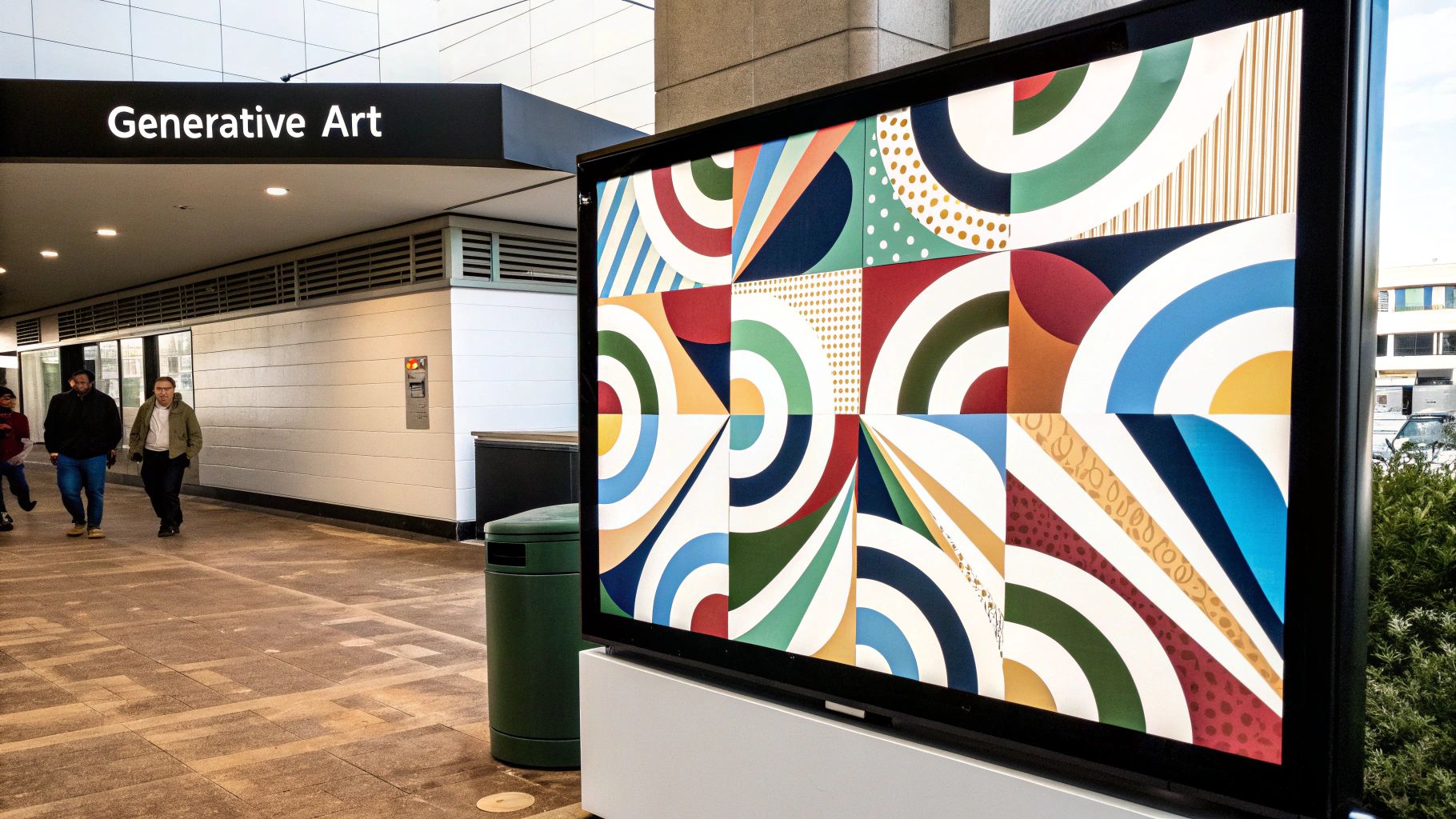
Generative art holds a crucial position in the "programming and art" landscape because it exemplifies the potential of code as a creative medium. It’s not merely about using software to create art; it's about leveraging the logic and power of programming to generate entirely new forms of artistic expression. This approach opens doors for both experienced software developers looking to explore creative coding and traditional artists seeking new digital tools.
One of the key features of generative art is its ability to produce infinite variations from a single codebase. By tweaking parameters, introducing randomness, or even altering the underlying algorithm, artists can generate a vast array of unique outputs. This inherent variability adds an element of surprise and discovery to the artistic process. From complex geometric abstractions to organic, flowing forms, the possibilities are virtually limitless. This aligns perfectly with the experimental nature of many digital artists and provides a platform for continuous exploration and innovation.
Pros:
- Complexity and Scale: Generative art enables the creation of intricate visual works, from minute details to massive installations, that would be incredibly time-consuming or even impossible to produce manually.
- Uniqueness and Variation: The incorporation of randomness allows for unique outputs each time the code is executed, providing a constant source of novel artistic creations.
- Exploration of Mathematical Principles: Generative art provides a visual and tangible representation of mathematical concepts, offering a unique perspective on abstract ideas.
- Ease of Scalability: Adapting generative artwork for different sizes and formats is often straightforward, simplifying the process of creating variations for different displays or installations.
Cons:
- Learning Curve: Mastering the programming skills required for generative art can be challenging for artists without prior coding experience.
- Potential for Predictability: While generative art can produce surprising results, poorly designed algorithms can lead to repetitive or mechanical-looking outputs.
- Unpredictability of Exact Outcomes: The inherent randomness can make it difficult to precisely control the final artwork, requiring a degree of acceptance of the unexpected.
- Lack of "Human Touch": Some argue that generative art can lack the emotional depth and personal expression found in traditional art forms.
Examples of Successful Implementation:
- Tyler Hobbs' "Fidenza" series: This collection of generative NFTs, which fetched millions in sales, demonstrates the market potential and artistic recognition generative art can achieve.
- Casey Reas' Installations: Reas, co-creator of Processing, showcases the potential of generative art in large-scale installations displayed in prominent museums globally.
- Manolo Gamboa Naon's Geometric Abstractions: Naon’s work highlights the ability of generative art to create visually stunning and complex geometric patterns.
- Vera Molnár's Pioneering Work: Molnár's early computational art from the 1960s and 70s demonstrates the enduring legacy and historical significance of this art form.
Tips for Aspiring Generative Artists:
- Start Simple: Begin with basic algorithms and gradually increase complexity as your skills develop.
- Controlled Randomness: Use randomness strategically to introduce organic variations while maintaining overall control over the aesthetic.
- Utilize Libraries: Leverage libraries like p5.js or Processing to simplify the process of creating visual outputs.
- Explore Color Theory: Combine algorithmic structures with principles of color theory to enhance the visual appeal of your work.
- Save Intermediate States: Documenting the generative process by saving intermediate stages can reveal unexpected and inspiring moments.
Generative art empowers artists with new tools and methodologies for creative expression. Whether you're a seasoned programmer, a digital artist, or simply curious about the intersection of art and technology, exploring generative art offers a unique and rewarding journey of discovery.
2. Creative Coding
Creative coding bridges the gap between programming and art, offering a powerful medium for artistic expression in the digital age. It uses code not for purely functional purposes, but as the primary tool for creating visual art, interactive experiences, installations, and multimedia works. This approach sits at the intersection of programming, art, design, and technology, blurring the lines between traditional artistic practices and the dynamic possibilities of code. Unlike conventional software development, which prioritizes solving practical problems, creative coding emphasizes aesthetics, user experience, and exploring new forms of creative output.
Creative coding distinguishes itself through several key features. It prioritizes artistic expression over utilitarian functions, often resulting in interactive or responsive artworks that engage the viewer in unique ways. This interactivity can manifest as real-time reactions to user input, dynamic visuals that evolve over time, or installations that respond to environmental changes. It often incorporates elements from traditional visual arts, such as color theory, composition, and form, and blends these with computational techniques like algorithms, generative systems, and data visualization. This cross-pollination allows artists to explore new aesthetic territories and push the boundaries of traditional media. Furthermore, creative coding transcends the limitations of static art forms, encompassing digital art, installation art, and even performance art, creating immersive and engaging experiences.
The benefits of creative coding are numerous. It democratizes art creation by making it accessible to individuals with coding skills, regardless of their background in traditional art forms. It enables new forms of interaction and user experience that are simply not possible with traditional media. Imagine artworks that react to your movements, visualizations that pulse with music, or installations that adapt to the surrounding environment – these are all within the realm of creative coding. Moreover, it fosters the creation of dynamic, evolving artworks that can incorporate real-time data as artistic input, adding an extra layer of complexity and responsiveness.
However, creative coding also presents certain challenges. There are technical barriers for traditional artists unfamiliar with programming concepts, requiring them to learn new skills and tools. As technologies evolve, creative coding projects often require ongoing maintenance and updates to ensure compatibility. Monetizing digital artworks in traditional art markets can be difficult, as the established frameworks for valuing and selling physical art don't always translate seamlessly to the digital realm. Finally, some creative coding projects require specialized hardware for proper display, adding to the overall cost and complexity.
Examples of successful creative coding projects include:
- Zach Lieberman's 'Daily Sketches' project: Lieberman, co-founder of the School for Poetic Computation, uses code to explore the intersection of drawing and computation, creating a series of captivating digital sketches.
- Kyle McDonald's interactive installations: McDonald uses code and sensors to create interactive public installations that respond to the presence and movements of viewers.
- Lauren Lee McCarthy's social experiments with code and cameras: McCarthy uses code to explore the social implications of technology, creating interactive works that challenge our relationship with surveillance and privacy.
- teamLab's immersive digital art spaces: teamLab, an international art collective, creates breathtaking immersive digital art experiences that blend projection mapping, interactive elements, and stunning visuals.
Tips for aspiring creative coders:
- Focus on iterative development: Start with simple versions of your ideas and gradually add complexity.
- Document your process: Capture screenshots or videos of your work to track your progress and share your journey.
- Join communities: Connect with other creative coders through online platforms like OpenProcessing or Creative Coding subreddits.
- Attend hackathons or coding jams: These events provide inspiration, collaboration opportunities, and a chance to learn from others.
- Don't be afraid to mix traditional art techniques with code: Combine your existing artistic skills with your coding knowledge to create unique and innovative works.
Creative coding deserves its place on this list because it represents a fundamental shift in how we think about the relationship between programming and art. It empowers artists and developers to create groundbreaking works that push the boundaries of both disciplines, leading to innovative forms of expression and audience engagement. It is a vital component of the evolving landscape of art and technology, making it an essential topic for anyone interested in exploring the creative potential of code. The influence of individuals like Zach Lieberman, Daniel Shiffman (Coding Train), Golan Levin, and collectives like teamLab has been instrumental in popularizing and advancing the field of creative coding.
3. Algorithmic Music Composition
Algorithmic music composition sits at the fascinating intersection of programming and art, utilizing computer algorithms to create musical pieces. These systems can generate everything from individual melodies and rhythms to fully realized compositions, either autonomously or working in tandem with human composers. The methods employed range from purely mathematical constructs, like fractal patterns translated into musical notes, to more sophisticated systems incorporating AI, machine learning, or rule-based structures derived from music theory. This opens up a world of creative possibilities, allowing for the exploration of musical landscapes beyond the reach of traditional composition.
Algorithmic composition provides a powerful set of tools for musicians and programmers alike. It can generate complete pieces or individual components, such as melodies, harmonies, or rhythmic patterns, which can then be integrated into a larger work. Many algorithmic systems utilize probabilistic models of music theory, enabling them to generate outputs that adhere to certain stylistic conventions or explore novel combinations within a defined framework. These systems can be designed to be generative, creating fixed compositions, or interactive, responding to real-time inputs from the environment or user interaction.
The benefits of embracing algorithmic composition are numerous. It allows for the exploration of musical possibilities beyond human intuition, pushing the boundaries of traditional musical structures and venturing into uncharted sonic territories. The ability to produce incredibly complex compositions that would be difficult or impossible to create manually is another significant advantage. Furthermore, algorithmic composition allows for limitless variations on musical themes, offering a powerful tool for experimentation and improvisation. Finally, it opens up exciting opportunities for interactive music that responds dynamically to its environment or user input, leading to unique and engaging musical experiences.
However, there are also challenges and limitations to consider. Algorithmic music, especially in its more autonomous forms, can sometimes lack the emotional nuance and depth found in human-composed music. The output can occasionally sound mechanical or predictable, especially when relying on simpler algorithms. Successfully utilizing algorithmic composition requires a certain level of understanding of both music theory and programming, which can present a barrier to entry for some. Finally, the use of algorithms in creative processes raises ethical questions about creativity and authorship, prompting discussions about the role of technology in artistic expression.
Examples of successful implementation: Brian Eno's generative music apps like 'Bloom' and 'Reflection' showcase the potential for ambient and evolving soundscapes. David Cope's 'Emily Howell' AI composer pushes the boundaries of AI-driven musical creativity. Holly Herndon's AI vocal collaborator 'Spawn' exemplifies the use of AI in a collaborative musical context. Max Cooper's algorithmic electronic compositions demonstrate the power of this approach in creating complex and engaging electronic music.
Tips for getting started:
- Start with simple musical patterns before attempting full compositions.
- Study music theory to inform your algorithmic rules and generate more musically coherent output.
- Explore and utilize libraries like Sonic Pi, TidalCycles, or SuperCollider, which offer powerful tools for algorithmic music creation.
- Incorporate human feedback loops in your generative process to refine and shape the output.
- Experiment with different musical scales, modes, and rhythmic patterns to discover new sonic possibilities.
Algorithmic music composition deserves its place in the "programming and art" landscape because it represents a fundamental shift in how music can be created and experienced. It empowers artists and programmers with new tools to explore the creative potential of code, opening up exciting avenues for innovation and expression. This approach is particularly relevant for aspiring vibe coders, experienced software developers, digital artists and creative technologists, educators and students in tech, and innovative entrepreneurs and hobbyists looking to push the boundaries of artistic expression through technology. It bridges the gap between technical skill and artistic vision, offering a unique pathway for crafting compelling and innovative musical experiences.
4. Interactive Art Installations
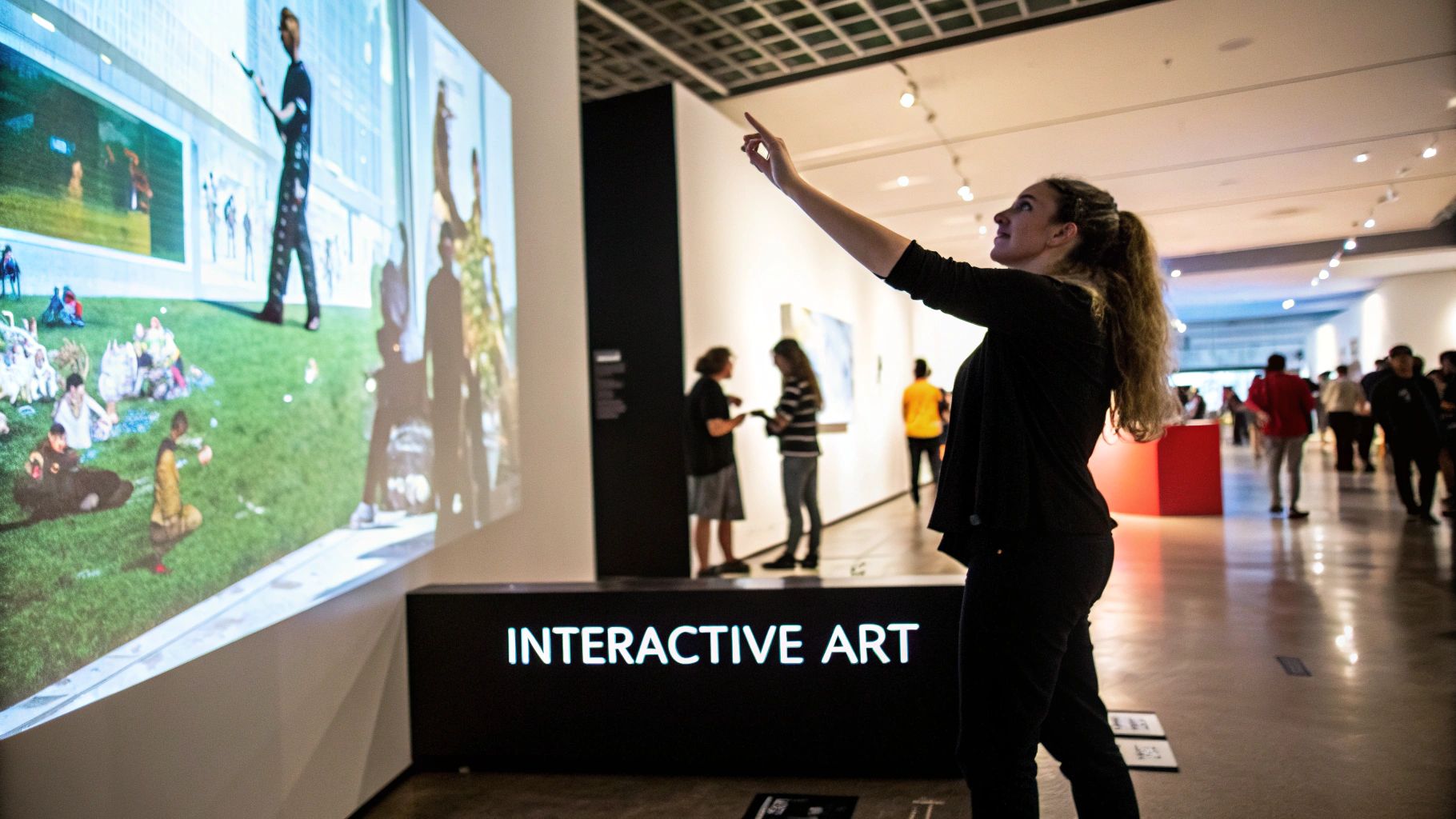
Interactive art installations represent a compelling intersection of programming and art, transforming passive viewers into active participants. These dynamic environments leverage code to respond to audience input, creating a two-way dialogue between the artwork and the observer. This interactivity is achieved through a combination of software, sensors, projections, and physical elements, often resulting in immersive experiences that blur the lines between the digital and physical realms.

These installations utilize a variety of technologies to facilitate interaction. Sensors, cameras, and other input devices detect presence, movement, touch, and sound, feeding this data into the program controlling the artwork. Features like computer vision and motion tracking allow for nuanced responses to audience behavior. Often site-specific, these works are designed to harmonize with the physical space, creating a cohesive blend of the digital and physical. For example, the software might adjust projected visuals based on the location of viewers within a room, or trigger soundscapes that react to their movements. Learn more about Interactive Art Installations This resource can provide further insights into the tools and techniques used to bring these installations to life.
Several renowned artists have pioneered this art form. Rafael Lozano-Hemmer's 'Pulse Room,' featuring lightbulbs that pulsate with the heartbeats of participants, exemplifies the power of biofeedback in interactive art. teamLab's immersive digital museums in Tokyo, Shanghai, and elsewhere offer sprawling environments where visitors navigate through breathtaking projected landscapes that respond to their presence. Random International's 'Rain Room' provides a seemingly impossible experience of walking through falling water without getting wet, while Camille Utterback's 'Text Rain' projects letters that playfully react to viewers' movements. These examples demonstrate the diverse range of experiences possible within the realm of interactive art installations.
This approach to art creation is particularly powerful for fostering memorable and engaging experiences. It breaks down the traditional barrier between artist and viewer, inviting the audience to become an integral part of the artwork itself. This participatory nature allows the art to adapt to different audiences and contexts, even evolving over time based on the cumulative interactions.
However, creating interactive installations comes with its own set of challenges. The complex technical requirements demand expertise in programming, sensor integration, and hardware setup. Maintaining these installations can also be demanding, requiring ongoing technical support and occasional troubleshooting. Technical failures, though hopefully rare, can disrupt the experience entirely. Furthermore, the specialized equipment and space often required can make these projects expensive to create and maintain.
For those venturing into this exciting field, several tips can help ensure a successful outcome. Prioritize the visitor experience over technical complexity, ensuring that the interaction is intuitive and engaging. Thorough testing with diverse users is essential to identify potential usability issues and refine the responsiveness of the artwork. Robust error handling in the code is crucial to minimize disruptions from technical glitches. Consider accessibility for diverse audiences, ensuring that the installation can be enjoyed by individuals with varying abilities. Finally, meticulous documentation with videos and photos will help preserve the artwork and facilitate future exhibitions or iterations. Interactive art installations, while demanding, offer a powerful medium for creating truly engaging and unforgettable art experiences. By carefully considering both the artistic and technical aspects, creators can harness the power of programming to blur the lines between art and audience, ushering in a new era of participatory art experiences.
5. Data Visualization Art
Data visualization art stands as a powerful intersection of programming and art, transforming complex datasets into visually compelling narratives. Unlike its purely functional counterpart, data visualization art prioritizes aesthetic experience and emotional impact alongside effective data communication. This approach leverages programming not just to chart numbers, but to craft visual stories that reveal hidden patterns, relationships, and meanings within the data. This fusion of artistic expression and analytical rigor secures its place within the realm of programming and art.
At its core, data visualization art takes abstract data and translates it into a visual form. This could be anything from static images and infographics to interactive installations and animated sequences. The key differentiator is the conscious balance between communicating information clearly and creating a captivating aesthetic experience. Often, data visualization art projects grapple with datasets related to social, environmental, or cultural issues, adding layers of meaning and relevance to the work.
Consider Jer Thorp's impactful visualization projects for The New York Times, which brought complex news data to life for a wider audience. Nathalie Miebach's intricate data sculptures translate weather data into stunning woven structures, transforming scientific observations into tangible artistic forms. Stefanie Posavec and Giorgia Lupi's "Dear Data" project exemplifies the personal and expressive potential of data visualization, using hand-drawn visualizations to document their daily lives. And Aaron Koblin's "Flight Patterns," visualizing global air traffic, demonstrates the breathtaking beauty that can emerge from visualizing large datasets.
Why use data visualization art?
It's an incredibly effective method for making complex information accessible and engaging. By transforming raw data into a visual language, it bridges the gap between abstract concepts and human understanding, fostering emotional connections and deeper comprehension. The ability to reveal hidden patterns and relationships within information offers new perspectives and insights, driving both scientific discovery and artistic exploration. This unique blend of scientific and artistic approaches to knowledge makes it an invaluable tool for anyone working with data.
Pros:
- Makes complex information accessible and engaging
- Creates emotional connections to otherwise abstract data
- Can reveal hidden patterns and relationships in information
- Bridges scientific and artistic approaches to knowledge
Cons:
- Risk of misrepresenting data for aesthetic purposes
- Requires both data analysis skills and visual design abilities
- Can be difficult to balance clarity with artistic expression
- May require ongoing updates as data changes
Tips for Creating Data Visualization Art:
- Start with datasets that have personal meaning or relevance: This will fuel your creative process and help you connect with the data on a deeper level.
- Consider the emotional quality you want to convey alongside the data: What story do you want to tell? What feeling do you want to evoke?
- Use libraries like D3.js, Processing, or p5.js for visualization: These tools provide powerful functionalities for manipulating and rendering data visually. Learn more about Data Visualization Art
- Prototype with small samples before working with big data: This allows you to experiment and refine your approach without getting overwhelmed.
- Document your process and transformation decisions: This is essential for maintaining transparency and ensuring the integrity of your work.
Data Visualization Art provides a compelling example of how programming and art can intersect to create something truly impactful. Whether you're an aspiring vibe coder, an experienced software developer, a digital artist, or simply a curious individual, exploring data visualization art opens up exciting possibilities for communication, exploration, and expression. Pioneering figures like Jer Thorp, Aaron Koblin, Giorgia Lupi, and Fernanda Viégas and Martin Wattenberg have paved the way for a vibrant field that continues to evolve and inspire.
6. Neural Art and Deep Learning Aesthetics
Neural art represents a fascinating intersection of programming and art, leveraging the power of artificial intelligence to generate and transform visual content in unprecedented ways. This approach uses artificial neural networks, specifically deep learning algorithms, to learn patterns from existing data (often large datasets of artwork or photographs) and then apply that learning to create new images, modify existing ones, or seamlessly blend styles and content. This makes it a compelling addition to any list exploring the synergy between programming and art.
At the heart of neural art are techniques like neural style transfer, where the style of one image is applied to the content of another, and Generative Adversarial Networks (GANs), which pit two networks against each other to generate increasingly realistic outputs. Other AI approaches also contribute to this rapidly evolving field, pushing the boundaries of computational creativity.
How it Works: Neural networks, inspired by the human brain, consist of interconnected layers of nodes. During training, these networks analyze vast datasets of images, learning to identify features, patterns, and stylistic elements. Once trained, they can apply this knowledge to generate new content based on provided inputs or prompts. For example, in style transfer, the network separates the content and style of two images, then recombines them to create a new image with the content of one and the style of the other.
Examples of Successful Implementation:
- Google's DeepDream: This early example of neural art produced surreal, dreamlike visualizations by enhancing patterns detected within images.
- Text-to-image systems (DALL-E, Midjourney, Stable Diffusion): These powerful models generate images from text prompts, allowing users to create unique visuals based on their descriptions.
- StyleGAN: This GAN architecture excels at generating realistic portraits of non-existent people, demonstrating the potential for AI in character design and other creative fields.
- Refik Anadol's AI data sculptures and installations: Anadol's work exemplifies the use of neural networks to transform data into mesmerizing, dynamic art installations.
When and Why to Use Neural Art:
Neural art is ideal for exploring new aesthetic frontiers and generating novel visuals that would be difficult or impossible to create through traditional means. It’s particularly useful when:
- Exploring new styles: Blend different artistic styles to create something entirely new.
- Generating variations on a theme: Create endless iterations of a specific visual concept.
- Visualizing abstract data: Transform data into visually compelling representations.
- Pushing creative boundaries: Experiment with the interplay of human creativity and machine learning.
Pros:
- Creates novel visual aesthetics.
- Generates infinite variations after training.
- Enables style transfer between diverse visual languages.
- Pushes the boundaries of computational creativity.
Cons:
- Raises questions about originality, authorship, and copyright.
- Requires significant computational resources for training.
- Results can be unpredictable.
- Models inherit biases from training data.
Tips for Getting Started:
- Start with pre-trained models: Platforms like RunwayML and Google Colab offer access to powerful models without needing extensive hardware.
- Experiment with prompt engineering: Refine your text prompts for text-to-image models to achieve desired results.
- Consider ethical implications: Be mindful of potential biases in training datasets and responsible use of AI-generated content.
- Combine AI-generated elements with your own work: Integrate AI outputs into your existing workflow for greater control and artistic expression.
Popularized By:
- Refik Anadol: AI artist known for data sculptures and installations.
- Sofia Crespo: Neural artist exploring nature-like forms.
- Alexander Mordvintsev: Creator of DeepDream at Google.
- Mario Klingemann: Pioneering artist using neural networks.
Neural art's unique blend of programming and art offers exciting possibilities for creative expression, making it a significant development in the ongoing dialogue between humans and machines. By understanding its capabilities and limitations, artists and programmers alike can harness its power to explore new aesthetic territories and expand the horizons of art in the digital age.
7. Physical Computing and Arts
Physical computing and arts represents a fascinating intersection of programming and art, pushing the boundaries of creative expression beyond the digital screen and into the tangible world. This approach merges the virtual realm of code with physical hardware, resulting in interactive installations, kinetic sculptures, and responsive environments that engage multiple senses. If you're looking for a way to bring your code to life in a truly interactive and physical way, then physical computing might be the perfect medium for you. This approach deserves its place on this list because it expands the definition of what "programming and art" can be, offering a powerful way to connect with audiences on a visceral level.
How it Works:
At its core, physical computing involves using software to control and interact with physical hardware. Sensors gather data from the real world – light levels, sound, movement, touch – and feed it into a microcontroller. This data is then processed by code, triggering outputs like the movement of motors, the illumination of LEDs, or the playing of sounds. Essentially, you're creating a feedback loop where the physical world influences the digital world, and vice versa. This dynamic interaction is what distinguishes physical computing from more traditional forms of digital art.
Features and Benefits:
- Combines physical hardware with software programming: This allows for the creation of truly interactive and responsive art pieces.
- Uses sensors to gather real-world data: This opens up a world of possibilities for creating art that reacts to its environment and the people within it.
- Creates objects or environments that respond to physical interaction: This makes the art more engaging and immersive for the viewer.
- Often incorporates mechanical or robotic elements: This adds a dynamic and kinetic dimension to the artwork.
- Bridges digital and physical worlds: This allows artists to explore new forms of expression and create experiences that blur the lines between the virtual and the real.
Examples of Successful Implementation:
- Theo Jansen's 'Strandbeests': These wind-powered kinetic sculptures, built from PVC pipe and ingenious mechanisms, walk along beaches, demonstrating the power of mechanics combined with artistic vision.
- ART+COM's 'Kinetic Rain': This mesmerizing installation at Singapore Changi Airport features hundreds of individually controlled bronze droplets that move in choreographed patterns, creating a captivating spectacle of motion and light.
- Daniel Rozin's mechanical mirrors: These interactive sculptures use arrays of small physical elements (wood, penguins, etc.) that move to create a reflected image of the viewer, showcasing the playful potential of physical computing.
- Ken Rinaldo's robotic installations: Rinaldo creates interactive robotic ecosystems that explore themes of artificial life and the relationship between humans and technology.
Pros and Cons:
Pros:
- Creates tangible experiences: Physical computing allows you to engage multiple senses, leading to a more immersive and memorable experience.
- Makes programming concepts accessible: Interacting with physical outputs makes abstract programming concepts more concrete and understandable.
- Surprising and delightful interactions: The dynamic nature of physical computing allows for unexpected and delightful interactions between the artwork and the viewer.
- Extends digital art into three-dimensional space: It breaks free from the limitations of the screen, allowing for larger-scale and more immersive art experiences.
Cons:
- Requires knowledge of electronics and hardware: You'll need to learn about circuits, sensors, and microcontrollers.
- Works can be fragile: Physical components can break down, requiring ongoing maintenance.
- Often more expensive: Hardware costs can add up quickly.
- More complex to transport and exhibit: Logistics can be challenging due to the physical nature of the work.
Tips for Getting Started:
- Start simple: Begin with basic circuits and microcontrollers like Arduino.
- Prototype with cheap materials: Cardboard, wood, and other readily available materials are great for prototyping.
- Build redundancy: If your work will be exhibited publicly, design systems with backup components to prevent failures.
- Document everything: Keep thorough records of both your code and your construction process.
- Consider power and durability: For long-term installations, carefully plan for power requirements and environmental factors.
Popularized By:
Key figures in the field include Tom Igoe (co-founder of Arduino and author of "Physical Computing"), Theo Jansen, Daniel Rozin, and Moritz Waldemeyer. Their work has inspired countless artists and makers to explore the creative potential of physical computing.
By bridging the gap between the digital and physical realms, physical computing in arts provides a powerful and engaging way to experience programming and art, making it a truly essential element in any exploration of the field.
8. Procedural Animation and Digital Motion
Procedural animation represents a fascinating intersection of programming and art, offering a powerful alternative to traditional keyframe animation. Instead of meticulously crafting each frame of movement by hand, artists leverage algorithms and code to define the rules governing motion, creating dynamic and organic results. This approach breathes life into digital art, enabling everything from gently swaying trees to complex, evolving abstract forms. This makes it a vital tool for any aspiring vibe coder, experienced software developer, digital artist, or creative technologist.
Instead of manually setting keyframes, procedural animation uses code to define how elements move and interact. This often involves incorporating physics simulations, particle systems, and mathematical functions to create complex behaviors from simple rules. Imagine a flock of birds: instead of animating each bird individually, you could write a program that simulates flocking behavior based on rules of attraction, repulsion, and alignment. This allows for organic, emergent motion that would be incredibly time-consuming to achieve with traditional techniques.
Several key features distinguish procedural animation:
- Code-Driven Movement: Animation is created through code rather than manual keyframing.
- Physics and Simulation: Often incorporates physics engines and particle systems to create realistic or stylized motion.
- Emergent Complexity: Complex movements arise from relatively simple underlying rules.
- Responsiveness and Adaptability: Motion can react to user input, environmental changes, or other dynamic conditions.
This approach yields numerous advantages:
Pros:
- Organic, Natural-Looking Movement: Algorithms can produce lifelike motion that's difficult to replicate manually.
- Unique Animations: Each execution of a procedural animation can yield slightly different results, introducing an element of surprise and variation.
- Scalability: Easily animate large numbers of elements, like a swarm of insects or a field of flowers, without manually keyframing each one.
- Interactive Motion: Create animations that respond to user input, creating engaging and dynamic experiences.
Cons:
- Precision and Control: Achieving precise, specific movements can be more challenging than with keyframing.
- Technical Expertise: Requires understanding of programming, algorithms, and potentially physics and mathematics.
- Debugging Complexity: Debugging procedural animations can be more complex than traditional animation.
- Performance: Computationally intensive simulations can lead to performance issues, especially in real-time applications.
Procedural animation has found a home in various artistic expressions. Examples include William Forsythe's "Choreographic Objects," which uses procedural movement systems to explore the intersection of choreography and computation; Universal Everything's dynamic digital characters and creatures; Memo Akten's fluid simulations and movement studies; and Studio DRIFT's "Concrete Storm" installation with procedurally animated drones. These examples highlight the versatility and power of procedural animation in creating captivating and innovative art.
To get started with procedural animation, consider these tips:
- Leverage Libraries: Start with established physics libraries and animation frameworks like Three.js (which you can learn more about here) rather than building everything from scratch.
- Simple Rules, Complex Behavior: Use simple rules to generate complex behaviors, such as flocking algorithms or L-systems.
- Balance and Control: Balance randomness with constraints to create motion that feels natural but remains controlled.
- Observe Nature: Record and analyze natural movements to inform your algorithms and create more realistic results.
- Optimize for Performance: Consider performance optimization techniques for real-time applications.
Procedural animation deserves its place in this list because it bridges the gap between programming and art, offering a powerful and expressive way to create dynamic, organic, and interactive motion. It empowers artists and programmers to explore new creative territories and push the boundaries of digital art.
8 Concepts Comparison in Programming & Art
| Concept | Implementation Complexity 🔄 | Resource Requirements ⚡ | Expected Outcomes 📊 | Ideal Use Cases 💡 | Key Advantages ⭐ |
|---|---|---|---|---|---|
| Generative Art | High learning curve; requires programming and math skills | Moderate; coding tools and hardware | Unique, complex visual artworks | Creating visual art with algorithmic rules | Complex, scalable, infinite variations |
| Creative Coding | Moderate complexity; combines coding with artistic design | Moderate; coding environment required | Interactive, evolving multimedia artworks | Interactive art, installations, expressive coding | Democratizes art; dynamic, interactive outputs |
| Algorithmic Music Composition | High; needs music theory + programming knowledge | Moderate to high; software and sound | Complex, varied musical pieces | Music generation, interactive or generative music | Explores novel musical possibilities |
| Interactive Art Installations | High; integrates sensors, software, physical components | High; specialized hardware and space | Immersive, responsive environments | Audience-engaging exhibits, site-specific works | Engages audience; adaptive, evolving experiences |
| Data Visualization Art | Moderate; requires data analysis + design skills | Moderate; data tools/software | Informative, emotionally compelling visuals | Communicating data aesthetically | Reveals hidden data patterns; emotional impact |
| Neural Art & Deep Learning | High; needs AI/ML expertise and computational power | High; significant computational needs | Novel, AI-generated or transformed images | AI-based visual generation, style transfer | Unprecedented creativity; infinite new aesthetics |
| Physical Computing & Arts | High; combines hardware, software, electronics | High; electronics and fabrication | Tangible, interactive physical artworks | Responsive sculptures, installations blending tech | Multi-sensory engagement; physical-digital blend |
| Procedural Animation & Motion | High; algorithmic with physics and math knowledge | Moderate to high; animation software | Dynamic, organic, adaptive animations | Real-time animation, simulations, interactive media | Organic motion; scalable and interactive |
The Future of Art is Coded
From generative art and algorithmic music composition to interactive installations and AI-driven aesthetics, the fusion of programming and art is revolutionizing creative expression. This article explored eight key areas where code and artistry intersect, showcasing how programming is becoming an essential tool for artists in the digital age. We've seen how data visualization can transform raw information into captivating visuals, how physical computing bridges the gap between the digital and physical realms, and how procedural animation breathes life into digital motion. Mastering these approaches empowers artists to explore new frontiers, pushing the boundaries of what's possible and creating experiences that captivate and inspire.
The key takeaway is this: programming and art are no longer separate disciplines but intertwined forces shaping the future of creativity. Whether you're a seasoned developer looking to add an artistic dimension to your work or a visual artist eager to harness the power of code, understanding these concepts opens doors to a world of innovative possibilities. The ability to code allows artists to generate complex visuals, build interactive experiences, and explore new forms of artistic expression that were previously unimaginable. These skills aren't just valuable for individual artists; they're increasingly sought after in industries like game development, advertising, and interactive design.
As we've explored the exciting intersection of programming and art, it's clear that creative inspiration is essential. For those looking to further enhance their innovative thinking and generate new ideas, exploring resources on sparking creativity can be invaluable. This intersection of programming and art offers a fertile ground for innovation. By embracing these technological advancements, artists can unlock new levels of creativity and connect with audiences in profound ways. The future of art is not just coded; it's vibrant, dynamic, and constantly evolving. Embrace the possibilities, experiment with the tools, and let your imagination run wild. The only limit is your creativity.