Understanding What Is Vibe Coding: Beyond Traditional Code
The rise of AI is changing the software development landscape. Vibe coding, a new approach to software creation, is gaining traction. This method simplifies the process by allowing developers, and even those without coding experience, to create software using natural language instructions. Imagine describing what you want your software to do in plain English, and letting the AI translate that into the necessary code. But how does vibe coding actually work?
Vibe coding focuses on capturing the essence, or "vibe", of your intended software. You communicate this "vibe" to an AI, which then generates the corresponding code. This differs significantly from traditional coding where developers meticulously write each line of code themselves, demanding a deep understanding of programming languages and syntax. Instead, vibe coding uses the power of Large Language Models (LLMs) to interpret natural language and convert it into functional code. This allows individuals to concentrate on the desired outcome, rather than the intricate technical details of its execution.
Vibe coding, a novel programming paradigm, was introduced by Andrej Karpathy, a prominent AI researcher and former Tesla AI leader, in February 2025. This approach utilizes LLMs like OpenAI's Codex, ChatGPT, and Claude to translate natural language descriptions into executable code. Rather than writing code manually, users express their intentions using everyday language or conversational commands, leaving the code generation to the AI. To delve deeper into this topic, check out this resource: Learn more about vibe coding. You might also find this helpful: How to master the fundamentals of vibe coding.
The Core Principles of Vibe Coding
Several key principles drive the effectiveness of vibe coding:
-
Intent-Driven Development: The focus is on clearly defining the intended result or functionality of the software. This involves articulating the problem you’re trying to solve to the AI.
-
Abstraction of Complexity: Vibe coding shields users from the complexities of code syntax and structure. The LLM acts as an intermediary, translating natural language into code.
-
Iterative Refinement: The process involves continuous communication with the AI, refining instructions and providing feedback until the desired outcome is reached.
The Benefits of Vibe Coding
Vibe coding offers a range of potential benefits:
-
Increased Accessibility: It opens the door to software development for a wider range of people, including those without formal coding training.
-
Faster Development Cycles: By automating code generation, projects can be completed much more quickly.
-
Reduced Development Costs: The automation involved in vibe coding can lead to substantial cost reductions.
-
Enhanced Creativity: Freed from manual coding, developers can focus on the creative aspects of problem-solving and innovation.
This innovative approach to software development is still in its early stages. However, its potential to democratize and accelerate software creation is clear. The ability to transform natural language into functioning code marks a significant advancement, empowering more people to bring their digital ideas to life.
The Engine Behind Vibe Coding: How It Actually Works
Vibe coding presents a significant shift in how we approach software development. But how does this intuitive translation from natural language to functional code actually happen? The core of this process relies on the impressive capabilities of Large Language Models (LLMs). These AI-powered systems are trained on enormous datasets of code, allowing them to learn programming concepts, syntax nuances, and even best practices across a range of languages.
From Vibe to Code: A Three-Step Process
The journey from an initial "vibe" to lines of code can be broken down into three key steps:
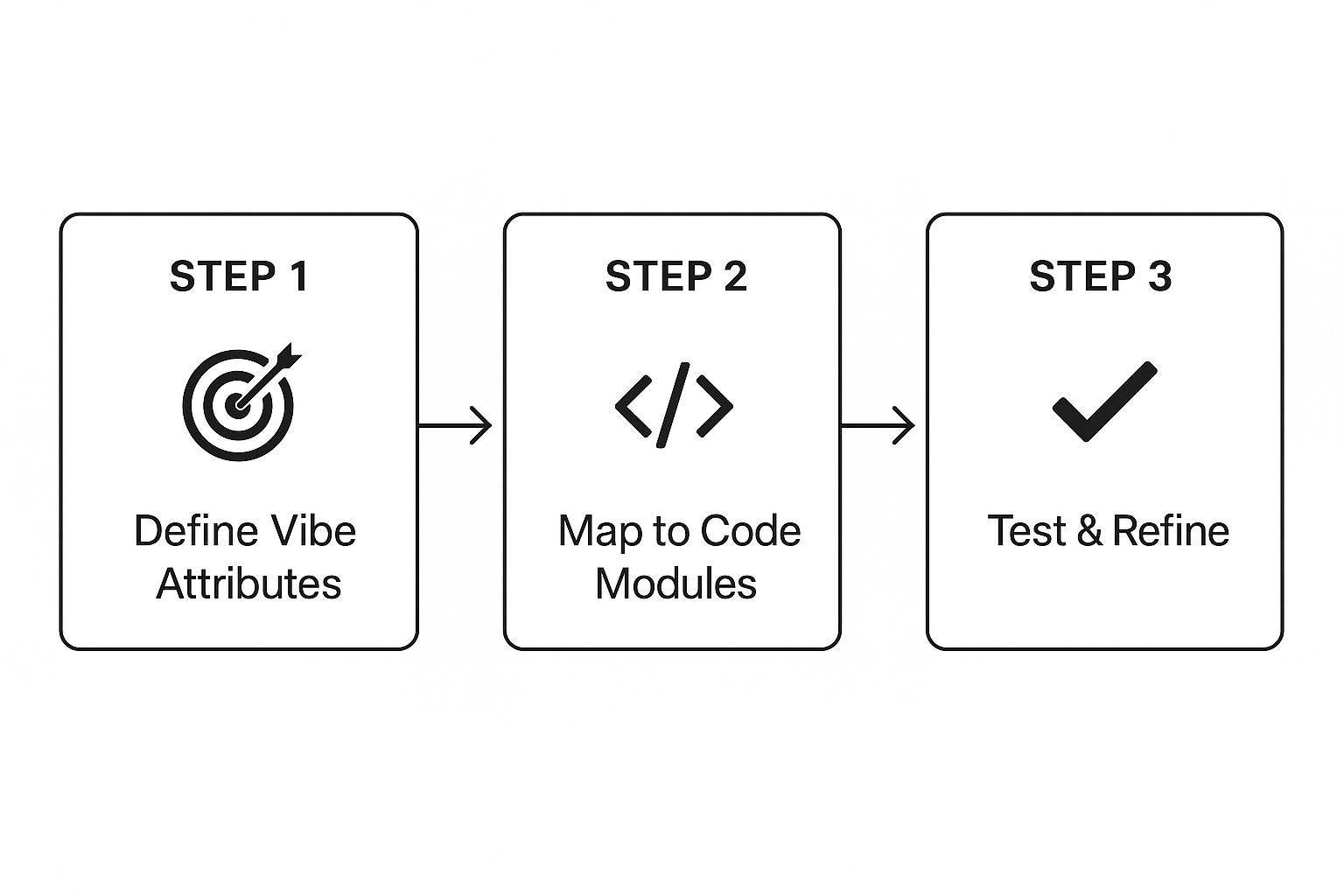
This infographic provides a visual representation of the vibe coding process. It begins with defining the desired "vibe" or attributes of the software. The system then maps these attributes to corresponding code modules. Finally, the generated code undergoes rigorous testing and refinement. This iterative process ensures the final output aligns with the user’s initial intent.
Understanding the AI’s Role
It's important to understand that LLMs don't simply copy and paste pre-existing code. Instead, they learn to recognize patterns, understand relationships between program components, and even anticipate potential issues. For example, if instructed to create a login system, the LLM recognizes the need for user authentication, data storage, and appropriate security measures. Using this knowledge, it generates relevant code blocks. Furthermore, continuous interaction and user feedback allow the AI to refine its output, ensuring the code not only functions correctly but also adheres to coding best practices.
Languages and Frameworks: Finding the Right Fit
While vibe coding can be applied to a variety of programming languages, certain languages and frameworks are more conducive to this approach. Languages like Python and JavaScript, with their readily available online documentation and vibrant open-source communities, offer rich training data for LLMs. This makes them excellent choices for vibe coding projects. Even within a particular language, specific frameworks can influence the AI's effectiveness. For example, within JavaScript, React is increasingly popular in vibe coding due to its component-based structure and abundance of online examples.
To illustrate the key differences between traditional coding and vibe coding, consider the following comparison:
Traditional Coding vs. Vibe Coding
A comparison of key differences between traditional programming approaches and the vibe coding paradigm
| Aspect | Traditional Coding | Vibe Coding |
|---|---|---|
| Initial Input | Detailed code specifications | High-level description of desired outcome ("vibe") |
| Process | Manual coding line by line | AI-assisted code generation |
| Control | Direct control over every aspect of the code | Indirect control through refining prompts and feedback |
| Speed | Can be time-consuming, especially for complex projects | Potentially much faster for initial code generation |
| Expertise | Requires extensive coding knowledge | Requires understanding of how to effectively prompt the AI |
| Maintenance | Manual debugging and updates | Potentially easier updates through modifying the initial prompt |
This table highlights how vibe coding streamlines the development process by focusing on the desired outcome rather than the intricate details of code implementation. While traditional coding offers granular control, vibe coding empowers developers to work at a higher level of abstraction.
The Human Element: Beyond the Code
The process of vibe coding is not entirely automated. Effective communication with the AI is essential. Clear, specific instructions are crucial for achieving desired results. Much like giving directions, vague instructions lead to confusion, while precise guidance yields the intended destination. Learning how to effectively "prompt" the AI is key to unlocking its full potential. This involves understanding the AI’s capabilities and limitations and crafting requests that guide the AI toward the desired outcome.
Why Developers Are Embracing Vibe Coding
Vibe coding is changing the landscape of software development. It offers a compelling alternative to traditional coding methods, promising increased efficiency and accessibility. Several key factors are driving this shift, making it easier and faster to bring software projects to life.
One of the biggest advantages is speed. Startups, for instance, are using vibe coding to develop Minimum Viable Products (MVPs) much faster than with traditional methods. This rapid development allows for quicker market testing and iteration based on user feedback.
Enterprise teams are also finding value in using vibe coding to address technical debt. By automating repetitive tasks, developers can focus on more strategic and complex aspects of their projects. This ultimately leads to more robust and maintainable software solutions.
This increased efficiency also results in significant cost savings. Streamlined development cycles and reduced manual coding free up resources for more effective allocation. This cost-effectiveness is particularly appealing to businesses seeking to maximize their return on investment.
The impact extends to non-technical founders as well. Vibe coding empowers them to realize their visions without needing extensive engineering teams. This increased accessibility democratizes software creation, allowing a wider range of individuals to contribute to innovation. For more insights into software development processes, explore this resource: Software Development.
One of the most impactful benefits of vibe coding is rapid prototyping. This significantly reduces the time needed to move from an idea to a working demo or MVP. What traditionally took days or weeks can now be accomplished in just a few hours, simply by describing the desired functionality in plain language. This accessibility opens doors for entrepreneurs, designers, and non-technical experts, democratizing coding across various global markets. Learn more about the impact of vibe coding here.
Addressing the Skills Gap and Empowering Developers
Beyond individual projects, vibe coding addresses the growing technical skills gap. By simplifying the coding process, it allows a new generation of developers to enter the field. This influx of talent helps alleviate the shortage of skilled programmers and promotes a more diverse tech community.
Vibe coding also empowers experienced developers. By automating routine tasks, it allows these professionals to focus on the most challenging and creative aspects of software development. They can tackle complex problems requiring human ingenuity and problem-solving skills, leading to more fulfilling work experiences.
This combination of human creativity and AI assistance is driving a new wave of innovation in the software industry. Experienced developers can contribute at a higher level, pushing the boundaries of what's possible with software.
Vibe Coding In Action: Real Success Stories
Moving beyond theory, let's explore how innovators are using vibe coding today. This approach, where you describe your desired software functionality in natural language and AI translates it into code, is already impacting various industries.
Healthcare Streamlined: Patient Management Reimagined
A healthcare startup built a patient management system in weeks, not months, using vibe coding. They described the functionalities – appointment scheduling, record keeping, billing integration – to the AI, which then generated the necessary code. This accelerated development brought their product to market faster, delivering vital services to patients sooner.
The speed and efficiency gained through this process proved invaluable in a fast-paced healthcare environment.
Financial Services Automated: Complex Reporting Simplified
A financial services company used vibe coding to automate complex reporting workflows. Instead of manual coding, they instructed the AI to generate reports based on specific criteria. This not only saved time but also minimized errors, freeing financial analysts for more strategic work. For more details, see our article on real-world examples of vibe coding.
This automation allowed for greater accuracy and efficiency in their reporting processes.
Personalized Learning: Tailoring Education To Each Student
Educational platforms are using vibe coding to create personalized learning experiences. By describing learning styles and desired outcomes to the AI, educators can generate customized learning paths and interactive exercises. This personalization enhances engagement and promotes more effective learning. Each student benefits from a learning experience tailored to their individual needs.
This approach transforms the way educational content is delivered and consumed.
Overcoming Challenges: Real-World Implementation And Results
While vibe coding offers significant potential, implementation does have its challenges. Teams often initially resisted adopting this new technology. However, by demonstrating tangible results – faster development cycles, reduced costs, and improved outcomes – these innovators overcame skepticism and proved vibe coding’s value. The positive results ultimately spoke for themselves.
Prompting Techniques And Integration: A Practical Roadmap
Each success story highlights the importance of effective prompting techniques. Clear, specific instructions given to the AI directly affect the generated code’s quality. Integrating these vibe-coded solutions with existing systems is also crucial. These teams seamlessly blended the AI-generated code with their existing infrastructure, ensuring a smooth workflow. You might find this resource helpful: How to master vibe coding. This allows organizations to maximize the benefits of vibe coding while minimizing disruption.
To provide a clearer picture of the efficiency gains, let's look at some statistical data. The following table compares traditional development with vibe coding across different project types.
Vibe Coding Efficiency Metrics
| Project Type | Traditional Development Time | Vibe Coding Development Time | Time Savings | Resource Reduction |
|---|---|---|---|---|
| Patient Management System | 6 months | 3 weeks | 88% | 60% |
| Automated Financial Reporting | 4 months | 2 weeks | 92% | 45% |
| Personalized Learning Platform | 8 months | 1 month | 88% | 70% |
As the table demonstrates, vibe coding significantly reduces development time and resource utilization across various projects. The substantial time savings and resource reductions highlight the potential of vibe coding to revolutionize software development. These results underscore the efficiency and cost-effectiveness of this innovative approach.
Where Vibe Coding Falls Short: Know the 7 Limitations
While vibe coding presents a novel approach to software development, it's important to understand its limitations. Knowing these shortcomings helps developers set realistic expectations and recognize when traditional coding methods are still necessary.
Debugging Challenges: Unraveling AI-Generated Code
A primary challenge with vibe coding is debugging. Tracing errors in AI-generated code can be difficult. Developers must decipher the AI's logic, a process that can be complex and time-consuming, especially for large projects.
Security Risks: Navigating the Unknown
Security is paramount in software development. Vibe coding carries the risk of unforeseen security vulnerabilities. AI might create code susceptible to exploitation, requiring rigorous testing and security audits, potentially offsetting time saved through code generation.
Maintenance Matters: Long-Term Considerations
Maintaining vibe-coded systems presents unique challenges. Future updates and modifications can be complicated if the original intent or the AI's decision-making process is unclear. Careful planning and documentation are crucial for long-term stability.
Quality Versus Speed: Finding the Right Balance
Vibe coding often prioritizes speed, which can sometimes compromise code quality. AI-generated code might not always follow best practices or be optimized for performance. Finding the balance between speed and quality is key.
The Hybrid Approach: Maximizing Benefits, Mitigating Risks
Many teams adopt hybrid approaches, using vibe coding for rapid prototyping and basic code structure while relying on traditional coding for complex logic and security-critical parts. This combines the strengths of both methods.
Reliance on External Platforms: A Potential Concern
Vibe coding often relies on external platforms for access to Large Language Models (LLMs) and AI functionalities. This dependence raises potential concerns about data privacy, vendor lock-in, and platform longevity. Careful platform selection is essential.
Documentation and Transparency: Keeping Track of the "Vibe"
Clear documentation of the initial "vibe" or intent is vital for long-term maintainability. Understanding the AI’s reasoning helps developers make necessary modifications and maintain code consistency over time. This documentation should be a key part of the development process.
Your First Vibe Coding Project: Tools and Techniques
Ready to dive into vibe coding? This section will guide you through the essential tools and techniques you'll need for your first project. This involves understanding the available platforms and mastering the art of prompting for optimal results. You'll gain a solid foundation for building your own applications.
Choosing the Right Platform
Several platforms cater to vibe coding, each with its strengths and weaknesses. Here’s a quick overview:
-
GitHub Copilot: This tool excels at generating code within your existing workflow. Tightly integrated with popular IDEs like Visual Studio Code, it's a convenient choice for experienced developers.
-
ChatGPT: Known for its conversational abilities, ChatGPT can generate code snippets, explain concepts, and even brainstorm ideas. However, it might require more guidance for complex projects.
-
Claude: Similar to ChatGPT, Claude handles conversational coding requests. Its strengths lie in handling larger contexts and providing more detailed responses.
Choosing the right platform depends on your needs and preferences. Experiment with different tools to find the best fit. For more in-depth information, check out this resource: How to master the different vibe coding tools. It offers valuable insights into maximizing their potential.
Prompting Techniques for Effective Vibe Coding
How you phrase your requests, or prompts, significantly influences the quality of the generated code. Think of it as communicating with a junior developer: clear, specific instructions yield better outcomes.
Here are some tips for crafting effective prompts:
-
Be Specific: Clearly define the desired functionality, including inputs, outputs, and any constraints. The more detail, the better the AI understands your intent.
-
Use Examples: Providing examples of the desired code style or functionality can help the AI generate more relevant output. This is especially useful for complex logic or specific formatting.
-
Iterate and Refine: Vibe coding is iterative. Start with a basic prompt, review the code, and refine your instructions based on the AI’s response.
-
Break Down Complex Tasks: Instead of requesting an entire application at once, break the project into smaller, manageable subtasks. This improves control and simplifies debugging.
Building Your First Project: A Step-by-Step Guide
Once you've chosen your platform and honed your prompting skills, you're ready for your first project. Here’s a suggested workflow:
-
Define the Scope: Clearly define what you want to build. What problem are you solving? What are the key features?
-
Create an Initial Prompt: Based on your scope, craft a clear and specific prompt for the AI, including as much detail as possible.
-
Review and Refine: Examine the AI-generated code. Does it meet your expectations? Are there errors or areas for improvement? Refine your prompt accordingly.
-
Test and Integrate: Test the code thoroughly. Integrate it with other project components, ensuring seamless functionality.
-
Document Your Progress: Keep a record of your prompts, the AI's responses, and any modifications. This helps with debugging and maintenance.
By following these steps, you can use vibe coding to accelerate your development process. Remember, practice makes perfect. The more you experiment, the better you'll become at harnessing the power of vibe coding.
What's Next for Vibe Coding: The Road Ahead
The world of vibe coding is constantly evolving. Understanding the future direction of this technology is crucial for staying ahead of the curve. Emerging trends, fueled by advancements in AI and developer tools, are set to reshape how we approach software development.
Improving AI Models and Addressing Limitations
Current vibe coding models, while impressive, still have limitations. Future development will concentrate on refining these models, reducing errors, and enhancing the overall quality of generated code. Imagine AI that not only interprets your intended "vibe" but also anticipates potential issues and proposes optimized solutions. This evolution will result in more robust and reliable AI-generated code, effectively bridging the gap between rapid prototyping and production-ready software.
Improved debugging tools will be essential for navigating the complexities of AI-generated code, simplifying the process of identifying and resolving issues.
The Evolution of Development Environments
Development environments are also transforming to better accommodate vibe coding workflows. We can expect to see tighter integration between AI coding assistants and popular IDEs like Visual Studio Code or IntelliJ IDEA, blurring the lines between human input and AI-generated code. This streamlined approach will boost developer efficiency, allowing for seamless transitions between writing code and refining AI suggestions.
New tools will likely emerge, specifically designed for managing multiple coding agents concurrently, similar to the concept of "agent fleets" described by Steve Yegge in his article "Revenge of the Junior Developer." This shift could significantly impact team structures and project management.
Industry Transformations and Impacts
Some industries are better positioned to reap the benefits of vibe coding advancements. Sectors with repetitive coding tasks, such as data entry or report generation, will likely experience the most immediate changes. To get started, you can explore resources like Vibe Coding Courses. However, the impact will extend beyond these areas. As AI models improve, even complex industries like healthcare and finance will discover new applications for vibe coding, leading to more efficient and innovative solutions.
The Changing Role of Developers and the Future of Work
This shift will undoubtedly change the roles of developers. While some fear job displacement, a more probable outcome is a shift in required skillsets. Developers will increasingly focus on higher-level tasks such as defining the project's "vibe," guiding the AI, and ensuring code quality. This signifies a greater emphasis on communication, problem-solving, and strategic thinking, as developers transition from code writers to code orchestrators. The ability to effectively communicate with AI and manage its output will become a highly valuable skill.
Preparing for the Future of Vibe Coding
Forward-thinking companies are already adapting to these changes. They're building teams that leverage both human creativity and AI capabilities, recognizing that the future of software development relies on a synergistic partnership between humans and machines. This involves investing in training programs to equip developers with the necessary skills for this evolving landscape and developing new processes that optimize the use of AI tools. Success in the world of vibe coding will depend on embracing change and adapting to this new era of AI-assisted development.