Understanding What Is Vibe Coding
Traditional coding often presents a challenge for aspiring developers. The complexities of syntax and logic can be daunting, creating a barrier to entry. Vibe coding, however, offers a fresh perspective. It aims to simplify the development process by bridging the gap between human intention and the way machines execute those intentions.
This new approach allows developers to express their goals in natural language, similar to having a conversation. Instead of wrestling with complex code, they can describe the desired outcome.
This shift towards natural language represents a significant change in programming methodology. It's about communicating the desired "vibe" of the software and letting Artificial Intelligence (AI) translate it into functional code. Imagine telling a computer, "Create a button that changes color when clicked," and having the AI generate the code automatically. This simplifies the process, allowing developers to focus on the creative aspects of their projects.
This ability to communicate using everyday language is transforming software creation. Vibe coding relies on AI to convert user intentions into executable code. Introduced by computer scientist Andrej Karpathy in February 2025, this concept shifts away from manually writing every line of code. Users articulate their ideas in plain language, and AI models handle the code generation. This allows for rapid prototyping and experimentation. Learn more about vibe coding here: https://www.ibm.com/think/topics/vibe-coding.
Exploring the Potential of Vibe Coding
Vibe coding democratizes software development. Its simplified approach makes it accessible to a broader audience, empowering not only experienced programmers but also those who may have found traditional coding too difficult. This opens doors for designers, entrepreneurs, and anyone with an idea they want to bring to life. You can explore further with these Real-world examples of vibe coding.
Early Adopters and Their Experiences
Early adopters of vibe coding report significant workflow improvements. They can concentrate on design and logic without getting stuck on syntax details. This accelerated development process fosters faster feedback loops, enabling quicker iterations and higher product quality. These initial experiences highlight the potential of vibe coding to reshape software development.
The Technical Magic Behind Vibe Coding

Vibe coding relies on advanced AI models and machine learning systems to interpret user intentions, learn from context, and translate natural language instructions into functional code. While the process is complex, it can be broken down into key components.
Understanding AI Models and Machine Learning
The core of vibe coding lies in Large Language Models (LLMs). Trained on massive datasets of code, these models understand and generate code in various programming languages. For instance, if you request an LLM to "create a login form," it recognizes the required elements: input fields for username and password, a submit button, and perhaps even security features. This understanding stems from the extensive code the model has processed during training. These LLMs often integrate with other machine learning systems to refine the code generation process, considering factors like context, user preferences, and best coding practices.
Learning and Adaptability in Vibe Coding
Vibe coding tools constantly learn from millions of code repositories. This continuous learning expands their knowledge base and improves their ability to generate accurate and efficient code. As coding practices and technologies evolve, these tools adapt accordingly.
Furthermore, vibe coding tools can personalize the coding experience. They analyze the code a user accepts and modifies, learning their preferences and tailoring future suggestions. This personalization creates a more efficient and satisfying coding experience. The AI becomes increasingly attuned to the individual developer's needs, anticipating their intentions more effectively over time.
Prompt Engineering for Better Results
The quality of generated code heavily depends on how you interact with the vibe coding system. Prompt engineering, the art of creating effective instructions for AI, is key to getting the best results.
Clear, specific prompts yield more accurate and relevant code. For example, instead of asking for a "button," request "a red button that triggers a pop-up message." This gives the AI greater context, leading to more precise code generation. Mastering prompt engineering techniques empowers developers to communicate their intentions more clearly and efficiently, maximizing the potential of vibe coding. This becomes increasingly important as AI models continue to advance.
Vibe Coding Tools That Are Changing the Game
Vibe coding is changing how we build software, and the tools driving this change are fascinating. These platforms offer different advantages and cater to various needs, making it essential to understand their unique strengths. Let's explore some of the leading tools shaping the future of development.
Replit: Bringing Ideas to Life Quickly
Replit excels with its browser-based collaborative coding environment. It supports many programming languages and allows for real-time collaboration, making it perfect for learning and rapid prototyping. Its intuitive interface and instant setup are particularly appealing to beginners and teams working on quick projects.
Cursor: An IDE Designed for AI-Powered Development
Cursor goes beyond basic code generation by integrating AI assistance deeply into the development workflow. Specialized features, such as debugging assistance and code explanations, streamline the coding process. This can significantly boost productivity, especially for tasks involving complex logic or unfamiliar libraries. Improve your code documentation by leveraging established Code Documentation practices.
GitHub Copilot: AI Pair Programming at Its Best
GitHub Copilot acts as an AI pair programmer, offering intelligent code suggestions and generating entire functions based on context. This speeds up development and makes software creation more accessible to less technical individuals, such as entrepreneurs and designers.
Combining Tools for Maximum Impact
Many development teams are discovering the benefits of combining these tools. A team might start prototyping on Replit, then move to Cursor for more robust development, using GitHub Copilot throughout for AI assistance. This approach leverages the strengths of each platform for a dynamic and efficient workflow. Learn more about effectively utilizing various vibe coding tools with this resource: How to master different vibe coding tools.
To help you choose the right platform, we've compiled a comparison of these popular vibe coding tools.
To help you choose the right platform, we've compiled a comparison of these popular vibe coding tools.
Popular Vibe Coding Platforms Comparison
| Platform | Best For | Key Features | Integration Options | Pricing Model |
|---|---|---|---|---|
| Replit | Beginners, rapid prototyping, education | Browser-based, collaborative, multi-language support | Various APIs and integrations | Free & paid plans |
| Cursor | AI-powered development, code generation & debugging | AI assistance, debugging tools, code explanations | Extensible via plugins | Free & paid plans |
| GitHub Copilot | AI-assisted coding, improving developer productivity | Code completion, function generation | Integrates with popular IDEs like VS Code | Subscription-based |
This table highlights the strengths of each platform, allowing developers to choose the best tool for their needs. Replit's accessibility makes it ideal for beginners, while Cursor and GitHub Copilot cater to more advanced users seeking AI-powered assistance. Consider your project requirements, team experience, and budget when selecting your vibe coding toolkit.
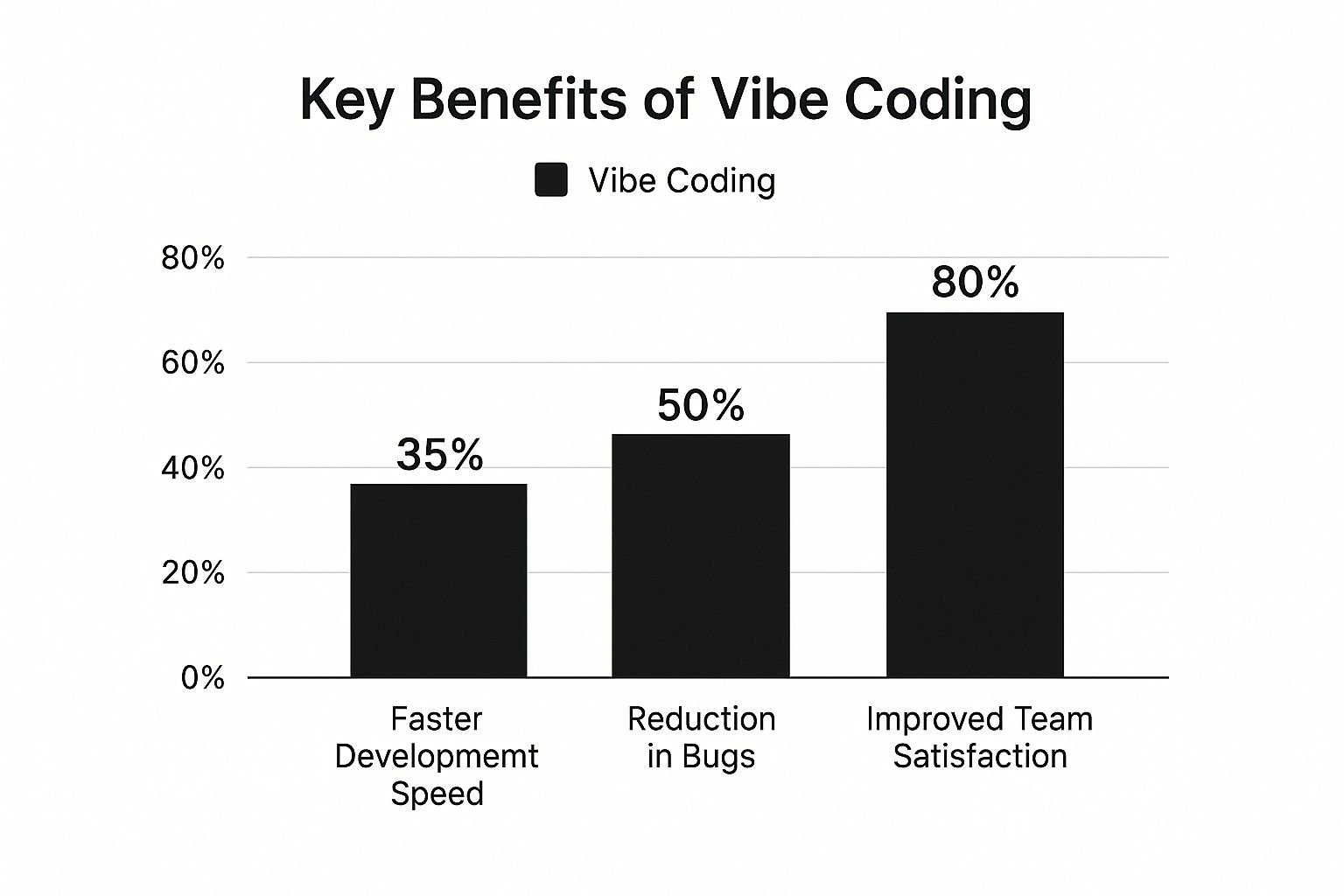
The infographic illustrates the key benefits of vibe coding, including a 35% increase in development speed, a 50% decrease in bugs, and an 80% boost in team satisfaction. These improvements highlight the potential of this development approach. These tools empower developers to work faster, produce higher-quality code, and improve team morale. They represent a significant shift in software development, promising greater efficiency and satisfaction. You can explore more about vibe coding here: Explore this topic further.
Who Benefits Most From Vibe Coding Approaches
Vibe coding is making software development more accessible, creating opportunities for a wider range of professionals to build software in innovative ways. This isn't simply about coding faster; it's about broadening participation in the development process.
Empowering Designers and Entrepreneurs
Designers can now create functional prototypes without needing extensive engineering help. Imagine a designer quickly building an interactive user interface just using natural language instructions. This allows for rapid design iterations and direct user experience testing. Entrepreneurs can also validate business ideas in days instead of months due to the accelerated development cycles vibe coding provides. This enables rapid testing of market fit and iteration based on real-world feedback, significantly reducing time to market. You might be interested in: How to master vibe coding with Manus.
Boosting Productivity for Seasoned Developers
Vibe coding can significantly boost productivity for experienced developers. They can concentrate on higher-level architecture and logic while AI handles repetitive coding tasks. Some seasoned developers report substantial productivity gains, giving them more time for challenging and creative aspects of development. Vibe coding is also being enhanced by new AI tools. Check out these top AI Tools for Coding.
The Tangible Economic Impact
Vibe coding offers real economic benefits. Faster development cycles mean quicker project completion, reduced labor costs, and faster time to revenue. Lower technical barriers create new software market opportunities for individuals and small businesses. Increased collaboration between designers, developers, and business stakeholders leads to more user-centered and efficient products.
Expanding Access and Collaboration
Vibe coding encourages more inclusive and collaborative development. By simplifying the technical complexities of coding, it empowers individuals with diverse backgrounds and skills to contribute to software projects. This cross-disciplinary approach results in more innovative and user-friendly products. The economic advantages of this collaboration are clear, allowing teams to iterate faster and adapt to changing market demands. This collaborative environment not only benefits individuals but also builds a more dynamic and innovative software development ecosystem.
The Real Challenges of Vibe Coding Implementation
While vibe coding offers significant potential, it's important to understand its limitations. This means acknowledging the potential drawbacks that aren't always apparent amidst the excitement surrounding this technology.
Code Quality and Maintainability Concerns
A key challenge lies in maintaining the quality and maintainability of AI-generated code. This becomes increasingly important as AI takes on more significant development roles. Automatically generated code can sometimes lack the clarity and structure of code written by a human, making it more difficult to debug and maintain over time. This is particularly important when developing complex systems where clarity is essential.
As codebases expand, understanding AI-generated sections can become challenging without proper documentation and human oversight.
Another maintainability aspect relates to updating and modifying AI-generated code. If the original purpose or context is unclear, making changes can be complex. This can introduce unexpected behaviors or bugs if modifications aren't carefully managed. Therefore, well-defined procedures for documenting and managing AI-generated code are crucial for long-term project success.
Addressing Security Vulnerabilities
Security is another vital concern. While powerful, AI models can unintentionally introduce vulnerabilities into the code. These vulnerabilities may not be immediately obvious, especially if code reviews don't specifically address the nuances of AI-generated code. This can heighten the risk of data breaches, emphasizing the importance of thorough security testing and human verification.
Over-reliance on AI for security-sensitive code could also create vulnerabilities that malicious actors might exploit.
To better understand these challenges and potential mitigation strategies, let's look at a detailed breakdown. The following table highlights key challenges, potential risks, current solutions, and future directions in vibe coding implementation.
Vibe Coding Challenges and Potential Solutions
| Challenge | Potential Risk | Current Solutions | Future Directions |
|---|---|---|---|
| Code Quality and Maintainability | Difficult debugging, complex updates, unclear code structure | Rigorous Code Reviews, Clear Documentation, Human Oversight | Improved AI Model Training, Automated Code Refactoring Tools |
| Security Vulnerabilities | Data breaches, system exploits | Enhanced Testing, Human Verification, Secure Coding Practices | AI-Driven Vulnerability Detection, Formal Verification Methods |
| Regulatory Compliance | Legal issues, fines, reputational damage | Legal Expertise, Compliance Audits, Industry Best Practices | Automated Compliance Checks, Standardized Regulatory Frameworks |
This table summarizes some of the significant hurdles facing vibe coding adoption. By proactively addressing these challenges, the industry can ensure that AI-generated code is secure, reliable, and meets required standards.
The Need for Human Oversight
Many believe that vibe coding eliminates the need for human developers. However, human oversight remains crucial, particularly for complex projects. While AI can handle routine tasks, ensuring alignment with project goals and quality standards still requires human intervention. Senior developers play a vital role in guiding the AI, reviewing its output, and solving complex problems that the AI cannot address independently.
This collaboration between humans and AI becomes even more important as project complexity increases.
Navigating the Regulatory Landscape
As vibe coding becomes more widely used, navigating the legal and regulatory landscape is critical. Different industries have specific compliance requirements that AI-generated code must satisfy. This means keeping up-to-date with changing regulations and integrating them into the development process. Ensuring compliance with accessibility standards is also crucial for creating inclusive software.
Balancing Vibe Coding with Traditional Methods
Vibe coding isn’t a one-size-fits-all solution. Traditional coding methods still have their place, especially for highly specialized or security-critical applications. Finding the right balance between vibe coding and traditional approaches is essential for maximizing efficiency and minimizing risk. This requires a clear understanding of the strengths and limitations of each method and adapting development strategies accordingly.
A hybrid approach, combining both methods, may often be the most effective solution.
Mitigating Risks and Practical Strategies
Teams are employing several strategies to reduce the risks associated with vibe coding. These include:
- Rigorous Code Reviews: Human review of AI-generated code remains vital for identifying errors and ensuring quality.
- Enhanced Testing: Comprehensive testing procedures are essential for detecting and addressing vulnerabilities.
- Improved AI Model Training: Training AI models on high-quality code and best practices improves the quality of their output.
- Clear Documentation: Maintaining detailed documentation for AI-generated code simplifies future maintenance and updates.
By implementing these strategies, teams can successfully integrate vibe coding into their workflows while minimizing potential risks and upholding high development standards. Companies like Lovable are working to make AI-generated code more dependable by addressing these challenges. You can learn more about vibe coding by exploring resources like this Wikipedia article.
The Future of Development in a Vibe Coding World
The emergence of vibe coding presents a significant moment in software development. This naturally leads to questions about how it will shape the future of the field and its impact on various aspects of the development process.
The Evolution of Career Paths
Vibe coding is set to reshape career paths in software development. While concerns about job displacement exist, the situation is more complex. Demand for developers skilled in managing and guiding AI coding agents is likely to grow. This shift calls for new skillsets, emphasizing areas like prompt engineering, AI model training, and code validation.
Traditional coding expertise will remain important, particularly for intricate or security-critical tasks. However, the focus will shift towards collaboration between humans and AI. This collaborative approach necessitates that developers adapt to working effectively with AI.
Restructuring Development Teams and Methodologies
Development team structures and operations will also undergo substantial changes. The rise of coding agents may result in smaller, more specialized teams concentrating on specific project components. This allows for increased team agility and efficiency, leading to faster iteration cycles.
Agile methodologies will gain even greater importance, emphasizing rapid prototyping, continuous integration, and continuous delivery. Teams that readily embrace these changes and adapt their workflows will be well-equipped to succeed in this evolving environment.
The Changing Landscape of Education
Software engineering education must adapt to align with the shift towards vibe coding. Educational institutions will need to integrate AI principles and techniques into their curricula. This will provide future developers with the necessary skills for an AI-driven development environment.
Courses on prompt engineering, AI ethics, and AI-assisted development workflows will become increasingly essential. Cultivating a collaborative mindset between human developers and AI tools will be a key educational objective.
The Next Decade of Vibe Coding
Vibe coding is expected to evolve significantly in the coming years. We can anticipate more advanced AI models capable of handling increasingly complex coding tasks. Advancements in natural language processing (NLP) will refine developer-AI interaction, leading to more intuitive and efficient workflows.
As AI models learn from larger code repositories, their ability to generate high-quality code will improve. While vibe coding enables amateur programmers to create software, human oversight remains vital to ensure code quality and alignment with project goals. This synergy of AI efficiency and human creativity is poised to reshape software development. This could potentially shift how software engineering is taught and practiced worldwide. Learn more about vibe coding.
Industry Transformation and Your Professional Journey
The impact of vibe coding will vary across industries. Sectors with large codebases and repetitive coding tasks, such as finance and healthcare, are likely to experience the most rapid transformation. This accelerated adoption presents significant opportunities for those prepared for change.
Positioning yourself for success in this evolving landscape requires a proactive mindset. Embracing continuous learning and exploring new tools and techniques is crucial, regardless of your current technical skills. The key is to see AI not as a replacement, but as a powerful tool that augments human capabilities. By focusing on collaboration with AI, you can stay at the forefront of software development's future.